Warp Empire Battles — collected rules, edge cases, and important restrictions
V1.9 — Last updated 09/14/2026
Part I — Playing the Game
1. Welcome — The Galaxy Awakens
Aeons ago, a great galactic war shattered civilization across the stars. The conflict
was so devastating that entire sectors were reduced to silence. Warp lanes went dark.
Worlds that had once traded freely across light-years found themselves isolated, cut off
from neighbors they could no longer reach. Over the millennia that followed, knowledge
faded. Technologies were forgotten. The galaxy slid into a long barbarism, and the war
that caused it passed out of memory entirely.
No one remembered the ancient highways between the stars — until explorers from
a handful of resurgent civilizations ventured beyond their own systems and discovered
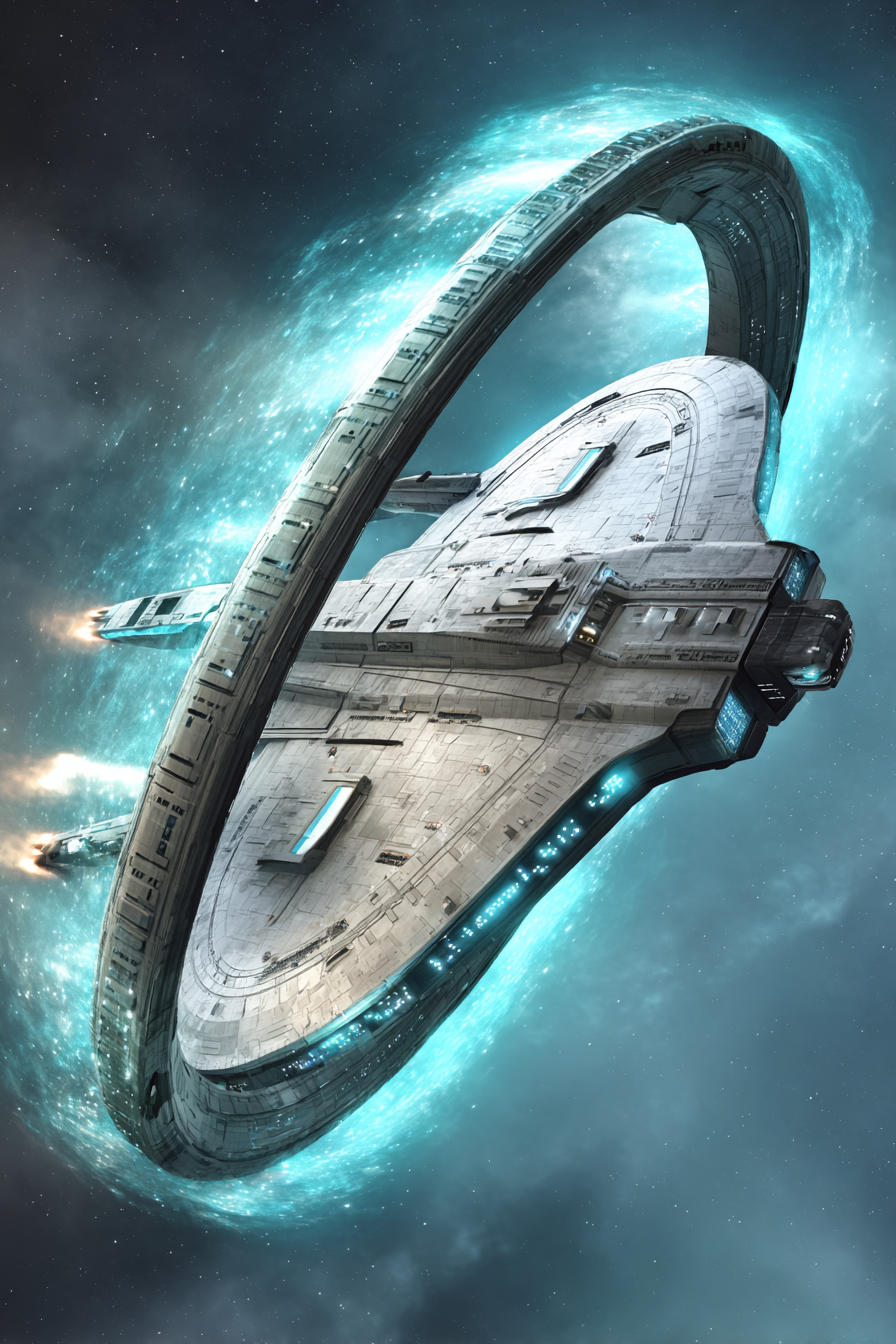
something extraordinary: warp gates. Massive ring-like structures orbiting
near every star, built by a forgotten race in an age no one can date. The gates were
dormant but intact, connected to one another in a vast web-like network spanning the
galaxy. With enough study, engineers learned that a ship equipped with a specialized
warp field generator could activate a gate, opening a near-instantaneous
corridor to the next gate along the network.
This discovery changed everything. Civilizations that had spent centuries rebuilding
on single worlds suddenly had access to the stars again. But expansion brings need:
the advanced industries and infrastructure required to sustain interstellar society
demand far more resources than any one planet can provide. Minerals, population,
production capacity — the hunger for growth is insatiable, and every neighboring
system is a prize worth claiming.
You are one of these resurgent empires. Your scientists have cracked the
secret of the warp gates, and your fleets are ready to push outward along the ancient
lanes. But you are not alone. Other empires have made the same breakthrough, and they
have the same ambitions you do.
Scattered among the stars you will also find independent civilizations
— worlds that have rebuilt enough to field local defense fleets but have not yet
unlocked the secret of the gates. They cannot project power beyond their own system,
but they are far from helpless. Some may welcome you as liberators; others will fight
to the last ship. How you treat them will shape your reputation across the galaxy.
And in the dark spaces between the civilized belts — the Dead Systems and
drifting asteroid fields at the galaxy's edge — pirates lurk. These
lawless fleets prey on any system rich enough to plunder, raiding along the warp lanes
from hidden bases in regions too remote or too dangerous for legitimate settlement.
They answer to no empire and respect no treaty (see Pirates). Left unchecked, a pirate armada can
grow powerful enough to threaten even a well-defended frontier.
Strategy Overview — Explore, Expand, Secure
The early game is a race to explore the galaxy and expand your
borders. Every habitable system you claim serves two purposes: it increases your
production capacity (more factories building more ships) and it secures
mineral income to feed those factories and keep your fleet supplied with
Ion-9 crystals.
But production alone won't sustain a growing empire. You need a steady flow of
minerals — the raw material behind everything you build and everything
that keeps your ships in the fight. There are three sources of minerals in the galaxy:
Habitable Systems (Planets A–E):
Your primary mineral source. Each colonized world starts with some minerals on hand and
generates more each turn through its minerals-per-turn rate. Higher-quality planets tend to
produce more. Population not used for production automatically mines minerals, adding to the
stockpile.
Dead Systems:
These blasted worlds carry no population and produce nothing on their own, but some contain
mineral stockpiles — salvageable remnants from the ancient war. Claim a
Dead System by placing a Starbase, and your ships can load the minerals. Once collected,
the stockpile is not replenished — Dead Systems are a one-time windfall, not
a long-term supply line.
Asteroid Fields:
Dangerous but rewarding. Freighters stationed in an asteroid field mine +1 mineral
per turn each (up to their 3-mineral cargo capacity). The risk is real — ships
take debris damage every turn — but a well-protected mining fleet can generate a
reliable stream of minerals from a source that never runs dry.
Nebulas:
These shrouded systems play by their own rules — the swirling clouds warp sensors and
weapons fire, so combat inside a nebula follows its own special rules. They're
also haunted by the ancient war: drifting somewhere in the haze may be
Derelict ships — lost vessels that a patient
commander can find, claim, and restore to service. Keep your ships in the cloud long enough,
and you may turn up more than just trouble.
Smart commanders don't just build fleets — they build supply chains.
Use Freighters to shuttle minerals from mining systems and asteroid operations to your
production centers and home world. A powerful fleet without minerals behind it is a fleet
that will slowly starve.
2. How to Win
Victory Conditions
The war ends when one empire establishes dominance. There are three paths to victory:
Galaxy Domination: Control 30% of the galaxy's ownable
systems — Star Systems plus Dead Systems you have claimed with a Starbase
both count (the same 30% applies at every player count). Your empire's reach becomes
undeniable.
Vanquish Your Enemies: Control 3 original home worlds,
including your own, in games of 4–6 players — or 4 including
your own in games of 7+ players (thresholds are set by the players at the
start of the game and don't drop as empires fall). It is a simple ownership
count of the galaxy's original home systems on any turn: your own counts, and every
rival home you hold counts. Crushing your rivals at their seat of power breaks their
capacity to resist.
Victory Points: If neither of the above is achieved by the turn
limit, the empire with the highest Victory Point total wins a marginal
victory. VP are scored as:
Home System = 10 VP — yours, and any enemy homes you hold
Gaia System = 4 VP
Other Star System = 2 VP — 4 VP if it carries the Avian prestige ability
Plundered systems lose value: every pirate plunder that steals more than 1 mineral
takes 1 VP off that system’s value, permanently — but a system can never
drop below half its value, however many times it is plundered (see
Plundering)
Population = 1 VP per 5 population, rounded up
Minerals at home = 1 VP per 10 minerals in your home system’s stockpile,
no cap — counted fresh every turn, so banking minerals scores and spending them gives the
points back
Mission rewards that grant VP
Combat glory = 1 VP per 50 enemy player ships destroyed
Standing fleet = 1 VP per 75 ships — counted fresh every turn from the ships you have in the air right now. A Carrier counts as 10 ships for this (and this only — it is still one ship everywhere else), so three Carriers are worth 30 toward the total. Starbases and Defense Satellites are structures and do not count at all. Lose the fleet and you lose the points.
1 VP per enemy Carrier destroyed
Dead Systems = 0 VP — they count toward Galaxy Domination instead
(the Dead System Network legacy adds 1 VP for each one you hold with a Starbase)
Territory, prosperity, and battlefield prowess all matter.
Galactic Ranking
Win or lose, every finished game earns you a score based on how many players
you beat. In a 9-player game, the winner beat 8 rivals and scores 8 points.
Second place beat 7 and scores 7. Last place scores 0.
Bigger games mean bigger scores. Coming in 2nd out of 9 players (7 points) is
worth more than winning a 4-player game (3 points). This rewards commanders who
test themselves in the largest wars the galaxy has to offer.
Your Galactic Ranking in the Hall of Fame is your average score
across all finished games. You need at least 3 completed games to appear on the
ranked leaderboard.
Empires that are eliminated during a game are ranked by how long
they survived — holding out to turn 20 places you above someone knocked out on
turn 5. Empires that abandon a game (AI takeover) receive last place
for that game, scoring 0 points. There is always something to play for, even when the
war turns against you.
Vanquished — Defeat & Ship-to-Pirate Conversion
When an empire loses its last star system, it is vanquished.
All of its surviving ships — fleets still in transit, raiding forces, stragglers
at enemy systems — are absorbed by the galaxy’s pirate empire and drift toward
the nearest Dead System or Asteroid Field. They raise the black flag and
become part of the pirate threat.
Any Starbase the fallen empire still held on a Dead System
does not change hands. Its crew abandons the station and sets the reactor to overload rather
than let it be captured — the Starbase and any Defense Satellites there are destroyed in
the blast, and the Dead System immediately becomes unclaimed, free for anyone
to take by placing a Starbase of their own. Every empire with ships at the system watches it
happen.
Every surviving player receives an in-game announcement naming the
fallen empire and the empire that delivered the killing blow. The vanquished player is
locked out of the game — no orders, no map access — until
the game ends. Once the game finishes, the full map is revealed and the vanquished
player can review the final results.
Victory Rewards
Winners earn credits that can be used to join future games:
Large games (9+ players): The winner earns 2 credits
and the runner-up earns 1 credit.
Smaller games (under 9 players): The winner earns 1 credit.
Skilled commanders can sustain their campaigns through victory alone. The bigger
the war, the greater the spoils. Practice and Single Player games never earn credits.
Practice and Single Player Games
Besides multiplayer games, there are two ways to play alone against the AI. Both are
in the Lobby: Practice on the Public Multi-Player tab, and
Single Player on its own tab.
Practice
Single Player
Cost
Free — 2 per account
1 credit, always (the Free-to-Join offer never applies)
AI difficulty
Normal
You choose: Normal, Hard or Extreme
Turn deadline
Yes — it plays like a multiplayer game
None. Play at your own pace
When the turn processes
The moment you submit. There is no Unsubmit.
Notifications
The same as a multiplayer game
None, except one email if the game is about to be deleted
Idle games
Deleted after 7 days without a turn
Deleted after 30 days without a turn, with a warning email 5 days before. No refund
Your empire is destroyed
Game over — the game ends that turn
Hall of Fame
Not recorded anywhere
The Single Player Hall of Fame, ranked separately for each difficulty
Credibility and Galactic ranking
Never affected
The difficulties: Normal is the standard AI. On Hard, the AI
starts with more ships, minerals and Ion-9 crystals. Extreme has all the
advantages of Hard, plus lower fleet maintenance and higher mineral output. Either kind of solo
game counts toward the limit of 3 games you can play at once. You can abandon a Single Player
game from your Dashboard at any time; the credit is not refunded.
The Golden Rules — What Overrides What
Specific beats general. A rule for a specific situation — an Advantage Card, a race ability, a terrain effect like a Nebula — overrides the general rule it contradicts.
Advantage Card text beats race abilities, and race abilities beat the general rules.
The game is the referee. If the game and this manual ever disagree, the game is right — please report the difference through Feedback so the manual gets fixed.
3. Your First Turns
New to W.E.B.? Start here. The fastest way to learn is to watch the short
how-to videos below — each one walks through a real first game, about 2 minutes per turn.
Then play along: the game's built-in guided tour and advice tips
point out each screen as you go, and the Video Help button in the top bar always
offers the right video for your current turn.
Each turn is processed in a fixed sequence. Understanding this order helps you
time your actions — minerals and population unloaded in Phase 1 are available
for production and mining the same turn, and ships that move in Phase 3 arrive before Combat
Round 2 in Phase 4. (The list below shows the major phases a player sees; the engine runs many
smaller housekeeping passes between them.)
Phase 1 — Load / Unload / Place Starbases (placements are recorded now but only finalized in Phase 15)
Phase 1.5 — Local Traders (passive mineral flow along your active warp lanes — see §7i)
Phase 2 — Combat Round 1 (opens with the fighter battle — launches, dogfights, flak, strikes — then withdrawal fire and phased ship fire)
Phase 3 — Movement (fleets warp to destination systems)
Phase 4 — Combat Round 2 (pirate plunder resolves just before; then ambush fire, phased ship fire, and invasion)
Phase 5 — Pirate Activity (pirate captures of destroyed ships; new raids launch; rewards for fighting pirates)
Phase 6 — Production (build ships, PD, industry), then Fleet Maintenance (Ion-9 crystals deducted one per system per pass, farthest systems first)
Phase 7 — Mining (population not used for production mines minerals)
Phase 8 — Population Growth
Phase 9 — Unrest Check
Phase 10 — Asteroid Damage
Phase 12 — Ownership Changes (invaded systems transfer to their conquerors; lost capitals are reassigned)
Phase 13 — Independent System Join Transfers (independent systems that voted to join complete the handover)
Phase 14 — Independent System Diplomacy (ongoing relations rolls, missions, and the turn's relations reports)
Phase 15 — Finalize Starbases (pending Starbase placements land on their systems)
Key insight: Movement happens between the two combat rounds. Ships
leaving a system face withdrawal fire in round 1 but escape before round 2. Ships
arriving at a system skip round 1 entirely and have arrival immunity in round 2
— unless the defending fleet has ambush fire set on the gate they arrived from.
Timing your movements around this sequence is critical.
4a. Missing a Deadline
A turn processes when every player has submitted or the deadline
passes — whichever comes first. If you miss one, auto-production keeps your empire
alive: 1 Ion-9 Crystal at every system with an Ion-9 Refinery, Destroyers everywhere else with the Build
Points remaining. No fleets move and no other orders are given on your behalf. (On Turns 1–2
the auto-advisor plays a full opening turn instead, so a late start doesn't sink your game.)
Miss three turns in a row and the AI takes permanent control of your empire
— you are out of that game. You are warned by email, Discord, and in-game notification after
every miss, and the warning tells you how many you have left.
If you already missed a turn, the next deadline can come early. Should you
become the last player left to submit, the game will not hold everyone else to the full
deadline — it processes one hour later instead, and you are told the
moment that hour starts. Submit within the hour and nothing changes: the turn runs on your
orders exactly as normal. This only ever applies to a player who missed the previous turn, it
can only move a deadline earlier and never later, and players in good standing are
never affected. It applies only in games that began with every seat filled by a real
player — games that started with AI opponents always run to the full deadline.
The galaxy is made up of many different kinds of locations. Some are thriving worlds
with populations and industry; others are barren wastelands or hazardous phenomena left
behind by the ancient cataclysm. Understanding what you'll find at each type of system
is essential before committing your fleets.
5a. Star Systems (Quality A–E)
Star systems are habitable worlds with populations, industry, and natural resources.
Each is rated by quality from A (best) to E (poorest), which determines its
population capacity, industrial base, and growth potential.
Interestingly, the most developed worlds are not always the richest in raw materials.
Higher-quality systems spent centuries building up their infrastructure before rediscovering
the gates — their mines are well-established but increasingly depleted. Lower-quality
systems, while less developed, often sit on untapped mineral wealth that fuels rapid
expansion for any empire willing to invest in their growth.
Quality
Pop Limit
Minerals/Turn
Typical Industry
Growth Rate
Character
A (Gaia)
12
4
4
10%
Rare, powerful — major strategic prize
B
10
2
2–3
8%
Well-developed, strong foundation
C
6
2
2
6%
Moderate — reliable but not exceptional
D
5
2
1
4%
Frontier world — underdeveloped but functional
E
4
3
1
2%
Primitive but mineral-rich — excellent mining outpost
Tip: Don't overlook Class E systems. While their populations are small
and industry is minimal, they produce 3 minerals per turn — more than
any other quality except Gaia Systems. These systems are good for supplying minerals
to your hungry industries at your capital.
Independent systems keep producing: While a system is still independent
(not yet part of your empire), it continues to generate minerals on its own each turn
— those minerals accumulate in the system's stockpile. Class D and E systems are
particularly attractive targets for this reason: a Class D produces 2 minerals
per turn and a Class E produces 3 minerals per turn even while
independent. When the system eventually joins your empire — through diplomacy or
conquest — you inherit the full mineral stockpile that has been building up since
game start.
Most star systems you encounter will be controlled by independent civilizations
— worlds that have rebuilt enough to field local defense fleets but have not yet
unlocked the secret of the warp gates. Their reaction to your arrival depends on your
empire's reputation (see Independent Systems).
5b. Home Systems
Every player begins the game with a home system — a Class B world that
serves as the heart of your empire. Home systems are better-established than typical
colonies, with higher starting population, industry, and planetary defense.
Here is how to read a system card in the game — your home system's card has all
four panels from turn 1:
Property
Value
Notes
Quality
B
Population
6.0 (limit 10)
Needed to work industries and mineral mines
Industry
5.0
Produces Build Points if enough population and minerals
Minerals/Turn
2
Produces minerals if enough population to mine
Minerals on Hand
20
Used by industries
Ion-9 Crystals
5
Needed by ships to maintain full combat readiness
Planetary Defense
8
Prevents unrest and resists invasions
D-Sats
2
Inexpensive and effective system defense
Starbase
1
Strong defense; its fighter wing stands up to 5 over the first two turns
Starting Fleet
2 CR + 5 DD + 2 Fr
Used to move to and explore nearby systems
Key: Losing your home system doesn't eliminate you from the game, but
the Vanquish Your Enemies victory is won by controlling original home
worlds — 3 including your own in games of 4–6 players,
4 including your own in games of 7+ players. Defend yours and target
your rivals'.
5c. Dead Systems
Scattered across the galaxy are worlds that bear the scars of the ancient war —
planets blasted so thoroughly by the devastating weapons of those forgotten empires that
they can no longer sustain life. Their atmospheres burned away, their surfaces reduced to
irradiated glass, these Dead Systems are silent monuments to the destruction
that ended the previous age.
No population, no industry, no natural mineral production.
Some Dead Systems still contain mineral stockpiles — leftover war
materiel or salvageable debris from the old civilization. However, you must first
claim the system by placing a Starbase before your ships can access
these minerals. Once collected, they are not replenished.
A Starbase is the only way to claim ownership of a Dead System, since
there is no population to conquer or negotiate with. It is also the only way to lose one:
a Dead System goes back to being unclaimed when its Starbase is destroyed
and the owner has no ships or Defense Satellites left there — or when the owning
empire is vanquished, in
which case the crew scuttles the station themselves.
Dead Systems may harbor pirate fleets — scavengers lurking among
the ruins (see Pirates).
If two or more empires attempt to place a Starbase at the same Dead System on the
same turn, all placements are cancelled and each Starbase is returned to
its Freighter. No one claims the system.
Precursor Archaeology: Dead Systems that harbor pirate garrisons are
often the most promising sites — the pirates were drawn there for a reason. Once you
defeat the pirates and establish a Starbase, your scientists begin excavating the ancient
ruins in search of lost relics and forgotten technologies. Most digs take several turns,
and there is no guarantee: some ruins have been stripped too thoroughly, or their secrets
simply died with the civilization that built them. But when a dig does turn something up,
the Precursors left behind remarkable discoveries — strange artifacts
and reawakened technologies that can grant your empire a powerful advantage, sometimes
fleeting and sometimes lasting.
Ancient technology stays with the system, not with you. A relic is bolted
to the world it was dug out of. If your Starbase there is destroyed and you lose control of
the system, the technology does not follow you home — it goes quiet and waits. Any empire
that then plants a Starbase on that Dead System inherits whatever is left of it:
the turns still on its clock, the charges still in its magazine, or a one-off effect nobody has
spent yet. Timed relics do not count down while the system sits unowned, so a rival who takes
the world gets the full remainder. The one exception is the Ancient Data Banks
— those star charts are copied out the moment they are found, and nothing is left behind
for anyone else.
Any fleet parked at such a world can see the ruins for itself: the system card names the ancient
technology and how much of it remains, whether or not you own the system. And on the turn a
holder's Starbase falls, every empire with ships in that system is told plainly what has just
been left lying there.
Precursor stargate technology. Two of the things a dig can turn
up act on the warp lanes themselves, and neither can be found more than once in a game. Both work
only from the Dead System they were found at, while you hold it with a Starbase, and both fire once:
The Precursor Wormhole Generator opens one permanent warp lane from that system
to any system where you have a Cruiser with no move order. That Cruiser holds the far end open and
cannot move that turn. The lane is open to every empire. It cannot reach one of the system’s
neighbors, or a system across a severed lane: a dead stargate cannot be re-lit.
The Precursor Stargate Virus severs one of that system’s own warp lanes,
permanently, for every empire. The cut happens before ships move, so every fleet
moving across that lane that turn loses its lead Cruiser and stays where it was — yours
included. An ambush watching that lane stops watching it, and a Local Traders route along it
is dropped.
You use either one from the system’s card: pick the other end and press the button. That files an
ordinary order in your Orders panel, and deleting the order changes your mind. If the order cannot run
when the turn processes (your Starbase there was destroyed, or the Cruiser at the far end is gone), your
report says why and the technology is not used up. Every turn you hold one unused, your
report reminds you in General.
Tip: Dead Systems make excellent forward operating bases. Placing a Starbase
not only creates a formidable defensive position controlling the surrounding warp lanes,
it also claims the system for your empire — and claimed systems count toward the
Galaxy Domination victory condition. Don't overlook these lifeless worlds;
they can be the difference between falling short and crossing the threshold.
Tip: Look for Dead Systems with pirate fleets — the bigger the garrison,
the more likely the ruins hold something valuable. Clear out the pirates, build a Starbase,
and let your archaeologists get to work. The Precursors left powerful things behind in these
forgotten places. Finding them first could change the course of the war.
5d. Asteroid Fields
Asteroid fields are resource-rich but dangerous locations. Fleets stationed there face
ongoing hazards, and only Freighters can mine minerals from the debris.
Debris Damage:
Ships in an asteroid field take damage from collisions with debris each turn:
Event
Chance per ship
On arrival (entering the field)
5%
Each subsequent turn (stationary)
5%
Each affected ship is destroyed (one hull point or not, it's a debris strike). Carriers are the exception — a debris strike costs a Carrier 1–3 hull points (equal chance of each) rather than destroying it outright. A Carrier is only lost when its hull reaches 0 HP, so a healthy 10-HP Carrier can weather several strikes — but a battered one should not linger in the rocks.
A strike that deals the full 3 hull points also destroys 1 Fighter Squadron
caught on the hangar deck.
If a Freighter is destroyed, the cargo aboard it is lost with it —
destroyed Freighters are picked at random from the group, and your turn report names what
was lost.
Pirate fleets are immune to asteroid damage.
Fleets that are moving through (not stationary) skip the per-turn 5% check, but still take the 5% arrival hit at their destination.
Freighter Mining:
Freighters stationed in an asteroid field automatically mine minerals:
Each surviving Freighter with free cargo space mines +1 mineral per turn.
Freighters whose cargo hold is full (3 minerals max per Freighter) do not mine.
A Freighter carrying a Starbase package or a population unit counts as full.
Mining happens after debris damage is applied, so only surviving Freighters mine.
Combat restriction: If combat occurs at an asteroid field during a turn,
no mining takes place that turn. Your Freighters are too busy dodging fire
to collect minerals. This applies to all fleets at the location, regardless of
which empires were involved in the fighting.
Movement & Trapping:
Only Cruisers (CR) carry a warp field generator powerful enough to activate the
ancient warp gates for a whole fleet. All other ship types require a Cruiser to tow them
through. Destroyers, Novas, and Carriers carry a small generator that moves only themselves
(a lone Destroyer can still make a one-way probe jump, but it cannot tow anyone else).
Trap warning: If all your Cruisers at an asteroid field are
destroyed — by debris or combat — your remaining ships are stranded.
They cannot leave until a Cruiser arrives to activate the gate for them.
Tip: Always keep spare Cruisers with any asteroid mining fleet. Losing your
only CR to a debris strike means your Freighters (and their cargo) are stuck indefinitely.
Combat in Asteroid Fields:
Missile Ships are nearly useless in asteroid fields, raising their to-hit number from 5 to 10 (on a d10, essentially impossible). The iron-nickel cores inside tumbling asteroids generate chaotic, shifting magnetic fields as they spin. In a dense field, thousands of these rotating metallic bodies create an electromagnetic storm of overlapping anomalies that overwhelms missile guidance systems — targeting locks break within seconds, inertial navigation drifts wildly, and the missiles veer off course into the rocks long before reaching anything living.
All other ship combat stats remain unchanged.
Starbases cannot be placed in asteroid fields.
Pirate fleets may also lurk at asteroid fields. They are immune to debris damage and use
asteroid fields as staging areas for raids into nearby systems (see
Pirates).
5e. Nebulas
Nebulas are dense clouds of interstellar gas and charged particles that drift between
the stars. Ships can pass through freely, but the electromagnetic interference disrupts
targeting systems and makes sustained operations impossible.
−1 die roll penalty for all ships (harder to score hits) —
targeting through the interference is difficult.
Small fleet vs. large fleet — a small fleet (20 or fewer
ships) fighting a large fleet (40 or more) gets +1 to hit
the large fleet, while the large fleet gets −1 to hit the small one. Fleet
sizes count each player's own fleet separately (allies are not combined), and this applies to
mobile ships only — Starbases and D-Sats are unaffected. Nebulas play havoc on sensors
and visibility — small fleets can use hit-and-run tactics to out-maneuver larger forces.
No ambush allowed — sensor readings are too unreliable to set a trap.
No Starbases can be placed in a nebula.
All fire is resolved simultaneously — ships destroyed in a round still
get to fire that round. Hits are pooled and applied at the end of each phase.
Nebulas have no population, no industry, and no resources.
A Derelict ship may drift hidden in the cloud
— keep ships here to search it out, then claim and restore it (see Chapter 16).
5f. Ion Nebulas
Ion nebulas are far more dangerous than ordinary nebulas. The intense ion storms
surging through these regions disable ship shields entirely, stripping away
the energy barriers that normally protect hulls from weapons fire.
All rules from regular nebulas apply (no ambush, no Starbases, −1 die roll penalty,
simultaneous fire).
All ships are reduced to 1 HP regardless of their normal hit points.
A single hit destroys any ship — Destroyer or Starbase, it makes no difference.
Like ordinary nebulas, an Ion Nebula may hide a Derelict
ship to find and claim (see Chapter 16).
Warning: Ion nebulas are the deadliest combat terrain in the game. Every
ship has 1 HP, meaning a single hit destroys even a Cruiser. Battles here are fast
and brutal — bring numbers, not expensive ships.
5g. Black Holes
Black holes are gravity wells of absolute destruction. Any fleet that enters a
black hole is instantly and completely destroyed — ships, cargo, and all.
There is no combat and no survivors. The only thing the doomed fleet relays back before it is
lost is the names of the systems bordering the black hole.
Black holes are visible on the star map. Flying into one is entirely avoidable
— and entirely your fault if it happens.
Discovering a black hole (by having it on a connected warp lane) reveals its
position permanently.
There is exactly one black hole per galaxy.
Tip: A black hole adjacent to your territory can be a strategic asset.
Enemies can't attack from that direction, and the warp lanes around it create natural
chokepoints. Just don't accidentally send your fleet through it.
systemsasteroidnebulaminingcombatmovement
5h. The Star Map
RULE-009
The star map is your primary strategic view of the galaxy. It displays all known
systems, the warp lanes connecting them, fleet positions, and empire territories.
Learning to read the map quickly is essential.
System Symbols
Each system is drawn as a circle on the map. Inside the circle, a letter or short
code tells you the system type at a glance:
Symbol
Meaning
Color
A
Quality A (Gaia) star system (best)
Green
B
Quality B star system
Lime
C
Quality C star system
Amber
D
Quality D star system
Orange
E
Quality E star system
Red
AF
Asteroid Field
Black
N
Nebula
Hot pink
Ion
Ion Nebula
Magenta
BH
Black Hole
Red
DS
Dead System
Gray
DS+
Dead System dig site — it started with pirates, so an archaeology excavation is possible there. The + disappears once the dig is completed or comes up empty.
Gray
If you haven’t fully explored a star system yet, the quality letter may not appear.
Star system circles also scale in size based on population limit — larger circles
mean bigger worlds.
Circle Colors (System Ownership)
The fill color of each system circle tells you who controls it:
Your empire’s color — a system you own
Another empire’s color — an enemy-controlled system
Muted blue-gray — an independent system
Very dark / dim — a system in the fog of war (unexplored)
System Name Labels
The name label below each system is also color-coded:
Empire color — any owned system is labeled in its owner's empire color — both yours and your rivals'. (You tell your own systems apart by your color and the star outline on your capitals.)
Muted gray — an independent system
Dim / default — unexplored
Home System Star
Home systems are marked with a five-pointed star outline drawn
around the circle, in the empire’s color. This makes capitals easy to spot at
any zoom level.
Warp Lanes
Thin lines connecting systems represent warp lanes — the only routes your
fleets can travel. The galaxy is displayed on a sphere, so lanes wrap naturally
around the globe with no artificial edges.
Fleet Orbit Dots
Small colored dots orbiting a system show fleets present there. Each dot represents
one empire’s fleet at that system.
Your empire’s color — your fleet
Another empire’s color — a foreign fleet
Red — pirate or hostile fleet
Gray — neutral fleet
If a fleet has more than one ship, the count appears inside the dot.
Pulsing Threat Alerts
Systems under threat display a pulsing ring around the circle:
Red pulse — hostile fleets (pirates or enemies) are present at this system right now
Amber pulse — the system is threatened but no hostile fleet is on-site yet
Empire Borders
Soft, glowing colored blobs in the background show approximate empire territory.
These borders connect your owned systems along warp lanes, giving you a quick sense
of where each empire’s space begins and ends.
Fog of War
You can only see systems you have explored. Unexplored systems appear very dark
and dim, with muted warp lanes. A system becomes visible when:
You own it or have owned it previously
Your fleets have visited or passed through it
You have probed it
It is adjacent (one lane away) to any system you currently have intel on — one you own, have visited, or have probed — not only systems you own
Using the Map
Hover over any system to see a tooltip with details: system name, type,
owner, population, industry, minerals, and your fleet composition (if present).
The tooltip appears after a brief delay.
Click a system to select it. The selected system gets a bright ring
highlight, and its detail card opens in the side panel.
Search using the search box at the top of the map. Type a system name
and matching systems will highlight. Press Enter to jump to the best match and
center the map on it.
Zoom with the +/− buttons, or use your mouse scroll wheel.
Rotate the globe by clicking and dragging on empty space. The Reset
button rotates back to your home system and restores the default zoom.
Quick navigation: Use the search box to jump to any system instantly
rather than scrolling around the map. This is especially useful in large galaxies
with many systems.
Your fleet is composed of seven core ship types, each with distinct roles. Understanding
their strengths and limitations is the foundation of effective strategy. An eighth class — the
Carrier and its fighter wing — joins the fleet once you unlock it midway through
the game (described below; full rules in Chapter 15).
Ship
HP
To-Hit
BP Cost
Role
Cruiser (CR)
3
5+
2
Fleet backbone — gates other ships through warp lanes
Destroyer (DD)
2
6+
1
Expendable screen & probe scout
Missile Ship (Mi)
1
5+
1
Fires first in combat (long range) — fragile but accurate
Nova (N)
2
8+
2
Anti-matter beam — 5 damage in one strike (kills any regular ship)
The Cruiser is the backbone of every interstellar navy. It carries a full-size
warp field generator — the only ship class powerful enough to activate the
ancient gates for an entire fleet. Without a Cruiser, no fleet can move. With one,
an unlimited number of ships can ride its warp field through the gate in a single
movement order.
In combat, Cruisers are tough and reliable: 3 hull points absorb sustained punishment,
and their twin-battery turrets hit on 5+ (60%). They sit in the middle of the screening
order, shielded by Destroyers and Novas but protecting the Freighters and fixed defenses
behind them. Every ton of hull is given over to the warp field generator and weapons
— a Cruiser carries no cargo; hauling is Freighter work.
When the fleet turns to ground operations, Cruisers excel. Their precision orbital
bombardment platforms (Invasion Rating A) can knock out planetary defense
installations with surgical strikes and zero collateral damage. A Cruiser over your
world is both a shield and a scalpel.
Tip: Lose your last Cruiser at an asteroid field and every ship
without its own generator is stranded. Always keep a spare.
Destroyer (DD)
Cheap, fast, and expendable — the Destroyer is the workhorse of the fleet.
At just 1 BP each, Destroyers are built in volume and thrown into battle as the
first line of defense. In the screening order they absorb hits before
any other ship type, buying time for heavier vessels to fire.
Destroyers carry a micro-scale warp field generator — not powerful
enough to gate other ships, but just enough to activate a gate for themselves alone.
This makes them ideal for probe missions: a lone Destroyer overloads
its power plant to force the gate open, hurling itself through in a blinding surge.
The strain is catastrophic — the ship's systems burn out shortly after arrival
— but in its final moments it transmits a full sensor sweep back through the gate:
fleet composition, population, industry, defenses. The defending player never knows
the probe was there. One ship sacrificed for intelligence that can change a war.
In ground operations (Invasion Rating B), Destroyers can manage rough surface
strikes but lack precision targeting — a hit on 8+ with a chance of collateral
damage to industry or population. Use them to invade only when better options aren't
available.
Tip: Every home system starts with 5 Destroyers. They're
your scouts, your shields, and your first line of expansion. Don't neglect them.
Missile Ship (Mi)
Missile Ships carry long-range guided warheads and one critical advantage:
they fire first. Before Starbases, before Cruisers, before anything
else — Missiles launch. A coordinated salvo can eliminate fragile targets before
they ever get a shot off, making Missile Ships devastating alpha-strike platforms in
the opening moments of an engagement.
The trade-off is fragility. At just 1 HP, a single hit destroys them. And they
carry no warp field generator — a Missile Ship requires a Cruiser to activate
the gate for it. In asteroid fields, spinning iron-nickel asteroid cores
create chaotic magnetic fields that overwhelm their guidance systems, raising their
to-hit from 5+ to a near-useless 10.
On the ground they're the worst option (Invasion Rating C). Their warheads
were designed to track ships in open space, not hit fixed ground installations —
and a missed warhead can level a city block. Avoid using Missile Ships for invasion
if you want anything left to conquer.
Tip: Missiles excel in early-game fleet actions where the enemy
lacks heavy armor. A Missile-heavy fleet wins the first volley — but struggles
if the battle drags on.
Nova (N)
The Nova-class warship represents the cutting edge of military technology
— a breakthrough so profound that strategists agree it will one day become the
standard bearer of every civilized navy. Its weapon: an anti-matter beam,
a needle-thin lance of absolute destruction capable of annihilating any vessel
regardless of size or armor. When a Nova scores a hit, it deals up to
5 damage in a single strike — enough to instantly destroy any
regular ship in the game. A single beam vaporizes a 3-HP Cruiser outright; only the
largest hulls (a healthy 10-HP Starbase or Carrier) can ride out the antimatter
strike, and even they are left crippled — a second hit finishes the job.
But the technology is still new, unstable, and expensive. Anti-matter containment
systems are finicky (2 BP to build), and the beam's targeting arrays are maddeningly
unreliable — the worst accuracy in the fleet at 8+ (30% hit chance). Novas also
fire last among combat ships, meaning they must survive the opening volleys before they
can return fire. And their targeting is indiscriminate: a Nova hit strikes a
random enemy ship, weighted by ship count. You cannot choose the target.
Novas carry a small warp field generator — enough to move themselves through a
gate, but not to carry others. In ground operations (Invasion Rating A), their
pinpoint antimatter beams excel at neutralizing planetary defense with zero collateral
damage.
Tip: Novas bypass the normal screening order entirely —
their beam strikes a random target in the enemy fleet. Even a small Nova contingent
is feared because any hit is catastrophic.
Freighter (Fr)
Freighters are the economic lifeline of your empire. Their cavernous cargo
bays can carry 3 minerals, 1 population unit,
or 1 Starbase (mutually exclusive) — making them the only ship
that can transport population to new colonies, deliver minerals to production centers,
and deploy Starbases to claim Dead Systems.
In asteroid fields, Freighters become miners. After sitting stationary
for one full turn, each Freighter with free cargo space extracts +1 mineral per turn
— a dangerous but lucrative operation in the debris-strewn belts. Smart commanders
build supply chains: Freighters shuttling minerals from asteroid mines and Dead Systems
to home worlds and factories. A powerful fleet without minerals behind it is a fleet
on borrowed time.
In combat, Freighters are nearly helpless — 1 HP, to-hit of 10 (10%), and they
fire dead last. But the screening order protects them behind every other ship type,
and they are excluded from ambush calculations. Lose a Freighter, though, and you
lose its cargo with it.
Freighters are actually your best invasion ships (Invasion Rating A).
Their vast cargo bays harbor multiple marine divisions, and their drop pods deliver
precision landings on defense installations with zero collateral damage. Critically,
each Freighter hit deals 2 damage to Planetary Defense — enough to
destroy a standard PD unit in a single shot. Cruisers and Novas only deal 1 damage per hit
and need two hits per PD unit. When conquest is the mission, load up on Freighters.
Tip: Don't just build fleets — build supply chains. A
Freighter hauling 3 minerals per trip is the engine that keeps your shipyards running.
Defense Satellite (DS)
Defense Satellites are immobile orbital platforms anchored to a system's
gravity well. They cannot move, cannot be transported, and cannot participate in invasion
or ambush fire. What they can do is fight. At 3 HP and a to-hit of 5+
(60%), a Defense Satellite hits harder and survives longer than most mobile warships
— and they cost just 1 BP.
D-Sats are generated automatically when the galaxy is created, their numbers determined
by system quality. You can also build more D-Sats using Build Points, up to the maximum
for that system's quality class:
Quality
Max D-Sats
A (Gaia)
20
B
15
C
10
D
8
E
5
The pirate homeworld fields a formidable
ring of 8. Once in place, D-Sats fire alongside the owning player's fleet — a
permanent garrison that never needs reinforcement.
In the screening order, D-Sats sit deep behind mobile ships, meaning attackers must
chew through your fleet before reaching them. Like all fixed platforms, D-Sats cannot
initiate combat — enemy fleets can maneuver to avoid stationary defenses —
but they fire back with full force the moment an attacker commits to an engagement.
(An ambush aimed at ships arriving down a warp lane is not such a commitment: it is
fought out at the gate, so your D-Sats hold fire — and cannot be destroyed by it. See
Starbase for the full rule.) They are the silent guardians of your empire — always watching, always ready.
Starbase (SB)
The Starbase is the most powerful unit in the game — a massive
orbital fortress, a large city in space. Starbases offer the following benefits:
Determines system ownership of Dead Systems (DS and DS+).
Can send search parties to search for ancient wonders in Dead Systems + (DS+).
Can rapidly repair Carriers and rapidly replace their fighters.
Have 2 massive beam weapons as well as 5 Fighter Squadrons for defense.
Can activate a Warp gate connecting an adjacent system with a Starbase.
Can collect minerals from Dead Systems (allowing Freighters to move them to other
systems). (DS and DS+)
At 10 HP, a to-hit of 3+ (80%), and two shots per combat round,
a single Starbase can shred attacking fleets. It costs a steep 4 BP to build and
consumes 1 population from the system during construction (there are over a million
engineers and crew permanently stationed aboard).
Starbases are immobile — once placed, they cannot be moved. They
must be built via a build order, then loaded onto a Freighter for transport and placement
at their destination. Only one Starbase may exist per system. They are the
only way to claim ownership of a Dead System, making them essential for
accessing those irradiated mineral stockpiles left over from the ancient war.
A Starbase can't be placed when your forces are outnumbered and under attack
in the system — the placement is cancelled that turn. And the deployment itself is
risky: the Freighter
carrying the Starbase remains a normal combat target during the battle, and if it is
destroyed before deployment completes, the Starbase is destroyed with it.
Because a Starbase is locked to its orbital position, enemy fleets in the same system
can keep their distance and avoid engagement — as long as no attack orders are
given. However, the moment they attack (or are attacked by ships), they enter
the Starbase's devastating weapons envelope — at which point the Starbase will
participate. So it's a good idea for the Starbase owner to also keep a ship or two in
the system so that they can force combat on enemy fleets and force them to engage the
Starbase.
For all their power, Starbases fear one weapon above all others: the Nova's
needle-thin anti-matter beam. A single Nova hit tears 5 hull points off
the station in one blinding antimatter strike — half a healthy Starbase's hull in
an instant — and a damaged Starbase at 5 hull or less is destroyed outright.
Two Nova hits will fell even a pristine fortress.
Against ordinary weapons fire, however, Starbases are remarkably resilient. Hull damage
accumulates between rounds and between turns — a battered Starbase
does not magically heal — but the onboard repair bays mend
1 hit point at the start of every turn until the station is back to full
strength. Throughout that recovery, the Starbase keeps fighting at full capability: both
shots, full accuracy, undiminished firepower right up until its last hull point falls.
Tip: Place Starbases at Dead Systems to claim their minerals,
at strategic chokepoints to control warp lanes, and at your home world for a nearly
impenetrable defense. But always keep Nova-hunters nearby — each Nova beam hit
rips 5 hull off the station, and two hits will destroy it.
Carrier (CV)
Carriers become available midway through the game — you unlock the technology
empire-wide by placing a Starbase on a Dead System. A Carrier
is a flagship-class command ship with a hangar of 12 fighters. At 10 HP and
a to-hit of 3+ (one shot per round, firing right after Cruisers) it is a capable gun platform in
its own right — but its real weapon is its fighter wing, which strikes before the
normal combat rounds begin.
A Carrier self-propels like a Nova (it can warp alone, but carries no cargo and cannot tow),
costs 5 BP, and adds +1 Ion-9 crystal per turn in upkeep. Its hull damage and
combat experience persist between turns, it is screened last (so it dies only once
the rest of the fleet is gone), and it cannot be captured — a Carrier
self-destructs rather than fall into enemy hands. See Chapter 15 for the
full carrier and fighter rules.
Fighters
Fighters are never built or moved on their own — they live inside Carriers, Fighter Bases,
and fighter-equipped Starbases, and launch automatically when battle is joined. Each fighter has
1 HP and flies in one of two roles: CAP (a defensive screen
that intercepts enemy fighters and soaks hits for your fleet) and Strike
(offensive fighters that fly out and attack a chosen enemy ship type). The whole fighter exchange
— launch, dogfight, flak, and strike — resolves in a pre-combat phase before
Round 1. See Chapter 15 for the full rules.
6a. Invasion Ratings
When invading a system, different ship types have different effectiveness against
Planetary Defense. Each PD unit has 2 hit points and must absorb that much
damage before it is destroyed. Freighters deal 2 damage per hit — the
only ship type that can destroy a PD unit in a single shot. All other ships deal 1 damage
per hit.
Rating
Ships
To-Hit vs PD
Damage/Hit
Collateral
A (best)
CR, Nova
6+
1
None
A (best)
Freighter
6+
2
None
B
Destroyer
8+
1
May damage industry/pop
C (worst)
Missile Ship
9+
1
Higher collateral risk
Note:Fighter superiority provides a bonus to Freighter die rolls (either +1 or +2).
Note: A Reviled empire's Freighters deal +1
invasion damage (Shock Troops) and its own PD units take +1 HP to destroy (Fearless PD); both
stack with the Elite Troops card. See
Invasion & Conquest.
Tip: Freighters are your best invaders — their marines deal 2 damage per
hit, taking out a standard PD unit in one shot. Cruisers and Novas are clean too (no collateral)
but need two hits per PD unit. Avoid Missile Ships if you want anything left to conquer.
An ancient, long-forgotten race once built a vast network of warp gates near
the stars of every inhabited system. These gates are connected in a web-like pattern
— the warp lanes shown on your star map. The gates still function, but they
require a warp field generator to activate. Once a gate is powered up, nearby
ships are accelerated along the warp lane to the gate at the destination star almost
instantaneously. Most of the travel time is actually spent generating the warp field
and activating the gate.
Movement is always one hop per turn: you pick a connected system and your
ships jump there when the turn processes.
Restoring the Ancient Network — Active Warp Lanes:
The warp gates were originally designed to stay permanently open, held alive by
massive computer intelligences that calibrated both ends of every lane in real time. When
the ancients vanished, those calibration computers fell silent and the lanes collapsed
into dormant rings of metal — passable only by ships carrying their own portable warp
field generator (Cruisers, Novas, and lone Destroyer probes).
Your engineers have rediscovered the secret. By building a Starbase at a
system, you install a reactor and AI core powerful enough to restore one end of an
ancient gate's calibration. To light up a lane you need a Starbase at both ends of
that specific lane — meaning two of your Starbases in adjacent systems
that are directly connected by a warp lane on the map. Starbases in systems that
aren't connected to each other do nothing for each other; only the lane linking two
neighbouring Starbase systems comes alive. When both endpoints are yours, the
resonance is fully restored: that lane wakes up, glows mint
green on your star map, and becomes an Active Warp Lane.
Once a lane is active, any of your ships can travel along it freely — no Cruiser
required, no escort needed. A lone Freighter, a single Missile Ship, a stray
Destroyer, or any mixed group can move from one end to the other on its own. The gate
itself does the work, exactly as the ancients intended. Build out a network of Starbases
at adjacent owned systems and you progressively restore the ancient highway, removing the
Cruiser bottleneck across more and more of your empire. Full details are in
section 7h below.
7a. Warp-Capable Ships
Not every ship carries a warp field generator. A valid move order requires at least one
ship equipped with a generator to activate the gate:
Ship
Warp Field Generator
Can Gate Others
Notes
Cruiser (CR)
Full-size
Yes
Primary fleet mover — activates the gate for any number of ships
Destroyer (DD)
Micro
No
Can activate a gate alone as a probe (see below); cannot gate other ships
Nova (N)
Small
No
Has a small warp field generator that can only move itself through a gate
Carrier (CV)
Small
No
Self-propels like a Nova — moves itself through a gate, but cannot gate other ships. (A Carrier given a move order also launches no fighters that turn — even if it is attacked while leaving.)
Missile Ship (Mi)
None
No
Requires a Cruiser to activate the gate
Freighter (Fr)
None
No
Requires a Cruiser to activate the gate
Starbase (SB)
None
No
Cannot move once placed
Defense Sat (DS)
None
No
Stationary; cannot move
Key rule: Cruisers are the backbone of fleet movement. A single Cruiser's warp
field generator can activate the gate for any number of Freighters, Missile Ships,
and other ships without generators in the same move order. Novas and Carriers carry a
small generator that can only move themselves — they cannot gate other ships through.
7b. Destroyer Probes
Destroyers carry only a micro-scale warp field generator — not powerful enough for
sustained gate travel. When a lone Destroyer activates a gate by itself (without a Cruiser
in the same move order), it overloads its power plant to force the gate open.
The surge generates just enough field strength to hurl the ship through, but the strain
is catastrophic: the Destroyer's systems burn out shortly after arrival. In its final
moments, the ship transmits a full sensor sweep back through the gate before breaking
apart. This is a probe — a one-way reconnaissance mission:
The Destroyer reaches the target system and burns up — it is destroyed
before combat round 2.
It transmits full intel on the destination system (fleets, owner, minerals,
population). The probed system also counts for map adjacency — the systems one lane
beyond it appear on your map by name (though the probe report itself doesn't list them).
The defending player is not notified of the probe.
The probe does not engage in combat and is not affected by ambush.
Tip: Probes are cheap (1 BP) and expendable. Use them to scout unknown
systems before committing your main fleet. A single DD can reveal everything you need
to know about a system without risking a fight.
7c. How to Issue Move Orders
There are three ways to initiate a fleet move from the player portal:
Move link: Click the "Move" action link on any system card where you
have warp-capable ships. This opens the move modal with that system as the origin.
Dropdown menu: Click the menu icon on a system card header and select
"Move" from the dropdown. Same result as above.
Drag and drop: Drag a CR or N ship chip from the
ships section of a system card and drop it onto one of the warp lane pills
(the destination system names shown on the card). The move modal opens with the
destination and ship type pre-filled.
All three methods open the same move modal, where you choose exactly which ships and
cargo to send.
7d. Cargo & Transport
Ships can carry cargo during movement. Each ship type has different capacity:
Ship
Cargo Capacity
Freighter (Fr)
3 minerals OR 1 population OR 1 starbase (mutually exclusive)
All others
None
One cargo type per Freighter: each Freighter's hold carries a single
kind of cargo — up to 3 minerals, OR 1 population unit, OR 1 Starbase package. A
Freighter carrying a Starbase package or a population unit has no room for anything else.
Losing Freighters loses cargo: when Freighters are destroyed — by
enemy fire, Nova ships, fighters, ambush, withdrawal fire, or asteroids — the destroyed
Freighters are picked at random from the group, and whatever they were
carrying is destroyed with them. Your turn report names exactly what was lost. Minerals are
spread as evenly as possible across your free Freighters; Starbase packages and population
each ride a dedicated Freighter. Example: 4 Freighters carrying 1 Starbase package — if
a Nova destroys one Freighter, there is a 1-in-4 chance the Starbase dies with it.
Cargo must be explicitly included in the move order — ships don't
automatically carry what's at a system.
Use Load/Unload orders to transfer cargo between ships and systems
before issuing move orders on the same turn.
Population works immediately: Population unloaded into a system you own
is put to work the same turn — unloading happens in Phase 1, before Production and
Mining, so new arrivals count for both that very turn.
The move modal shows how much cargo your moving ships can carry and prevents
overloading.
A Freighter that is placing a Starbase this turn cannot move or load any cargo —
it is fully committed to the placement operation.
Pirate raid lockout: Load and Unload orders at a system are blocked
while a Pirate Raider fleet is over it with that system as its
target. You can't lift minerals onto freighters to evacuate them ahead of a raid.
7e. What Happens When You Move
Movement is processed as Phase 3 of the turn, between the two rounds of combat.
Here's the sequence:
Combat Round 1 — Your ships that are staying behind fight normally. Ships
marked for movement do not fire in round 1 (they're preparing to jump). If
enemies destroy all your staying ships, overflow damage hits the departing ships
as withdrawal fire.
Movement — Surviving ships warp to the destination. A fleet that lost
every Cruiser in round 1 can't activate the gate: its jump is canceled and it stays put
(see Stranded Fleets).
Arrival checks — If the destination is an asteroid field, each ship has
a 5% chance of being destroyed by debris on arrival (Carriers instead take 1–3 hull
damage per strike — see Asteroid Fields). If it's an
independent system you haven't visited, a reaction roll is triggered.
Combat Round 2 — Ships that just arrived have arrival immunity:
they cannot be targeted by normal fire (only ambush fire can hit them).
Withdrawal fire: If you're leaving a system where enemies are present, your
departing ships are at risk. They don't shoot in round 1, and if your staying ships
are wiped out, the enemy's remaining hits carry over to your moving ships. Moving
out of a contested system is dangerous.
Tip: Newly arrived ships are protected from normal combat fire in round 2.
This means moving into an enemy system is safer than you might expect — your
fleet gets a turn to settle in before taking fire. Only ambush stances can hit
arriving ships.
7f. Black Holes
If you move a fleet into a black hole, all ships and cargo are
instantly destroyed. There is no combat, no intel gained — just total loss.
Black holes are visible on the map, so this is entirely avoidable.
7g. Stranded Fleets
Only a Cruiser can tow other ships through a warp gate. If the last Cruiser at
a system is destroyed — by combat, debris, or withdrawal fire — any
Freighters and Missile Ships left there are stranded: they have no
way to activate the gate and cannot leave until a Cruiser arrives to tow them out.
Destroyers fare little better: a lone Destroyer can overload its micro
generator for a one-way probe jump — it escapes, but is destroyed on
arrival — while two or more Destroyers without a Cruiser (or an
active warp lane) cannot move at all. Only Novas and
Carriers carry a generator strong enough to leave on their own and survive the trip
— though they can't take anyone else with them.
Stranded mid-jump. If your Cruisers are destroyed during
combat round 1 while a move order is pending — or the
Starbase powering your warp lane is destroyed that round —
the jump is canceled. Your fleet re-forms and fights normally in round 2,
with no accuracy penalty: it held fire in round 1 preparing to warp, but once the gate
fails those guns come back online. Your turn report will tell you the gate activation failed.
Novas and Carriers ordered out on their own still leave — but a Nova or Carrier
moving alongside Freighters, Missile Ships or Destroyers is stranded with the rest of them.
A stranded Carrier fights round 2 with its guns but launches no
fighters — it had already secured them for the jump, and the fighter phase is over.
See A Carrier under a move order launches no
fighters.
Trap warning: This is especially dangerous at asteroid fields, where debris
can randomly destroy your only Cruiser. Always keep a spare Cruiser alongside
any fleet that includes Freighters or Missile Ships.
7h. Active Warp Lanes (Starbase Network)
The warp gates of the ancients were never designed for individual ships. They were built as
a permanent network — pairs of gates locked in a continuous resonance, the warp lane between
them held open by a vast computer intelligence calibrating both ends in real time. When the
ancients vanished, the calibration computers fell silent and the lanes collapsed back into
dormant rings of metal — passable only by ships equipped with their own warp field generator.
A Starbase is the only modern structure massive enough to host the AI cores
and reactor banks needed to wake a gate and hold it open. Activating a lane requires
two of your Starbases in adjacent systems — that is, in the two systems sitting at
opposite ends of the same warp-lane line on your star map. Starbases in systems that
aren't directly connected to each other don't form a lane; only a pair of neighbouring
Starbase systems does. When both endpoints of a lane are yours, the resonance is restored:
the lane snaps alive, glowing on your star map in mint green. While that lane
is active, any of your ships — in any combination, with or without a Cruiser
— can travel along it freely. Lone Freighters, lone Missile Ships, mixed groups,
anything goes.
The rule: A warp lane is active for you when the two systems
it connects both contain one of your Starbases. The two Starbases must be in
adjacent systems (directly linked by that warp lane on the map) —
Starbases in non-adjacent systems have no effect on each other. No Cruiser is needed to
escort ships through an active lane; the gate itself does the work.
Same empire only: Both Starbases must belong to you. An ally's
Starbase does not count.
Lane timing: A Starbase placed this turn does not activate a new lane until next turn. If a Starbase supporting a lane is destroyed in combat Round 1, the lane collapses immediately — any fleet relying on that lane without a Cruiser may have its move order canceled and be stranded in system.
Cargo rules unchanged: Freighters still respect their cargo capacity.
Active lanes only remove the Cruiser requirement — they do not increase what a ship can carry.
Ambush still applies: Defenders ambushing the lane still get their
free round on incoming ships, exactly as with a Cruiser-led move.
Black holes and Ion Nebulas cannot host Starbases, so no active lanes are possible there.
Enemy active lanes are rendered on your star map in red
(visible only when both endpoints have been scouted). A red lane signals strategic threat:
an enemy with a working Starbase logistics network can move freight and combat ships freely
along it without needing Cruisers, and is dangerous. Cutting an enemy's network by destroying one of their
Starbases will instantly collapse every active lane that depended on it.
Lore: A Cruiser can’t hold a gate open the way a Starbase can. What it
carries instead is a tactical warp field projector — a clever hack that briefly tricks the
gate’s beacon data into wrapping the Cruiser and any ships flying in its formation in a
localized warp envelope. The lane never truly opens; the fleet just rides a temporary bubble
along the same ancient routing. A Nova carries a one-shot version of the same hack, small
enough to envelop only itself.
Tip: Build your Starbase network outward from your home system, placing
Starbases at adjacent owned systems to chain active lanes together. A single new Starbase
can light up two or three lanes at once if it sits between existing Starbase systems.
Every inhabited system has its own merchant captains, bush pilots, and gray-market haulers.
They don’t report to Fleet Command, they don’t take orders, and they don’t
file manifests. Give them a safe warp lane and a buyer on the other side, and a handful of
mineral crates find their way across every week. It isn’t a supply line — it’s
a rumor that happens to be true. When fighting breaks out, they vanish until the shooting stops.
Once you have active warp lanes (see 7h above), local traders will
automatically move a small trickle of minerals along each active lane every turn —
no orders required, no cost, fully passive.
The rule: For each of your active warp lanes, one mineral moves one
direction per turn. Minerals flow mostly toward your home system, and also
toward other systems that are running low on stockpile. Traders never leave your
empire's network. Captured Dead Systems with a Starbase participate too —
the Starbase warehouse holds the minerals and acts as a normal node in the network.
Only on active warp lanes. Plain (inactive) warp lanes and disrupted
lanes never carry traders. If a lane doesn’t glow mint green for you, it doesn’t trade.
Home comes first. Most trader movement flows toward your home system
— that’s where your empire’s commerce centers on.
Running-low systems get help. Traders also redirect some minerals
to systems that are burning more than they mine and have a low stockpile.
Enemy ships block the lane. If an enemy fleet is at either endpoint
of an active lane, no mineral moves on that lane this turn. The lane itself stays lit
— ships still move through it normally — but the civilian traders wait out
the trouble.
Freighters still do the heavy lifting. Traders are a trickle, not a
supply line. Freighters remain strictly better for bulk hauling and long-range moves.
Traders just reduce the micromanagement burden on short, well-connected stretches of
your empire.
You can take manual control. Click the Starbase icon on any
of your owned systems (other than your home) to open a trade-route panel and
pick which neighbors that system sends a trader to each turn. The first time you
change a checkbox, your empire switches to manual mode for the rest of the
game — the auto algorithm stops adjusting routes for you and your stored
selections drive every shipment from then on.
Losing your home matters. Trader flow is loyal to your ancestral home
— the system you started the game in — not any re-anchored capital. If your ancestral
home is captured, the entire Local Traders network goes dark for your empire until you recapture it.
Freighters and other mechanics still work normally, but the civilian trade network stays loyal
to the original.
Tip: A long, connected chain of active warp lanes reaching back to your
home is a quiet economic multiplier. Systems in the interior stay fed without you spending
a single Freighter order on them, freeing your shipping orders for the front line.
7j. Fleet Size Limitations
One giant fleet is tempting — but the galaxy is quietly hostile to it. Several rules key
on the number of ships you have in a single system (the fleet standing in front
of the enemy, not your total navy), and every one of them favors the smaller force:
The underdog shoots back. Outnumber an enemy fleet more than 3-to-1 and
every mobile ship they fire gets +1 to its die roll against you — small fleets maneuver
and react faster than your cumbersome armada
(see 9g. Outnumbered Bonus).
Nebulas favor the nimble. In a Nebula or Ion Nebula, a fleet of 20 or fewer
hulls firing at a fleet of 40 or more hits +1 easier — and the big fleet firing back hits
−1 harder. A two-step swing against the giant (see 5e. Nebulas).
Novas love big targets. Enemy Nova Ships hit your fleet +1 easier at
41–80 hulls, +2 at 81–120, and +3 at 121 or more — the swarm is the target.
One bad jump can end it all. Move into an unexplored Black Hole and the
entire moving fleet — ships and cargo — is destroyed
(see 7f. Black Holes). Probe first. The bigger the fleet, the
bigger the funeral.
economymineralstradewarpactive-lanesstarbasehome
7k. Rally Points
A rally point is a standing instruction: "pull my ships here." Plant one on a
system and, every turn, the fleet computer drafts Move orders that bring your chosen ship types from
every fleet within range one jump closer along the shortest safe route. You no longer have to
hand-move a dozen small groups toward a staging system.
Placing one. Open a system's ⋮ menu and choose
Add Rally Point, or press-and-hold the system on the map (right-click on a
desktop). Any system you have seen will do — your own, an Independent, even an enemy world
(the modal warns you in red; ships arriving there will fight). You may hold up to
3 rally points at a time.
What it pulls. Tick the ship types to pull (Cruisers, Destroyers, Missiles,
Novas, Freighters — and Carriers in fighter games) and the range in jumps (1–6,
default 2). Everything of those types in every fleet within range is drawn in; a fleet already
sitting at a rally point is never pulled away.
Timing. The moment you create (or change) a rally point, Move orders for every
fleet in range appear in your Orders panel and as arrows on the map — if you
have already submitted this turn, they start next turn instead. From then on every new turn's
Orders panel opens already filled with a fresh set of drafted Move orders, each tagged RALLY.
They are ordinary orders: edit them, delete them, or leave them. Whatever you leave in the panel
is what happens; the next turn drafts a fresh set from wherever your ships ended up.
Ship limit. Optionally cap the number of ships (of the selected types) the
rally point gathers. Once the ships already there plus those arriving next turn reach the cap,
only fleets one jump out keep moving, trimmed to fit; ships two or more jumps out hold where they
are until losses at the rally point re-open room.
The usual movement rules apply. Destroyers, Missiles and Freighters still
need a Cruiser (or an Active Warp Lane) to move — if you left Cruisers unticked but the
fleet has one, a single Cruiser is borrowed as escort. A lone Destroyer is never sent (that would
be a probe). A Freighter's cargo stays behind unless no Freighter would remain to hold it, in which
case all the Freighters and their cargo travel together. A fleet you gave an Attack or Ambush order
this turn is left alone.
Expiry. Leave it standing forever or set it to expire in N turns. Your turn
report notes what each rally point did ("4 ships ordered toward it, 2 arrive next turn").
On the map a waving banner in your colour marks each rally point, with the
pull range printed on it and a sonar ring that stops once the cap is reached. Hover it for the
live count.
Tip: Rally points make excellent staging posts — plant one a jump short of the
enemy border with a ship limit, let reinforcements trickle in, then issue the attack move yourself.
Because the drafts appear in your Orders panel, you always see exactly what will move before you
submit.
Your empire runs on three interconnected resources: population,
industry, and minerals. Mastering the economy is just as important
as winning battles — fleets must be built, systems must grow, and resources must flow
where they're needed most.
8a. Build Points (BP)
Everything you build costs Build Points. Each BP requires:
1 population (workers)
1 industry (factories)
1 mineral (raw materials)
Your BP output at a system equals min(population, industry, minerals on hand),
rounded down for fractional industry — if you have 5 population, 3 industry, and 10
minerals, you produce 3 BP that turn. Of the three, only minerals are actually
spent: each BP used consumes 1 mineral from the stockpile. Population isn't consumed
— but every worker on the production line is tied up for the turn and cannot mine
(see Mining). Industry is never used up at all; the factories keep
standing.
Key: Minerals unloaded at a system during Phase 1 (Load/Unload) are available
for production that same turn — and so is population: colonists unloaded
onto a system you own go straight to work, counting toward both production and mining that
very turn. Time your freighter deliveries to maximize output.
Tip: You can add an additional BP on any turn at a home system by using the
Forced Labor option. This will consume an extra mineral. The cost of doing this
is that your reputation will drop one level.
8b. What You Can Build
Item
BP Cost
Notes
Destroyer (DD)
1
Missile Ship (Mi)
1
Freighter (Fr)
1
Defense Satellite (DS)
1
Immobile system defense; max varies by quality (A:20, B:15, C:10, D:8, E:5)
Cruiser (CR)
2
Nova (N)
2
Starbase (SB)
4
Max 1 per system; requires an empty Freighter, which may be one built in the same order; removes 1 population. The Freighter placing the Starbase cannot move or load cargo that turn.
Carrier (CV)
5
Available once you unlock Carriers (place a Starbase on a Dead System). Carries 12 fighters; +1 Ion-9 crystal/turn upkeep.
Fighter Base
2
Max 1 per system. A fixed installation that launches fighters to defend the system. Opens with 1 fighter and rearms to its 5-fighter capacity.
Upgrades an existing Starbase so this system can build Ion-9 crystals. Needs 3 industry; one per Starbase; lost if the Starbase is destroyed. Every home starts with one.
Tip: If you don't issue build orders at a system, it will automatically
build Destroyers with its available BP. This ensures idle systems still contribute
to your fleet strength.
8c. Mining
Population not used for production automatically mines minerals:
Mined minerals are added to the system's stockpile and available next turn.
Systems with high minerals/turn but low industry will stockpile resources quickly. Use
Freighters to transport those minerals to your production centers.
Home System depletion. Home Systems have been mined since long before the
war started, and they run dry. On turn 24 and again on turn 32,
every Home System in the galaxy permanently loses 1 mineral/turn. A Home System
starts at 2 minerals/turn, so from turn 32 it mines nothing of its own. This applies to
every Home System, including one you have captured from another empire — and to
the original Home System only, never to a capital you relocated after losing it. You are told in
your turn report when it happens, and the turn it is announced still mines at the old rate.
Plan for it. An empire still living off its Home System on turn 30 is an empire
about to run out of minerals. Take real mineral worlds early.
8d. Population Growth
Population grows each turn based on system quality:
Quality
Growth Rate
A (Gaia)
10% per turn
B
8% per turn
C
6% per turn
D
4% per turn
E
2% per turn
Minimum growth is always 0.1 per turn, even at low populations.
Population cannot exceed the system's population limit.
Systems in unrest grow at only 0.1 per turn regardless of quality.
8e. Unrest
Systems enter unrest when conquered or when population significantly exceeds
planetary defense. During unrest:
Industry output is halved (rounded in the system's favour — a
5-industry system still produces 3, and 1 industry never drops to 0).
Minerals per turn is halved (rounded down, minimum 1).
Population growth drops to 0.1 per turn.
Unrest clears gradually as you build up Planetary Defense relative to population. Keeping
PD close to your population level prevents unrest from triggering.
Warning: Unrest is triggered when population exceeds PD + 2. Each point
above that threshold has a 10% chance of sparking unrest each turn. Build PD alongside
your population to keep systems stable.
8f. Production Disruption
Production is cancelled if an enemy fleet with ATTACK orders is present at
your system and you have no defending ships, D-Sats, or Starbases. Your workers cannot
operate factories under threat of orbital bombardment.
8g. Fleet Maintenance — Ion-9 Crystals
Every ship in your fleet is powered by Ion-9 crystals — rare, high-energy
lattices grown in the orbital furnaces of an Ion-9 Refinery. Ion-9 crystals degrade with each
warp jump and every weapons discharge. Without regular replacement, a ship's power core loses
output: targeting systems drift, shield generators falter, and weapons fire weakens. A fleet
running on stale crystals is a fleet fighting at a disadvantage.
Ion-9 crystals are a stockpile resource — a discrete, per-system count
that you produce, hold, and draw down. They are not automatically refined from minerals
each turn. You must deliberately build crystals, just as you build ships, and store them at the
systems where they are produced.
The Ion-9 Refinery — Starbase Level 2
Crystals are produced through the Build modal, but only at a system whose
Starbase carries an Ion-9 Refinery. A refinery is an upgrade installed in an
existing Starbase — think of it as taking the station to level 2. No
refinery, no crystals: a system's quality, its population and its history count for nothing here.
Every home system starts with one. Nothing else does — not a Gaia
world, not a captured capital, not your best-developed colony. That first refinery over your
home is where your entire fleet's supply comes from until you build a second one.
To install a refinery
Requirement
A Starbase must already be in orbit
The refinery is built into the station, so place a Starbase first
The system needs 3 industry
Below that the build row does not appear at all
The upgrade costs 3 Build Points
The row greys out until you can afford it. No population is consumed
One per Starbase
Once installed, the Ion-9 Crystal row appears in that system's Build modal
Look for the upgraded station on the map and on system cards: a Starbase with a refinery
shows an Ion-9 crystal at the centre of its orbit ring instead of the usual
star, and its tooltip reads “Ion-9 Refinery present” — for you and for
rivals who can see the system. Knowing where an enemy refines is knowing where to hit them.
A refinery dies with its Starbase. Destroy the station and the refinery goes
with it; rebuilding means a new Starbase (4 BP, a free Freighter and a turn to deploy) and
then the 3 BP upgrade again. This makes the Starbase over a home a genuine military target
— break it and the owner's whole fleet starts running down its stockpile with no way to
top it up.
Ownership changes are different: a refinery is removed only by the destruction of
its Starbase. If a Starbase survives a change of hands — a cultural rebellion, an
independent world joining your empire — the refinery survives with it and the new owner
inherits the production line. Existing crystal stockpiles always stay with the system,
whoever holds it, and a system keeps showing its crystal count on the card until the last one is
spent, even after its refinery is gone.
Each crystal then costs 1 Build Point, drawn from the same pool you use for
ships, PD and industry upgrades.
Supply Cost
Each turn your fleet consumes crystals in proportion to its size: 1 crystal per
50 ships, measured to the tenth of a crystal. Ten ships use 0.2 crystals
a turn, 25 ships use 0.5, 50 ships use exactly 1, 75 use 1.5 — the 51st ship adds a fraction,
not a whole crystal. Any fleet at all uses at least 0.1.
Ion-9 Usage Breakpoints — the fleet size at which usage ticks up
Ships
Ion-9
Ships
Ion-9
Ships
Ion-9
Ships
Ion-9
Ships
Ion-9
1
0.1
53
1.1
103
2.1
153
3.1
203
4.1
8
0.2
58
1.2
108
2.2
158
3.2
208
4.2
13
0.3
63
1.3
113
2.3
163
3.3
213
4.3
18
0.4
68
1.4
118
2.4
168
3.4
218
4.4
23
0.5
73
1.5
123
2.5
173
3.5
223
4.5
28
0.6
78
1.6
128
2.6
178
3.6
228
4.6
33
0.7
83
1.7
133
2.7
183
3.7
233
4.7
38
0.8
88
1.8
138
2.8
188
3.8
238
4.8
43
0.9
93
1.9
143
2.9
193
3.9
243
4.9
48
1.0
98
2.0
148
3.0
198
4.0
248
5.0
Every 5 ships add 0.1 crystals.
Usage and stockpiles are both kept to the tenth, and exactly your usage leaves the
stockpile every turn — a system holding 6 crystals that pays 1.2 shows 4.8 next turn.
Whole numbers are shown without a decimal (9, not 9.0), and nothing is ever rounded beyond the
first decimal place. Only your mobile fleet counts toward the total —
Cruisers, Destroyers, Missile Ships, Novas, and Freighters. Starbases and D-Sats do not
count: they are fixed installations running on their own onboard power, not the fleet's
Ion-9 supply chain.
Each Carrier you field adds a flat
+1 Ion-9 crystal per turn on top of the usage above — an irreducible
surcharge that Revered reputation and the Ion-9 Catalyst do not reduce.
When You Can’t Pay the Full Bill
Each turn the game adds up your crystal stockpile across every system you own. If the
total covers your supply cost, you pay it and your fleet is in supply. If it
falls short, even by a tenth of a crystal, your fleet is out of supply, and
three things happen:
You pay what you have. The bill is always collected: every crystal
you hold is consumed, down to zero. You cannot hold crystals back, and a part payment does
not buy supply. For example, a fleet using 2.4 crystals a turn with 1.5 in the stockpile spends
all 1.5 and is still out of supply.
−1 to hit. Your ships fire at a −1 die roll
penalty until supply is restored (see Combat
Penalty below for the timing). Starbases and D-Sats are exempt.
Ships break down. A few ships are lost to low-power failures each turn
you end out of supply. The number scales with your usage (none at 1 crystal a turn or less,
up to 10 in a turn at most), and the crystals you did manage to pay count toward reducing it
(see Attrition below).
Combat Penalty
If your fleet is unsupplied (maintenance unpaid), your ships suffer a
−1 die roll penalty (harder to score hits) until supply is restored.
Ships with degraded Ion-9 crystals simply cannot aim or fire as effectively. Note the timing:
the supply check runs after each turn's battles, so a shortfall detected this turn
degrades your fire starting with next turn's combat — and restoring supply
likewise takes effect a turn later.
Starbases and D-Sats are exempt from this penalty. They are static defenses
with their own onboard power, not drawn from the fleet's Ion-9 supply chain, so their anti-ship
fire stays at full accuracy even when your fleet is out of supply.
Attrition — Ships Lost to Low Power
Aiming badly is the least of it. A ship running on dead crystals is a ship running its
containment fields, coolant pumps and magazine safeties on reserve power, and every turn your
fleet ends out of supply a few of them fail: a drive core overloads, a weapons
bay loses cooling, a sensor suite browns out at the wrong moment. Our engineers put the
breakdown rate at roughly 1–2% of the fleet per turn.
The exact number depends on your supply usage. A fleet using
1 crystal/turn or less never loses a ship this way. Above that the risk fades in
with your usage: at 1.2 crystals/turn there is a one-in-five chance of the losses a 2-crystal
fleet faces, at 1.5 a one-in-two chance. At 2 crystals/turn you can lose 1 or 2
ships; at 3 crystals/turn, 1, 2 or 3 — and so on, up to your usage, though
never more than 10 ships in a turn. The bigger the fleet, the more ships fail.
Every crystal helps: a fleet that can pay part of its bill runs its reserve systems a
little longer, and the engineers report noticeably fewer breakdowns than a fleet with nothing in
the stockpile at all — but once your usage reaches a whole 2 crystals a turn, at least one
ship is always lost.
Cruisers are never lost — their heavy cores ride out a brown-out.
Losses come from your largest ship-type group first, the
second-largest next, then alternate back and forth.
Only empty Freighters can fail. Loaded Freighters are never lost, and if
every Freighter is loaded the group is skipped entirely.
Ships only. Carriers, Starbases, D-Sats and Planetary Defenses are never
affected.
The turn report names the ships lost and where they were. Losses stop the turn supply is
restored.
Stockpile & Deduction Order
Crystals are stored on the system where they were built. They cannot be loaded onto
Freighters and cannot be moved between systems — the lattices are too unstable to
ship. To keep a forward outpost stocked, you must build crystals there directly, which means
putting a Starbase and a refinery on it.
Your supply each turn is paid out of every system you own, not out of one. The
collector takes one crystal from each stocked system in turn, starting with the
system furthest from your original home and working inward, with your home last.
If the cost is not covered after that first pass, the round begins again at the furthest system
and takes a second crystal from each — and so on until the bill is paid.
An example. Your fleet costs 3 crystals this turn, and you hold three stocked systems: a
frontier outpost with 2, a mid-empire colony with 1, and your home with 5.
System
Before
Pass 1
After
Frontier outpost (furthest)
2
−1
1
Mid-empire colony
1
−1
0
Home system (last)
5
−1
4
Three crystals, one pass, one taken from each. The frontier outpost is not stripped
of both of its crystals before the collector moves on — the load is spread, so no single
forward system is emptied while others sit full. Had the cost been 5, the round would simply
repeat: the outpost would give its last crystal, the empty colony would be skipped, and your home
would cover the rest.
While the cost is 1 crystal — which it is for most of a game — this all comes to
the same thing: the furthest stocked system pays, and your home reserve is the last to be
touched.
Holding Multiple Producers
Every system you own contributes its stockpile to the supply check, whether or not it can
still produce. Refineries are what you should be counting: hold two or three and the loss of any
one of them is an inconvenience rather than a crisis.
A single refinery is a single point of failure. If your home Starbase is
destroyed, your only production line dies with it — your empire keeps burning crystals
while nothing replaces them. A second refinery, on a defensible system with 3 industry well
away from your frontier, is one of the better 3 BP an empire can spend. If you hold no
refinery at all, your fleet will run dry and fight at reduced effectiveness until you build one.
Key: Crystals are produced only at a system whose Starbase carries an
Ion-9 Refinery (every home starts with one; a refinery costs 3 BP and needs
3 industry). They cannot be transported. Your fleet’s supply each turn is the
sum of crystals across every system you own — if that sum is below the supply
cost, your whole fleet fights at reduced effectiveness until you build more.
Maintenance Reductions
Two effects can reduce your Ion-9 crystal cost below the standard table:
Revered Reputation: When your reputation reaches Revered, allied traders and independent system councils begin routing surplus Ion-9 feedstock directly to your refineries. Your fleet maintenance cost is reduced by 1 crystal per turn (minimum 1). This bonus applies automatically each turn you hold Revered status and stacks with other reductions.
Precursor Ion-9 Catalyst (temporary relic): A cache of ancient catalytic material discovered in Dead System ruins doubles the efficiency of your Ion-9 crystals, so each crystal powers 100 ships instead of 50 — your fleet's usage is halved while it lasts (a 60-ship fleet pays 0.6 a turn instead of 1.2). This bonus lasts 6 turns and then expires.
When both are active simultaneously, the Catalyst divisor is applied first, then the Revered flat reduction is subtracted, floored at 1 crystal.
Checking Your Supply Status
Your current crystal stockpile is shown on the card of every system holding one —
look for the Ion-9 crystal icon in the Economy stats bar. The count stays visible on a system
that has lost its refinery, so you can watch a stranded stockpile drain away. The card also shows a usage
line indicating how many crystals you spend per turn and roughly how many turns of supply you
have remaining (which pulses Amber at 2 turns or fewer, and Red when you are out of supply).
Your per-turn supply cost is also displayed in the top bar next to your
total ship count — for example, Ships 73 (1.5×crystal/turn) means a 73-ship
fleet consumes 1.5 crystals per turn. The Ships Present box on every system card shows a small
crystal icon next to each empire that is currently in supply, or a pulsing “–1 to
hit” indicator if that empire’s fleet is unsupplied.
Tip: Treat crystals as a strategic reserve. Producing one costs the same Build
Point as a Destroyer, so each crystal you build is a ship you didn’t. Keep a buffer of
several turns’ supply at all times — running out before a major battle can turn a
winning fleet into a losing one. A second Ion-9 Refinery, somewhere
defensible with 4 industry, is cheap insurance against a siege of your home world —
lose your only one and production stops entirely. Watch the Amber pulse on your
system card and Build modal — that is your warning that supply is about to run dry.
Combat occurs when hostile fleets share a system. Each turn has two rounds of
combat (Phases 2 and 4), with fleet movement happening in between. Understanding
stances, firing order, and screening is key to winning battles.
This chapter covers ship-to-ship fighting. Landing marines and taking a
system away from its owner is a separate operation with its own rules — see
Chapter 10 — Invasions & Conquering.
9a. Combat Stances
Every fleet has a combat stance that determines when and how it fights:
Stance
Behavior
When It Fires
Conditional
Default stance. Only fires if attacked first.
Both rounds, but only in retaliation
Attack
Actively targets a named enemy empire. Initiates combat.
Both rounds
Ambush
Lies in wait watching specific warp lanes. Fires on ships arriving from
those lanes.
Round 2 only
Conditional is the default for all fleets. Your ships won't start a fight
on their own, but they'll fight back if attacked. Two Conditional fleets sharing a
system will coexist peacefully.
Attack requires you to select one or more enemy empires to target.
You can set this via the Attack action on a system card. Your fleet will fire on all
selected targets in both combat rounds.
Ambush requires you to select one or more adjacent warp lanes to watch.
Your fleet does not fire in round 1 — it waits. In round 2, if enemy ships
arrive from a watched lane, your fleet opens fire on them. Warning: your
fleet's firepower is split evenly across all watched lanes — the more
gates you cover, the less damage you deal at each one. Watching a single lane
concentrates your full ambush firepower on that gate.
Ambush restrictions: Ambush cannot be set in nebula or
ion nebula systems. Additionally, Freighters, Defense Satellites, and
Starbases do not participate in ambush fire — only combat ships (CR, DD, Mi, N, and
Carriers) can ambush. When a Carrier ambushes, its fighters share the same
drawback as everything else firing from concealment — they strike a little less
effectively than they would in an open battle.
Two things can cancel an ambush you have set. Cancellation is by
warp gate, not by target: when a gate is cancelled, nobody arriving through
it is fired on.
The arriving player already has ships in the system — and that player did
not give an Attack order against you. Reinforcements that join a force their owner is
already holding the system with cannot be caught alone at the gate, so that gate's ambush is
called off completely — and any other empire arriving through that same gate on
the same turn rides in untouched alongside them. Exception: a small, token
force cannot prevent an ambush, and your ships will simply ignore it. See what counts as a
token force below.
Ships that arrived this turn do not count: the covering ships must have been in the system
already, and must still be alive when the reinforcements land. Defense Satellites, Starbases
and Fighter Bases do not cover a gate — they are fixed to the planet, not out at the
warp point — and neither do Freighters. Warships do, Carriers included.
Only that gate is cancelled — assuming that same player has no
other ships coming through your other watched gates. If they arrive through two
of them, both are cancelled. If you were watching three lanes and one is covered, the
other two still fire — but your firepower is still split three
ways, at 1/3 per lane. The ships you posted at the covered gate were out of position,
and there was no time to recall them.
You take hostile fire. A fleet cannot be engaged and lie in wait at
the same time. If an enemy in the system opens fire on you in round 1, your ambush is
abandoned and your fleet turns to fight them instead — every watched gate, not just
one. Exception: a small, token force cannot switch your ambush off this
way either. See below.
What counts as a small, token force. If the fleet in question has no Carrier
(and holds no Starbase or Fighter Base here), numbers ten combat ships or fewer, and you
outnumber it by more than three to one, that fleet cannot cancel your ambush for any
reason. Freighters are not combat ships and are never counted. For the first rule the test is
applied to each arriving player's own ships; for the second it is applied to
everyone shooting at you, added together.
A token force is ignored. Your ambush springs on its reinforcements at the gate, and only on
them — the ships that were already sitting in the system take no fire, and they return
none. If the token force gave Attack orders it may still shoot at you and you will take that
damage, but your ships will not fire back: they carry out the ambush instead. If nothing then
arrives, your ships effectively do not fire that turn even though they took damage — so be
careful setting an ambush with hostile ships present. Without ships present, a Starbase,
D-Sats and/or a Fighter Base alone cannot interrupt an ambush under any circumstances
(they are out of range).
You are told in your combat report for that system whenever a gate is called off, so an
ambush order that did nothing is never left unexplained. The player whose reinforcements you
ambushed is told that their ships already in the system were too weak to prevent it.
Tip: Conditional is often the safest stance. If no one attacks you, you don't
waste ships in unnecessary fights. Switch to Attack only when you intend to conquer a
system or destroy an enemy fleet.
9b. Turn Structure & Two Rounds
Combat fits into the broader turn sequence like this:
Phase 1 — Load/Unload cargo, place Starbases
Phase 2 — Combat Round 1 — opens with the fighter
battle (if fighters are present, all launches, dogfights, flak, and fighter strikes
resolve first — see Chapter 15), then fleets fire; moving ships
take withdrawal fire (see below)
Phase 3 — Movement — Surviving ships warp to their destinations
Phase 4 — Combat Round 2 — Fleets fire again; ambush fires; newly
arrived ships have arrival immunity; invasion resolved
Phases 5–15 — Pirate activity, production, mining, growth,
ownership changes, etc. (see Turn Order)
Key insight: Because movement happens between the two combat rounds,
you can move ships out of a system after round 1 (risking withdrawal fire) or move
ships into a system before round 2 (gaining arrival immunity).
9c. How Firing Works
Each ship rolls a d10 to hit. If the roll meets or exceeds the ship's
to-hit number, it scores a hit. Modifiers can make hitting harder.
Ship
To-Hit (base)
Shots per Round
Notes
Starbase (SB)
3+
2
Best accuracy, fires twice
Missile Ship (Mi)
5+
1
Fires first in sequence
Cruiser (CR)
5+
1
Carrier (CV)
3+
1
Fires after Cruisers; also launches fighters (see Chapter 15). A Carrier with one weapon array critically destroyed fires at 5+; with both destroyed it does not fire at all (fighters and flak are unaffected)
Defense Sat (DS)
5+
1
Destroyer (DD)
6+
1
Nova (N)
8+
1
Hard to hit with, but a 5-damage antimatter strike on hit
Freighter (Fr)
10
1
Almost never hits
To-hit penalties (each subtracts from the firing ship’s die roll, making it harder to score hits):
Nebula / Ion Nebula: −1 die roll penalty (interference makes targeting difficult)
Ambush fire: −1 die roll penalty (firing from concealment is less precise)
Asteroid field (Missile Ships only): −5 die roll penalty (Missile Ships need a “10” to hit, nearly useless)
To-hit bonuses (each adds +1 to the firing ship’s die roll, making it easier):
Outnumbered more than 3-to-1: +1 die roll bonus for the smaller fleet’s mobile
ships — the underdog fires easier (see section 9g)
Modifiers stack, but the final to-hit is capped at 10. A natural 10 always
has a chance to hit — and a natural 1 always misses, no matter how many
bonuses a ship, base or fighter has piled up.
9d. Fire Order
Fighter strike combat always takes place first (see Chapter 15 for
more about carriers and fighters). But for standard combat (Rounds 1 and 2) each ship rolls a
d10 to hit during each combat round.
Ships don't all fire simultaneously. They fire in a strict sequence, and hits are
applied immediately — meaning early-firing ships can destroy enemies before
those enemies get a chance to shoot.
The firing sequence during Rounds 1 and 2 is:
Missile Ships — fire first, can eliminate threats before they shoot
Starbases — fire twice (2 shots)
Cruisers
Carriers — 3+ to hit, one shot (their fighters already struck in the pre-combat phase)
Destroyers
Defense Satellites
Novas
Freighters — fire last
When several empires fire the same ship type in the same round, the smaller fleet
shoots first — the nimbler force gets its volley off (and claims its kills) ahead
of a larger one. Damage from all fleets firing the same ship type still lands together at the
end of that firing step, so a bigger rival's broadside can't silence your ships mid-step.
Tip: Missile Ships fire first — but they're easily destroyed once your
Destroyer screen is wiped out. Keep a balance of Destroyers and Missile Ships in your fleets.
9e. Screening Order & Damage
When your fleet takes hits, damage is absorbed by ships in screening order.
The front-line ship absorbs all incoming hits until it's destroyed, then the next ship
type in line takes over.
Priority
Ship
Hit Points
Role
1st
Destroyer (DD)
2 HP
Expendable screen
2nd
Nova (N)
2 HP
3rd
Missile Ship (Mi)
1 HP
4th
Cruiser (CR)
3 HP
Tough, protected by screen
5th
D-Sat / Starbase
3 / 10 HP
Heavily armored
6th
Freighter (Fr)
1 HP
Nearly last
7th
Carrier (CV)
10 HP
Screens last of all
Hits are applied one at a time. Each hit reduces the front-line ship by 1 HP. When a
ship reaches 0 HP, it's destroyed, and the next hit moves to the next ship in the
screening order.
Example: Your fleet has 2 DD (2 HP each) and 2 CR (3 HP each) and takes 7 hits.
The DDs absorb the first 4 hits (2 × 2 HP), then the CRs start taking damage —
the first CR takes 3 hits and is destroyed. Total losses: 2 DD + 1 CR, with 1 CR
undamaged.
9f. Nova Antimatter Strike
The Nova-class warship represents the cutting edge of military technology. Its
anti-matter beam weapon is a breakthrough that will eventually make conventional
armaments obsolete — a single focused beam can annihilate almost any vessel, regardless of
size or armor. Military strategists agree that Novas will one day become the standard
warship in every fleet. But that day hasn't arrived yet. The technology is still new,
the beam targeting systems are unstable, and the anti-matter containment required makes
them significantly more expensive to produce than conventional ships. For now, Novas are
built for specialty roles — high-value strikes where one perfect shot can change the
course of a battle.
In game terms: when a Nova scores a hit, its antimatter strike deals up to
5 damage to one random enemy ship in a single blow. Every regular
warship in the game has 3 hull points or fewer, so a Nova hit still
instantly destroys any Cruiser, Destroyer, Missile Ship, Freighter,
D-Sat, or fellow Nova. Only the two capital hulls — the Starbase and the
Carrier (10 HP each) — can survive the strike, and only while their remaining
hull exceeds 5.
A Nova hit deals up to 5 damage against the target's current hull.
A ship at 5 or fewer remaining hull points is destroyed outright.
A healthy Starbase or Carrier survives its first Nova hit at roughly half
strength — a crippling antimatter strike reported in your combat
replay — and a second hit destroys it. Starbase damage persists between turns
(repairing 1 per turn as usual), so the follow-up blow can come next turn.
Target selection ignores screening order — any ship can be hit.
Novas are hard to hit with (need 8+ on d10), but devastating when they connect.
In an Ion-9 nebula, shields are down and every ship is reduced to
1 effective hull point — there, a Nova hit destroys even a Starbase or
Carrier in a single strike.
High risk, high reward: Novas are expensive (2 BP) and have the worst accuracy
in combat, but a single lucky hit can take out the most valuable ship in an enemy fleet.
A Nova strike on an enemy Starbase (10 HP, worth 4 BP) rips away half the
station's hull in one blow — and finishes a damaged one. A strike on an enemy
Carrier (10 HP, worth 5 BP) is just as brutal; when the strike is lethal it
takes every fighter aboard down with it.
Even more tactically, Novas can destroy enemy
Cruisers — the only ship with a full-size warp field generator. If all
of an enemy’s Cruisers are destroyed, most of their remaining ships become
stranded with no way to activate the gate and leave the system.
9g. Outnumbered Bonus
If your combat ships are outnumbered more than 3-to-1 by enemy combat ships,
all your mobile ships receive a +1 die roll to hit bonus (easier to land hits).
A small fleet is nimble — it maneuvers and reacts in seconds, while a massive fleet is
cumbersome and slow to answer. The bigger fleet gets nothing.
Not counted: Freighters, Defense Satellites, Starbases
The ratio must be strictly greater than 3:1 to trigger. Exactly 3:1 does
not trigger the bonus.
The bonus applies to all your mobile ships for that round, on top of any other
modifiers. Starbases and Defense Satellites never receive it — a station can’t
outmaneuver anyone.
It does not apply to ambush fire, and fighter dogfights are a different
system entirely — surplus CAP stacks up on individual Strike fighters rather than
outnumbering them (see Chapter 15).
Example: You have 3 combat ships facing 10 enemy combat ships. 10 > 3×3 = 9, so
the bonus applies. All your mobile ships get a +1 die roll bonus — your Cruisers now
need 4+ instead of 5+. In the battle replay, your dice show a
+1 Outnumbered 1:3 chip.
9h. Withdrawal Fire
When ships are ordered to move out of a system where combat is happening, they face
withdrawal fire in round 1:
Moving ships do not fire in round 1 — they're preparing to warp.
Your staying ships fight and absorb hits normally (using standard screening order).
If all staying ships are destroyed, overflow hits carry over to the departing
ships.
If staying ships survive, the moving ships escape unharmed.
If the withdrawal kills every Cruiser you had, the jump is canceled —
those ships are stranded and fight normally in round 2
at no accuracy penalty.
Warning: Moving out of a contested system is risky. Your moving ships can't
shoot back, and if your rear guard falls, the departing ships take the remaining fire.
Make sure you leave enough staying ships to absorb damage, or accept the risk.
9i. Arrival Immunity
Ships that arrive at a system during the movement phase (Phase 3) receive
arrival immunity in combat round 2:
Arriving ships cannot be targeted by normal fire in round 2.
The only exception is ambush fire, which specifically targets arriving ships.
Arriving ships also do not fire in round 2 — they're reforming after the jump.
Strategy: Arrival immunity makes offensive movement relatively safe against
normal defenders. But beware of ambush — a well-placed ambush fleet can fire on
your arriving ships before they can react.
9j. Defense Satellites & Starbases
Defense Satellites (DS) are fixed defenses attached to a system (not a fleet):
3 HP, to-hit 5+, 1 shot per round.
Fire on attackers of their system automatically — even if the owner has no ships present. A world defended only by D-Sats (and its Planetary Defense) still fights back.
Cannot move, cannot ambush.
Not counted for the outnumbered-bonus ratio.
Never Out of Ion-9 supply. A D-Sat is a fixed installation, not part of a
fleet's supply chain, so it never pays the out-of-supply die roll penalty.
Starbases (SB) are the most powerful defensive unit in the game — massive
orbital cities housing weapons platforms, command centers, repair bays, and the millions
of crew and their families needed to keep them running. Constructing a Starbase is a
monumental undertaking that permanently draws workers and their dependents away from the
planet below.
10 HP, to-hit 3+ (best accuracy), 2 shots per round.
One Starbase per system maximum.
Costs 1 population from the system when built (crew, engineers, and their families relocate permanently to the station).
Cannot be placed in nebula, ion nebula, or asteroid field systems.
Cannot ambush, not counted for outnumber.
Never Out of Ion-9 supply. Like D-Sats, a Starbase is a fixed installation
off the fleet's supply chain, so it never pays the out-of-supply die roll penalty.
A Nova antimatter strike deals 5 damage in one blow — a healthy Starbase
survives one strike crippled; a second (or a strike on a Starbase at 5 hull or
less) destroys it.
Damage persists between turns. Starbases accumulate hull damage
from combat hits and carry it across rounds and turns — they do not snap back
to full HP at turn's end. Onboard repair crews mend 1 hit point at the
start of each turn until the Starbase is back to full strength. A wounded
Starbase still fights at full effectiveness — both shots, full accuracy,
full firepower — right up until its last hull point falls.
Can be upgraded to level 2 — an Ion-9 Refinery
(3 BP, needs 3 industry at the system). Only a refinery system can build Ion-9 crystals.
Every home system's Starbase starts upgraded. A damaged Starbase can still be upgraded, but
the refinery is destroyed along with the station — which makes a Starbase over a
crystal-producing world one of the most valuable targets on the map.
Tip: A Starbase turns a system into a fortress. With 10 HP it's extremely hard
to destroy through normal fire, and its 2 shots at 3+ accuracy make it a consistent
damage dealer every round. Prioritize building one at key defensive positions — but
remember the population cost. Building a Starbase at a small colony will noticeably
reduce its future production capacity.
Immobile platforms cannot initiate combat. Starbases, D-Sats and
Fighter Bases are fixed installations locked to a system's orbital
infrastructure — they cannot maneuver to engage hostile fleets. Enemy ships in the same system can
simply keep their distance, staying beyond effective weapons range of stationary platforms. However, the
moment an enemy fleet commits to an attack, they must close range and
enter the platforms' engagement envelope — at which point Starbases and D-Sats
fire back with full force. To dislodge an enemy fleet camping in a system defended only
by fixed platforms, you must send in mobile warships to force the engagement.
Fighters do not change this. A Starbase's 5 squadrons and a Fighter Base's 5 squadrons
are short-ranged defensive cover, not a reach advantage — they scramble when your side is in the fight
and at no other time. A system holding a Starbase, a Fighter Base and a ring of D-Sats but no ships
still cannot give an attack order, and its wings stay in the hangar while an enemy fleet sits overhead.
One mobile hull is enough to change that — even a single Freighter makes the attack
order legal, and once it is given the Starbase, every D-Sat and both fighter wings all join in.
Ambush is not an attack on your platforms — and it cannot hurt them either.
An enemy fleet in your system may lie in wait at a warp gate and fire on ships arriving down the lane
(see Ambush). That volley is delivered out at the gate, against the arriving
fleet. The ambusher never closes on your orbital infrastructure, so the range works both ways:
Your Starbase, D-Sats and Fighter Base have nothing in range to shoot back at, so they hold fire.
And the ambusher cannot touch them. Even if your relief fleet is wiped out to the last hull and the
ambusher still has shots left, those shots are wasted — they do not carry on into
your D-Sats or your Starbase. A station that never had a chance to fire does not get shot.
Ships you already have stationed in the system are another matter: they return fire normally. And an
attack order changes everything — that fight is over the planet, where your Starbase,
every D-Sat and both fighter wings can reach the enemy, and the enemy can reach them.
9k. Special Terrain Effects
Nebula:
−1 die roll penalty for all ships (harder to score hits — interference).
No ambush allowed.
No Starbases allowed.
All fire is resolved simultaneously — ships destroyed in a round still get
to fire that round (hits are pooled and applied at the end).
Ion Nebula:
Same rules as nebula (no ambush, no Starbases, −1 die roll penalty).
The intense ion storms in these nebulae disable ship shields entirely,
reducing all ships to 1 HP regardless of their normal hit points.
A single hit destroys any ship.
Asteroid Field:
Missile Ships receive a −5 die roll penalty (requiring a “10” die roll to hit before any other combat modifiers — nearly useless). The spinning iron-nickel cores of asteroids generate chaotic magnetic fields that overwhelm missile guidance systems, causing targeting locks to break and munitions to veer off course into the rocks.
No Starbases allowed.
Debris damage applies to all ships each turn (see Asteroid Fields).
Ion nebula warning: Ion nebulae are the deadliest combat terrain. Every ship
has 1 HP, meaning a single hit destroys even a Cruiser. Battles here are fast and
brutal — bring numbers, not expensive ships.
Winning the battle in orbit is only half the job. Taking a system away from its owner
means landing marines and grinding down its Planetary Defense — a
separate operation with its own timing, its own to-hit numbers, and its own best ships.
This chapter covers that operation, from the moment an invasion becomes possible to the
unrest you inherit once the system is yours. Ship-to-ship fighting is covered in
Chapter 9 — Combat.
10a. When Invasions Happen
One invasion round per turn: There is only ever a single invasion round in a turn,
and it happens in place of Combat Round 2. If conditions for invasion aren't met,
Round 2 plays out as normal combat instead and the invasion is deferred to a later turn.
Note: Invasions are only ever resolved during Round 2 —
even if there was no ship combat in Round 1. An invasion is a complex operation that, in theory,
plays out across the entire turn, but the game rolls the dice and distributes all invasion damage in
a single round (Round 2).
Invasion happens in Combat Round 2, but only when the system has
no active defenses capable of firing at the start of the round.
Specifically, an invasion begins when:
The defender has no non-arrived ships (ships that just arrived this turn
cannot fire and do not count as defenders).
The system has no Starbase and no Defense Satellites.
If the defender has anything that can fire at the start of Round 2 — ships,
a Starbase, or D-Sats — Round 2 is spent on normal combat. The invasion is
deferred until next turn. Your fleet was engaged fighting active defenses
and could not simultaneously bombard the planet.
10b. Rolling Against Planetary Defense
Once the invasion begins, your ships fire at the system's
Planetary Defense (PD) to take control:
Invasion Rating
Ships
To-Hit vs PD
Damage Per Hit
Collateral Damage
A (best)
CR, Nova
6+
1
None
A (best)
Freighter
6+
2
None
B
Destroyer
8+
1
On hit: chance of industry or population damage
C (worst)
Missile Ship
9+
1
On hit: higher chance of collateral damage
Each PD unit has 2 hit points and must absorb that much damage before it is destroyed.
Freighters deal 2 damage per hit — enough to take out a PD unit in a single shot.
All other ships deal 1 damage per hit and need two successful hits per PD unit.
Reviled empires fight dirtier — on both ends. An empire at
Reviled reputation invades with Shock Troops (its
Freighters deal +1 damage per hit, so 3 instead of 2) and defends with a
Fearless PD (its PD units take +1 HP to destroy, so 3 instead
of 2). Both bonuses stack with the Elite Troops advantage card.
10c. Ships as Invaders
Not all ships are created equal when it comes to ground operations:
Cruisers (A) carry dedicated orbital bombardment batteries designed to
strike hardened planetary defense emplacements with surgical precision, leaving civilian
infrastructure untouched.
Freighters (A) — best invaders harbor multiple marine divisions in their vast cargo bays
— trained ground forces who deploy via drop pods to neutralize PD installations
from the surface. Each Freighter hit deals 2 damage, destroying a standard PD unit in one shot.
The fastest, cleanest way to take a planet.
Novas (A) can direct their antimatter beam at pinpoint defensive targets
from orbit. Devastating accuracy, zero collateral — though one wonders what happens
to the planet if the targeting drifts.
Destroyers (B) were built for ship-to-ship combat, not planetary
operations. Their light weapons can be turned against surface targets, but they lack the
targeting systems for precision strikes. Expect some stray fire hitting factories and
population centers.
Missile Ships (C) are the worst invaders in the fleet. Their long-range
warheads were designed to track engine signatures in open space, not strike fixed ground
positions. Against planetary targets they are wildly inaccurate, and when a warhead
designed to kill a starship hits a city block instead of a defense battery, the results
are catastrophic.
10d. Close Air Support — Carriers & Fighters
Fighters lend a hand to a ground
assault — not by landing troops (only marine-laden Freighters do that), but by flying cover
that suppresses the defenders and clears the marines' approach. The carriers themselves never
invade; the whole air battle is abstracted into a single bonus to your Freighter
to-hit rolls against PD.
Compare the fighters in the sky over the target — your invading carriers' fighters versus
the defending system's Fighter Base:
Net air advantage = (total fighters aboard all your invading
Carriers) − (fighters in the defending system's Fighter Base).
Net 6–11: Freighters gain +1 to hit (6+ becomes 5+)
— the marines have sufficient close air support.
Net 12 or more: Freighters gain +2 to hit (6+ becomes 4+)
— the marines have massive close air support.
Net 5 or less: no bonus.
Only the defending system's Fighter Base offsets your fighters — a defending Starbase's or
carrier's fighters do not. When it applies, the bonus shows as a Close air support modifier
line on the Freighter group in the invasion report. (Full carrier rules: Chapter 15.)
10e. Conquest & Aftermath
Each PD unit has 2 HP. Damage accumulates; a unit is destroyed when it absorbs 2 total damage.
When PD reaches 0, the system is conquered. PD resets to 1 and the
system enters unrest under your control.
Collateral damage from Destroyers and Missile Ships can destroy industry and
kill population during the invasion. Cruisers, Freighters, and Novas cause no collateral
damage.
Invasion tip: Freighters are your best invasion ships — their marines deal
2 damage per hit, taking out a standard PD unit in a single shot. Cruisers and Novas (also rating A)
need two hits per PD unit but cause no collateral damage. Missile Ships are the worst: their
warheads weren't meant for ground targets, so they rarely hit (need 9+) and devastate everything
around the impact zone. Destroyers fall in between — more accurate than missiles (8+) but
still rough on the local infrastructure.
10f. Multiple Invaders
Multiple invaders: If two or more empires are invading the same system on the
same turn, the invasion still happens — but only one fleet leads the ground assault. The
invader with the largest combat fleet carries out the attack, and only its ships fire at the
Planetary Defense that turn. Bystanders who weren't part of the invasion can never take the
conquest, no matter how many ships they have parked in the system.
Pirates are a hostile faction that, by default, threaten all players equally. They answer
to no government and can never be controlled — but they can be bargained with.
Tribute buys their patience, standing with the brethren earns real privileges (raids that skip
your worlds, fleets that hold their fire, even hired raids against your rivals), and one
advantage card puts an old debt of theirs in your pocket — see
11i. Pirate Diplomacy. Pirate fleets appear in red on the map and
in ship reports. There are two types of pirate activity: local pirate fleets that
lurk in dangerous locations, and raider fleets that actively hunt player
systems for plunder.
11a. Local Pirate Fleets
Pirate fleets may be present at Dead Systems and
Asteroid Fields. There is no way to know whether pirates are waiting at
one of these locations until you arrive. A typical pirate fleet consists of a Cruiser and a
group of Destroyers. They will remain in the system and fight any player ships that enter.
Rogue independent fleets (from failed diplomacy) may also end up joining pirate forces,
merging into any existing pirate fleet at their destination.
11b. Pirate Raiders
Beginning in the early turns of the game, organized Pirate Raider fleets will begin
launching raids from Asteroid Fields, targeting player-owned systems that have accumulated
mineral stockpiles. Raids become more frequent as the game progresses.
Pirate Raiders appear as a separate fleet from any local Pirates in a system. You may see
both “Pirates” and “Pirate Raiders”
listed under Ships Present — they are tracked independently.
When a raider fleet enters civilized space, all players will receive a
warning: “Traders are reporting a large Pirate Raiding fleet approaching civilized
space.” If you have ships present at the asteroid field where the raiders
originate, you will receive a more specific sighting report.
11c. Raider Targeting
Pirate Raiders will head toward the closest player-owned system that has a meaningful
mineral stockpile. They move one system per turn along a direct path, avoiding Black Holes.
The brethren avoid capitals. A home world is the hardest ground any
empire holds, and the raid captains know it. Your capital is targeted only when the empire
has nothing else worth taking within range — and even then the raid will usually turn
aside and go after somebody else instead. They are wary of the ring around it too: a system
one lane from its owner’s capital has to be a full hop closer than open country before
it looks worth the trip. A world you have just taken from a rival is not your
capital, and gets no such protection.
One exception: a raid a rival player has paid for. A contract can be
aimed anywhere, capital included — the coin buys the target.
If the raider fleet arrives at its target and finds the minerals have been depleted
(fewer than 5 remaining), it will redirect to the next closest eligible target. Systems
that have already been plundered will eventually become valid targets again if no fresh
targets remain.
Strategic note: Raiders move one hop per turn, so you have a window to
respond — if you see them coming. Since the brethren steer away from capitals and
the ring around them, the raid you actually have to worry about is the one aimed at an
outlying colony — the further from home a world sits, the more attractive it looks
to them. Station a Destroyer or Starbase in the systems
one and two hops out from your home world. If a raider fleet passes through, you’ll
get a sighting report and a turn or two to react. The moment you spot them, recall your
ships home and set the fleet to Ambush. Raiders arriving into a prepared
defense will walk straight into a trap of your choosing.
11d. Plundering
If a Pirate Raider fleet has been at a system for at least one full turn (it cannot
plunder on the turn it arrives) and there are no owner ships, Defense Satellites, or
Starbases to oppose them, they will attempt to plunder the system instead of fighting.
The outcome of a plunder depends on your Planetary Defense (PD) relative
to the size of the raider fleet:
If your PD equals or exceeds the raider fleet’s Destroyer count:
Your defenders fight off the raiders — no minerals are stolen
and the system does not enter unrest.
Your PD still takes losses from the fighting (reduced by half).
Production is disrupted for the turn due to the chaos of the raid.
The raiders withdraw regardless.
If the raider fleet overpowers your PD:
Minerals are stolen — the amount depends on how much the raider fleet’s
strength exceeds your PD.
For each mineral stolen, the raider fleet gains an additional Destroyer —
hired mercenaries paid from the plunder. Smugglers, deserters, and desperate
freelancers flock to any pirate captain who can pay, and stolen minerals are as good
as currency on the black market. The fleet leaves larger than when it
arrived.
Your PD is reduced by half from the fighting.
The system enters a state of unrest and loses all production for
the turn.
If more than 1 mineral was stolen, the system permanently loses 1 Victory
Point of value (a Home System worth 10 drops to 9, and so on). A system can never
fall below half its value, no matter how many times it is plundered.
Elite Troops halve the theft first, so they can save the point. Your turn
report tells you when a plunder costs VP, a red skull on the system card’s planet shows
how many times it has been plundered, and the galaxy map marks the system with a pulsing
skull on the turn it happens.
The raider fleet then withdraws and heads home, re-plotting the shortest route each turn
— the way home is not necessarily the way it came.
Blocking Raids with Fleet Defense
Stationing your own ships at a threatened system is the strongest defense against a
raid. The rules are strict:
Pirates cannot plunder on the turn they arrive — you always
get at least one turn’s warning to react after a raider fleet drops in.
Any surviving owner ships, Defense Satellites, or a Starbase at the system
will block the plunder attempt entirely. The raiders sit overhead and try
again the following turn.
Only the system owner’s ships count. Friendly or allied
fleets passing through do not defend a system against pirate plunder.
Ships that arrive on the same turn as the plunder attempt do not block
it — defenders must already be on station from a prior turn. Move your
fleet in before the raider arrives, not the same turn.
If you keep defenders alive for two full turns of blockade, the raiders
give up and head home with nothing stolen. Combat still happens each turn
— you don’t have to wipe the raiders out, you just have to survive.
Defense playbook: When the raid warning fires, identify the likely
target (your richest exposed system, one or two hops from the asteroid field), then
get a fleet there this turn — before the raider arrives. Even a modest
screen of Destroyers will block plunder and force a stand-off. If your fleet outlives
two turns of pirate combat, the raid ends with zero minerals lost. A Starbase is even
better — it permanently blocks plunder until destroyed.
You will receive a detailed report when raiders attempt to plunder one of your systems,
whether they succeed or are repelled.
No last-minute evacuations: Once a pirate raider fleet has arrived over a
system and that system is its target, Load and Unload orders at that system are
blocked until the raid resolves. You cannot lift minerals onto freighters to evacuate
them ahead of a raid — the minerals on hand are what the raiders have come for, and the
raiders get a shot at taking them.
Tip: A strong PD garrison can completely block a plunder and prevent
unrest. Investing in PD at mineral-rich systems is one of the best defenses against
pirate raids, even if you cannot station a fleet there.
11e. Pirate Combat
Pirates fight using standard combat rules with some important differences:
Ship capture: Half of all ships destroyed by pirates —
rounded down — are captured instead; they are added to the
pirate fleet and can be used against you in the very next combat round. Defense Satellites and
Starbases cannot be captured. Rounding is per ship type, so a lone ship of a type is destroyed
rather than captured (e.g. 3 Destroyers lost → 1 captured, 2 sunk).
Cargo plunder: When pirates capture Freighters, they seize the mineral
cargo. For each mineral captured, the pirate fleet recruits one additional Destroyer
— mercenary crews bought with the stolen goods.
No invasion: Pirates do not invade or take ownership of systems. They
raid for resources, not territory. Planetary Defense may be damaged but the system remains
under your control.
Asteroid immunity: Pirate ships are immune to asteroid field debris
damage.
Warning: The capture mechanic makes pirates especially dangerous. A fleet
that is barely strong enough to win may find itself losing as the pirates grow mid-battle
by capturing your ships. Bring overwhelming force when engaging pirates, or you risk
feeding them reinforcements.
11f. Raider Growth
The brethren do not breed in their lairs. Every Destroyer that flies the Black Flag was
bought with someone’s coin, dragged out of a smoking wreck, or sailed home with a hold
full of plunder. There is no quiet, automatic build-up between turns — the pirate
war chest grows only when the galaxy feeds it. Three streams do that feeding, listed in
order of how much they actually move the needle:
Tribute and bribes — the primary engine. This is by far the
largest source of pirate growth, and the one most under the empires’ own control.
Every mineral pressed into a pirate captain’s palm is poured straight back into
shipyards, powder, and fresh crews. The brethren do not save; they spend. Each
Pay Tribute payment, each Bribe to Raid fee, and every peace offering
swells the next raid that launches — often onto a neighbor, sometimes back onto
the empire that paid. The galaxy that pays the most pirates is the galaxy with the most
pirates in the air. (See 11i. Pirate Diplomacy.)
Returning raids after a plunder. When a raider fleet finishes a
successful plunder and warps back to its asteroid lair, its surviving ships and stolen
minerals are folded back into the pirate reserve. The cargo hires mercenary captains
from the lawless fringes — smugglers running from debts, disgraced naval officers,
opportunists who will fly for whoever pays — and the survivors re-fit for the next
contract. Each mineral that makes it home buys roughly one fresh Destroyer crew. Catch a
raid on its return leg and you remove both the ships and the loot from the brethren’s
books for good.
Captured ships in combat. Half (rounded down) of all ships destroyed by pirates in
a fight are seized rather than sunk and added to the pirate fleet on the spot. Defense
Satellites and Starbases cannot be captured. This is a smaller stream than the other two
in aggregate, but it can swing a single battle hard — a fleet that is barely strong
enough to win can find itself losing as the brethren grow mid-engagement.
Two consequences fall out of these rules. First, raider fleets do not grow
while sitting idle — if no one feeds them, they do not strengthen. Second, every
raider you destroy before it returns home is a permanent loss to the brethren’s
war chest, ships and loot both. Early-game raids are manageable threats; if the galaxy keeps
paying, late-game raids can field substantial fleets that require coordinated defense.
11g. Defending Against Pirates
Effective pirate defense strategies include:
Watch your frontier, not your capital. Raiders treat a capital as a
last resort and shy away from the systems next to it, so your outlying colonies are where
they will actually land — and an outlying colony is usually the one holding the
biggest untouched mineral pile.
Build a tripwire network. Station a Destroyer or Starbase in the
systems one and two hops from your home world. Raiders move one hop per turn, so a
sighting report from an outlying system gives you a turn or two of warning — enough
time to recall your fleet, set it to Ambush, and make your home system
a very unpleasant destination.
Build up Planetary Defense. A PD force that equals or exceeds the
raider fleet’s Destroyer count will completely block plundering and prevent unrest.
Even partial PD reduces the amount stolen.
Maintain garrison fleets. Even a small defensive force of ships or
D-Sats will prevent plundering entirely, since raiders only plunder when no enemy ships,
D-Sats, or Starbases are present.
Intercept raiders in transit. If you spot a raider fleet moving through
systems you control, you can position ships to engage them before they reach their
target.
Destroy returning raiders. Raiders head home after a raid, re-plotting
the shortest route each turn — they will not necessarily come back the way they went in,
so watch every lane toward their origin. Engaging them on the return trip prevents their
strength from being recycled into future raids.
Don't leave loaded Freighters in a raider's path. A raiding fleet passing
through will break off and stay to fight if it finds 4 or more
minerals sitting in holds at that system and it brings more combat ships than
the defenders do. Freighters do not count toward either side's combat strength — a convoy
cannot bluff its way past a raid on hull numbers alone, so send a real escort or send the
cargo the long way round.
Bottle them up. A raid that stays put for four turns runs out of patience:
the fleet breaks up and its strength returns to the pirate pool. Holding a raider in place is a
win even if you never destroy it — your turn report will tell you when they give up. You
have to keep something holding them, though: the moment the cargo that stopped them is gone
and a warp lane is open, they pick their run back up and move on.
Hurt them badly enough and they run. A raiding fleet that is cut down to
fewer than 10 ships gives up on its target and heads back to the hideout it
came from — captured Freighters count toward that ten. You do not have to destroy a raid
to end it; you only have to make it too expensive to continue.
Beating a raid buys you quiet. A system that has just dealt with a raid
— looted, or repelled it at your Planetary Defenses, or destroyed the fleet outright
— will not be chosen as a raid target again for five turns. Winning the
fight buys real breathing room, not just a turn.
Tip: At Marked Friendly (Lvl 2) and above,
no pirate fleet will fire on your ships — raiding fleets included. A raid may
still pass through your space and may still be aimed at a neighbour, but your ships and their
cargo are left alone. The one exception is an
Existential Threat declaration, which voids the protection entirely.
11h. Rewards for Fighting Pirates
Empires that fight valiantly against pirate forces earn tangible rewards. The galaxy
remembers those who stand against lawlessness, and independent systems take notice when
nearby empires show the courage to engage pirates in battle.
Reputation Boost: Your galactic reputation improves by one step each time your
lifetime tally of destroyed pirate ships crosses a milestone — at
10, 25, 50, and 100 pirate ships destroyed across the whole game. Every pirate
hull your forces kill counts toward the running total (it does not matter whether you wipe out a
whole fleet or pick off ships one at a time, nor where the fighting happens). A single big battle
can cross more than one milestone at once and improve your reputation several steps in
one turn. Reputation from pirate-hunting can carry you all the way up to Revered
(the floor for this bonus).
Diplomatic Relations Boost: If your fleet deals significant damage to
pirate forces during a turn, nearby independent systems that are currently Neutral toward
you will warm to your empire. Their diplomacy level improves by one step as word of your
campaign against the pirates reaches their councils. Only independent systems within a
couple of warp lane hops of your battle sites are affected — and only
Highly Civilized and Neutral race worlds.
Lawless races never warm to pirate-hunting: the brethren are kindred spirits,
and gunning them down impresses no one on the lawless fringe. The boost is also capped at
Friendly (level 8) — admiration alone never hands you the system; the
final push to a join must come from ongoing diplomacy or a favor.
Defending a Host: If you fire on pirates inside an independent
system's home space, the grateful host improves its relations with you by one step that turn
— again, only if the host is a Highly Civilized or
Neutral race world. Merely being shot at earns nothing; you must shoot back.
Cooperation Pays: If multiple empires fight the same pirate fleet together,
each empire can earn these rewards independently. Independent systems respect any empire
willing to take the fight to the pirates, and joint operations are no exception.
The brethren keep their own ledger. While the independent races and your
galactic reputation reward you for hunting pirates, the brethren themselves do not forgive
it. Combat with a pirate fleet inside an Asteroid Field costs you −2 pirate
diplo points per engagement; combat in a Dead System costs −1.
Fights anywhere else — open space, your own systems, or in transit — carry no
pirate-diplo penalty, and an Ambush leaves no witnesses to report it. If you are climbing
toward Tolerated Patron, Marked Friendly, or Brother of the Black Flag, raiding the
brethren’s lairs will drag you back down even as your reputation rises. (Full rules:
11i. Pirate Diplomacy — Attacking Pirates in Their
Lairs.)
11i. Pirate Diplomacy
For all their bluster about answering to no one, the brethren of the Black Flag are
merchants in the end. They have favored ports, captains they trust, and old debts they
honor. An empire that approaches them with the right coin — and the right
reputation — can buy a measure of peace, perhaps even a measure of cooperation.
But every coin pressed into a pirate captain’s palm sails right back out as
powder, sail-cloth, and crews. Tribute does not buy the brethren’s silence; it
buys their patience, and pays for the next raid landing somewhere down the lane.
This section covers your standing with the pirates — how it is earned, what
it grants, and what it costs.
First Contact
You begin the game with no relationship to the pirates and you will hear nothing
from them until your ships have crossed paths with one of theirs. The first turn after
any of these events:
One of your ships ends a turn in the same system as a pirate fleet (a lone probe
Destroyer doesn't count — it burns up before anyone trades names).
A pirate fleet — raider or otherwise — ends a turn at one of your systems.
… a contact message arrives from the Black Flag, and a Pirate Diplomacy panel
appears at the top of your diplomacy view. Until first contact the panel is hidden
— you do not yet exist to them.
Diplomacy Tiers
Your standing with the pirates is measured in diplomacy points.
Every empire begins at 0. Crossing certain thresholds promotes you to a named tier
with its own protections and privileges:
Tier
Name
Threshold
What it grants
0
Strangers
0 points
No relationship. Pirates raid your worlds and fire on your ships normally.
1
Tolerated Patrons
10 points
Pirate raids skip your worlds and target other empires instead.
2
Marked Friendly
20 points
Pirate fleets will not fire on your ships in shared systems. You may build a Starbase at a pirate-occupied Dead System without first destroying the pirate fleet.
3
Brother of the Black Flag
30 points
Pirate fleets in your systems fight on your side against your attackers. You may bribe the brethren to raid another empire. Other empires cannot bribe a raid against you.
Points come from two sources: tribute (one mineral paid = one
point, banked permanently) and reputation (your standing with the
independent races shifts how the pirates see you — see below).
Reputation Caps Your Standing With the Brethren
Pirates respect outlaws and brawlers. They do not trust saints. The cleaner you
look to the independent races, the lower the ceiling the pirates will let you climb
to:
Reputation
Maximum pirate tier reachable
Revered, Honored
Tolerated Patrons (Lvl 1)
Trustworthy, Neutral, Questionable, Dangerous
Marked Friendly (Lvl 2)
Menacing, Reviled
Brother of the Black Flag (Lvl 3)
Reputation also adjusts your point total directly. The more feared you are, the
better the pirates like you — Menacing and Reviled reputations grant a standing
bonus toward your pirate diplo total, and Honored and Revered reputations carry a
penalty. Your banked tribute is never lost when reputation shifts; only the displayed
tier and the reputation portion of your total move.
If your reputation rises high enough to drop the cap below your current tier, the
higher tier’s privileges are revoked at end of turn. Lower your reputation back
into the eligible band and the tier returns to whatever your points support. (See
Section 12d. Reputation for the full reputation chart.)
Pay Pirate Tribute
The Pay Pirate Tribute button on the Pirate diplomacy card opens a
modal where you choose how many minerals to send. Each mineral paid is +1 to your
pirate diplo points, banked permanently.
Source. Tribute can only be paid from your original
home system — the world you started the game on, even if you have since moved
your capital. If your original home is lost or held by another empire, you cannot
pay tribute.
Production reserve is protected. The modal’s Available
figure already subtracts what is needed to keep your home system’s production
running this turn. You cannot stall production to bribe the brethren.
One payment per turn. Pay the amount you want to pay; you
cannot split it across multiple orders.
Effects apply at end of turn. Tribute paid this turn does not
protect you from a raid landing this turn — it sets your tier going into next
turn’s targeting decisions.
Mid-flight grace. If word reaches a raid in transit that its
target has paid the brethren, the captain will swing onto a new heading rather than
honor a void contract.
Of the empires that have not paid the brethren at all, those who have given the
least are first to feel the brethren’s hunger. And when every empire has
bought peace, the brethren turn back to the independents until fresh marks emerge.
Tribute is a dangerous path. The brethren do not hoard the coin you
send them. Every mineral you pay is poured into shipyards, powder, and crews —
fueling new raids on the next mark down the lane. The empire you saved with tribute
today may pay for the raid that lands on your neighbor next turn, or back on your
own worlds the turn after. The galaxy that pays the most pirates has the most pirate
raids in the air.
Existential Threat — When the Brethren Hunt the Frontrunner
Late in the game the brethren stop nibbling at the edges and pick a single mark: the
empire out in front. Once one empire pulls far enough ahead — a commanding lead in
Victory Points, or standing one conquest away from a Vanquish
Your Enemies win, or three-quarters of the way to Galaxy
Domination — the Council of Captains declares it an Existential
Threat. Every black flag in the galaxy turns toward that empire: raids are aimed
at it, raiders already in flight swing onto it, and while marked it can neither buy the
brethren off with tribute nor hire a raid of its own.
What starts it. A large Victory-Point lead over the rest of the
galaxy, or being one home world short of a Vanquish win, or roughly three-quarters of
the way to the Galaxy Domination system count. (An empire that has climbed to Brother
of the Black Flag, or holds the Retired Pirate Empire card, is never marked.)
What ends it — and what does NOT. The brethren do not
relent just because your margin narrows. Once you are marked you stay marked until you
are genuinely knocked out of first place — another empire has to
actually pass you in Victory Points (a tie still counts as leading). Sliding from a
commanding lead to a razor-thin one keeps the target squarely on your back; only losing
the lead outright calls the hunt off.
Buying out early. Two things still end it before you are dethroned:
climbing to Brother of the Black Flag (Lvl 3) or taking the Retired Pirate Empire card
— the brethren will not hunt their own. (Elimination ends it too, for obvious
reasons.)
One frontrunner at a time. The brethren fix on a single leader. If
a different empire surges into a winning position while you are still marked, the
brethren wait their turn — the hunt only shifts once the current mark loses the
lead.
Bribe to Raid
At Brother of the Black Flag (Lvl 3) you unlock the Bribe to Raid
button: pay the brethren a small fee and the next pirate raid is redirected onto an
empire of your choosing.
Cost. The fee is computed from the current raid size at roughly
one mineral per five raider ships. The exact cost is shown in the modal at the moment
you open it.
What a bribe actually does. A bribed raid is not a new
raid. It is the brethren’s next scheduled raid, pulled forward and aimed at
your chosen target. The raid after that one still fires on its normal
schedule, so the gap between this raid and the next regular raid is larger than
usual. Bribing buys timing and target selection — not extra pirate activity.
Source & reserve rules. Same as tribute — minerals
come from your original home system, the production reserve is protected, and the
button is disabled if your original home is lost.
Targets. Empires you have met. The brethren refuse to turn
blades on a Brother of the Black Flag, so any target empire currently at Lvl 3 is
greyed out in the dropdown. The Retired Pirate Empire Advantage card grants the
same protection — a former captain of the Black Flag is never on the
contract list, regardless of their current pirate-diplo standing.
Reputation gate. Empires at Honored or Revered reputation cannot
Bribe to Raid at all — the Council of Captains refuses their coin.
“Your hands are too clean for our work,” the messenger replies.
“Find another knife — or dirty your own.”
Early-game lock. Bribes are unavailable until the brethren’s
first two raids of the game have launched — those raids are reserved for the
independent races. Early in the game, the brethren stick to the independents; they
will turn their attention to empires soon enough. (No empire can plausibly reach
Lvl 3 before then anyway, but the affordance exists for the rare edge case.)
Once paid, a bribe is final. If your target reaches Lvl 3
mid-flight, is eliminated mid-flight, or your own empire falls before the raid
lands, the brethren still complete the contract. Coin has changed hands; the work
gets done.
The strongest practical reward for climbing all the way to Lvl 3:
no other empire can bribe a raid against you. The brethren do not raise blades against
their own.
Attacking Pirates in Their Lairs
The brethren take it personally when their old anchorages are violated. Combat with
pirate fleets in their home turf carries a permanent diplomacy cost:
In an Asteroid Field: −2 pirate diplo points per combat
event. Asteroid fields are pirate homes — the Drift — and the
brethren never forget who came hunting.
In a Dead System: −1 pirate diplo point per combat event.
Anywhere else (regular space, your own systems, in transit):
no penalty.
Only your guns count. The penalty fires only if your own
ships fire at a pirate fleet. If you fly all your ships straight through —
moving fleets never fire — and the pirates shoot at you on the way past, you pay
nothing. You never raised a weapon against them, so your standing holds.
Ambush is exempt. An ambush leaves no witness reports. The
brethren cannot pin the engagement on you, so no penalty fires.
The penalty applies to every player whose ships fired on the pirate, not
just the empire that fired first. Two empires both shooting the same pirate fleet in an
Asteroid Field both pay −2.
At Lvl 0 or Lvl 1 you do not need to give attack orders to incur this penalty:
pirates in their lairs are hostile on sight, so a fleet you leave in the system on
Conditional stance will fire back at them — and that return fire is your
fire, so the penalty applies. The way to avoid it is to not fire at all: move your ships
through rather than leaving them to trade blows. Friendlier tiers (Lvl 2+) are spared
the trap entirely because the pirate fleet will not fire on them — combat only
occurs if the player gave explicit attack orders, and the penalty applies for that
choice.
Common Cause
If your fleet fires on another player’s fleet that the pirates are also
firing on — and you do not trade fire with the pirates yourself — the
brethren reward the courtesy with +1 pirate diplo point, capped at
+1 per turn no matter how many qualifying combats you fought. The Council of Captains
marks the shared target.
Practical access usually requires Lvl 2 standing or higher (otherwise pirates fire
on your ships on sight and the “no exchange of fire with pirates” condition
collapses). One useful exception: in a system where pirates are mid-raid, they fire
only on the system owner. An opportunistic attacker showing up to fight that owner
— not the pirate fleet — can earn the bonus even at Lvl 0 or
Lvl 1.
Permanent Decay
Captains die. New captains demand fresh tribute. Every 8 turns,
every empire’s pirate diplo points fall by 1 — a slow, permanent erosion
that cannot be prevented. The brethren’s leadership is fractious; standing slips
just by sitting still. Plan to top up your tribute periodically if you want to hold a
tier long-term.
Starbases at Pirate-Held Dead Systems
At Marked Friendly (Lvl 2) and above, you may place a Starbase at a Dead System
garrisoned by a pirate fleet without first destroying that fleet. The brethren let a
Friend set up shop. (Previously this perk required the Retired Pirate Empire
Advantage card; it is now folded into the tier system, and Retired Pirate inherits the
ability via their Lvl 2 floor — see Appendix A.)
Reading the Pirate Diplomacy Card
Your total pirate standing is shown in white
when nothing is shifting it. Amber means a
transient modifier (usually your reputation) is dragging your total down;
green means it is lifting you up. Hover the
modifier list under the progress bar for the per-source breakdown and a “what
if?” preview of how a reputation shift would change the picture. A red vertical
line on the progress bar marks a tier border you cannot currently cross because of
your reputation cap.
If You Reach for the Crown
Lead at your peril. The pirates have one rule above all others: no
banner shall fly over the entire galaxy. If your empire grows powerful enough that
the brethren see a Galactic Sovereign on the horizon, no payment, no friendship, and
no flag will keep them from coming for you. Brother of the Black Flag is the
strongest practical safeguard against this late-game crackdown; the Retired Pirate
Empire Advantage card grants the same lifelong pact. Outside those two protections,
the strongest empire in the galaxy will always be the brethren’s next mark.
Scattered across the galaxy are independent systems — star systems
controlled by minor factions that are not aligned with any player empire. They have
their own fleets, defenses, and attitudes. How they react to you depends on your
reputation and a bit of luck.
The Thirteen Races
Every independent world belongs to one of thirteen races. A world's race sets
its temperament at first contact, how your
reputation reads to it (its class — Highly Civilized,
Neutral, or Lawless), and the special bonus your empire enjoys while you hold a
world of that race.
Race
Special Bonus
Humans
Highly Civilized
Joins fully loyal — its fleet never goes rogue
Avians
Highly Civilized
Prestige world — worth 4 VP instead of 2 (at that world)
Overlords
Highly Civilized
Boosted mission rewards (+1 Missile Ship, +1 mineral, +1 Ion-9 crystal added to every mission reward you earn)
Flippers
Highly Civilized
Builds Novas for 1 BP (at that world)
Cephaloids
Highly Civilized
Telepathic network — full intel on every Cephaloid world and its neighbours
Arachnids
Neutral
Raider intelligence — your Arachnid crews in pirate service reveal where raider fleets are and where they’re headed each turn
Florans
Neutral
+1 ongoing diplomacy (and no random drops in diplomacy)
Skarn
Neutral
Dead-system scavenging (+5 minerals)
Stonies
Neutral
+1 mineral per turn (at that world)
Insectoids
Lawless
+1 Ion-9 crystal per turn, free at your home, for each Insectoid world you hold (hold 3 → +3/turn)
Lizardmen
Lawless
Local pirate ties — +3 pirate diplomacy the moment the world joins you peacefully, then +1/turn for each Lizardmen world you hold (take one by force and you get the ongoing +1/turn, but not the +3 — storming a world wins you no friends in the pirate dens)
Greys
Lawless
Alien targeting — +1 to-hit die roll for all your ships, Starbases & D-Sats fighting there (at that world)
Synths
Lawless
+1 fighter replacement per turn
12a. First Contact
When one of your fleets arrives at an independent system for the first time, the race there
sizes you up and settles on a starting attitude. That result is permanent for that
system and specific to your empire — every other player earns their own separate first contact.
First contact is deterministic and reputation-free — no die is rolled and your record does not
matter. The race greets you at a fixed relations level set by how its people feel about
the races you already hold (its temperament), not by luck:
Everyone starts at Neutral (5).
A race you already hold welcomes its own kind — +2, a Cordial (7) start.
A race that likes yours opens +1, Warm (6); a wary one −1, Cool (4); a distrustful one −2, Disgruntled (3).
Hold several races and the friendliest applicable attitude wins; the Appealing Race advantage card adds its bonus on top.
No race ever JOINS on first contact — the greeting is capped at Cordial (7). A world joins your empire only later, through ongoing diplomacy or a mission.
How each race greets a fresh Human empire — the opening baseline, before you
absorb any other races:
Greeting
Starting level
Races
Warm
6 (+1)
Avians, Flippers, Cephaloids, Skarn
Neutral
5 (0)
Arachnids, Florans, Greys, Stonies
Cool
4 (−1)
Lizardmen, Overlords, Synths
Disgruntled
3 (−2)
Insectoids
Special cases override the greeting above:
Reviled reputation is the one time your record touches first contact: Highly Civilized worlds refuse a Reviled empire and turn Hostile on sight, while Lawless and Neutral worlds still greet you normally. A fleet that outnumbers a garrison by more than 3:1 and carries at least 5 Freighters of ground troops intimidates any world (except Gaia) into surrendering — but a surrender born of fear leaves the system with Planetary Defense 1 and its population in unrest, and only a Lawless garrison will serve you afterward (Neutral and Highly Civilized crews turn pirate). See Reputation.
Gaia (Class A) systems always open Neutral and can be taken by conquest only — unless you hold the Cultural Hegemony legacy, the one power that can court them. See the box below.
So a first contact settles into one of:
A starting relations level (Disgruntled–Cordial) — the faction tolerates you and ongoing diplomacy begins from there.
Angry (2) — a resentful start from same-race resentment (you already took one of their kind by force); diplomacy can still win it back.
Hostile — war at once, its fleet attacking on sight (a Highly Civilized world meeting a Reviled empire).
Join and Rogue Join are earned in ongoing
diplomacy, not on first contact. You never win a system the turn you arrive; you
climb to a Join over time (Section 12b). When a world finally joins, its
fleet may go rogue — the civilian government joins but the local brass break away as
hostile warlords, so you gain the system and its population while the mutinous fleet keeps attacking your
ships (its new Cruiser deserts to the pirates). Exception — next door to home: if
the joining system is directly adjacent (1 hop) to your Home System, half its garrison
stays loyal and joins you (the defectors are rounded down, so any odd ship stays loyal to you); only the
other half defects. Systems further out defect in full.
Exception — loyal races: a joining
world never goes rogue when it is a Human world (the Humans' special:
their fleets always come over fully loyal, whichever empire absorbs them) or when its race
matches the absorbing empire's own race (nobody defects when joining their own kind).
This loyalty belongs to the joining world, not to your empire — absorbing Human worlds does
not protect later joins of other races, which roll the normal rogue chance.
Tip: Absorbing a race doesn’t just grant its ability — it also warms every
world of that race (kinship, a Cordial start), while taking one of their kind by force sours the rest.
Expand along a friendly temperament chain. And avoid needless early
aggression: at Reviled the Highly Civilized half of the galaxy slams its doors, though
the Lawless fringe respects a fearsome name.
Exception — Gaia Systems (Class A): Very high-quality Class A
independent systems are always Neutral on first contact, regardless of your reputation.
These powerful factions cannot be intimidated, but they also won’t attack you on sight.
More importantly, diplomacy will never move them — they are permanent
neutrals that can only be acquired through military conquest, or by the one legacy built to
court them, Cultural Hegemony.
See Section 12c for full details.
12b. Ongoing Diplomacy
When an independent system is Neutral toward you, diplomacy is ongoing.
Each turn that you have at least one ship stationed there, a diplomacy roll
occurs automatically.
The system tracks a hidden diplomacy level (2–8) that shifts each turn
based on a d10 roll:
Effective roll = d10 + your reputation modifier for that race's temperament (see Race Reputation Preferences), plus any advantage-card or same-race kinship bonus
Friendly neighbors: an independent system one warp hop from your Home
System gets +1 to the effective roll, and never rolls a natural 1
(any 1 is rerolled). Your founding neighbors already know you — relations there climb
faster and can never crater on a single bad day. Every empire gets this at its own
neighbors.
A natural 10 always shifts +1 (toward friendship) — it rises through any penalty, but never more than +1.
Effective roll of 9+ shifts +1 (improving relations).
Effective roll of 1 or less shifts −1 (worsening relations).
Everything else: no change that turn. Each Independent's Diplomacy card shows exactly which
rolls will move relations, given your current modifiers.
The diplomacy level has named stages so you can track how things are going:
Level
Status
Outlook
2
Angry
Dangerous
3
Disgruntled
Poor
4
Cool
Below average
5
Neutral
Default starting point
6
Warm
Promising
7
Cordial
Good
8
Friendly
Very good
If the level drops below 2, the faction goes Hostile and declares war.
If the level rises above 8, the faction joins your empire and you gain
control of the system on the following turn. However, there is a 33% chance
that the system's fleet defects to the pirates instead of staying under your
command (a "rogue join"). You still gain the system, but the fleet is lost
— unless the system is directly adjacent to your Home System
(half the fleet stays loyal), or the joining world is Human or of
your own race (the whole fleet stays loyal — see the Rogue Join
and Loyal Races notes in Section 12a above).
Tip: Reputation does not apply one flat modifier to every
Independent — each race reads your record through its temperament.
Highly Civilized worlds reward a clean record (Honored/Revered give
+2 to the effective roll, Trustworthy +1) and are put off by a bad one.
Lawless worlds are the mirror image — they warm to a fearsome
record (Menacing/Reviled +2, Questionable/Dangerous +1) and distrust a spotless one.
Neutral-temperament worlds prefer a balanced record (+1 from
Trustworthy through Questionable) and cool to either extreme. Each Independent's
Diplomacy card shows the exact modifier it applies — see
Race Reputation Preferences below.
(Revered's own distinguishing perk is a fleet maintenance discount — see
Fleet Maintenance.)
Important: You must keep at least one ship at the system for diplomacy to
continue. If you withdraw all ships, the diplomacy level freezes where it is until
you return.
12c. Gaia Systems — Fiercely Independent
Class A systems — known as Gaia Systems — are the rarest and most
powerful independent worlds in the galaxy. They boast the highest population limits, the strongest
industry, the most defense satellites, and the fastest population growth of any system type. They
are major strategic prizes. They are also the only independent systems that ordinary
diplomacy cannot touch.
The rules that govern every other neutral independent system do not apply to Gaia Systems. Every
aspect of the diplomatic process — first contact rolls, ongoing diplomacy shifts, aggression
ripple, pirate-fighting relation bonuses — is either fixed or skipped entirely for these worlds.
Understanding exactly what that means is critical before you build a strategy around one. A single
Tier 4 legacy, Cultural Hegemony, is carved out of every rule
in this section; everything below assumes you do not hold it.
First Contact: Always Neutral (one exception — a Reviled tyrant)
When your fleet arrives at a Gaia System for the first time, no d10 is rolled. The outcome is
determined before the dice even hit the table: the system is always Neutral
— no matter how good your reputation, or how bad, up to Menacing. The sole
exception is a Reviled reputation, which is met with hostility even here (see
below).
An empire with Revered reputation does not get a chance for the Gaia System to Join.
Reviled is the one exception: a Gaia System meets a Reviled tyrant with
immediate hostility (and never bows to intimidation regardless). See
Reputation.
At any reputation up to Menacing, the Gaia System’s government acknowledges your
presence and nothing more.
This also means that a Reviled empire cannot use overwhelming force to intimidate a Gaia System
into submission. Even if your fleet outnumbers the Gaia garrison three to one, the defenders will
not surrender. These civilizations are old, proud, and do not yield to tyrants.
Ongoing Diplomacy: Frozen in Place
After first contact, other neutral independent systems enter the ongoing diplomacy cycle —
each turn you station ships there, a diplomacy roll shifts the relationship level up or down until
the faction eventually joins or turns hostile. Gaia Systems are entirely exempt from this
cycle.
No diplomacy roll occurs at a Gaia System, ever.
The relationship level never changes. It starts at Neutral and stays at Neutral.
Stationing ships at a Gaia System has no diplomatic effect whatsoever.
The relationship will not drift Warm, Cordial, or Friendly no matter how long your fleet sits there
or how good your reputation is.
The relationship will not drift Cool, Disgruntled, or Angry from bad luck rolls, because there
are no rolls.
Key Rule: A Gaia System’s relationship level is locked at Neutral. It
cannot improve. It cannot worsen through diplomacy. No amount of time, fleet presence, or good
reputation will ever move it. The lone exception is a
Cultural Hegemon whose territory borders the
Gaia — and nothing else in the game, for any empire.
Immune to Aggression Ripple
When you attack a Neutral independent system, a solidarity ripple can spread to the neutral
systems you’ve visited within one warp lane of it, dropping their diplomacy levels (see
Section 12e). Gaia Systems are immune to this ripple.
Even if you go on a rampage against every other independent system in the region, the Gaia
System’s relationship with you does not change as a result.
Immune to Pirate-Fighting Bonuses
Destroying pirate fleets near a neutral system can boost that system’s diplomacy level by
+1 as a reward for protecting the region (see Section 11 — Pirates).
This bonus does not apply to Gaia Systems. Their relationship level is fixed and
cannot be shifted upward by any diplomatic mechanism.
The Only Path to Control Is Conquest
Because ordinary diplomacy can never move a Gaia System’s relationship level,
the system will never voluntarily join your empire. There is no diplomatic
endgame here. Unless you hold the Cultural Hegemony legacy — see
The One Exception below — the only way to take
control of a Gaia System is to attack it, destroy its defenses, and invade.
Destroy the fleet. Gaia Systems have large independent garrisons and can support up
to 20 Defense Satellites — the highest of any system type. You will need a substantial
combat force to crack their defenses.
Eliminate the Defense Satellites. D-Sats fire on attacking ships each turn
as long as they survive. Bring enough firepower to eliminate them quickly.
Invade. Once all defending ships are destroyed, land your ground troops.
Gaia Systems have high populations, so expect a tough ground fight.
Pay the reputation cost. Attacking a Gaia System that is Neutral toward you
costs you one reputation step, exactly as it would for attacking any other neutral independent
system. Plan for this before committing — if your reputation is already low, a Gaia
conquest can push you into territory where other systems become even harder to deal with.
Reputation Warning: Attacking any Neutral independent system — including a
Gaia System — damages your reputation by one step, with a single exception: a Gaia whose
native race is Lawless costs no reputation, just like any other Lawless
system. Since Gaia Systems are always Neutral, you can never make a non-Lawless Gaia
Hostile first to avoid this cost — every such conquest is a reputation sacrifice. Factor
this into your long-term strategy.
The One Exception: Cultural Hegemony
There is a single path that can win a Gaia System without a shot: the
Cultural Hegemony Tier 4 Political legacy (see
Section 14c). It is the only force in the galaxy that
moves a Gaia’s relations at all — no roll, no mission, no favor, and no other
empire can shift them by so much as a single step. It works two ways:
A rival-owned Gaia System bordering the hegemon’s territory
accumulates Cultural Influence like any other populated world and can
revolt and defect to the hegemon.
An independent Gaia System bordering the hegemon’s territory is
courted directly. It begins at Neutral and climbs
+1 step per turn for as long as the border holds — reaching Join,
and pledging itself to the hegemon, on the fourth turn. No fleet need
ever visit.
Two things end the courtship for good. Attack that Gaia and it turns
Hostile permanently — no amount of culture un-burns that bridge. And a hegemon who
lets their reputation rot to Reviled is refused on sight by any Gaia they
have not already met: a world waiting for a benevolent unifier does not yield to a tyrant,
however large the fleet parked in orbit.
About Gaia Systems
Gaia systems are rare survivors of the great war. They have turned inward to study the arts
and the universe and desire to be left alone. They have built up large enough defenses to keep
Pirates away and until recently — smaller feudal empires such as your own. They judge all
smaller empires and are waiting for a peaceful and benevolent unifier. They will join that
hegemony freely with a shared goal of unifying the galaxy under one Imperium of peace and
prosperity.
12d. Reputation
Your reputation is a permanent, empire-wide score that tracks how you have treated
independent systems — and other decisions you make with regards to your empire, such as using Forced Labor in the build menu. It is shown in the top bar of your player portal. Everyone starts
at Neutral.
First contact with an Independent is now
reputation-free — how a race first greets you depends on its temperament and your
shared history, not your record (see Race Reputation Preferences).
Your reputation instead shapes ongoing diplomacy, and each race reads it differently —
the three numbers below are the roll modifier for Highly Civilized · Neutral · Lawless
worlds. The lone exception is Reviled; see the note beneath the table.
Reputation
Ongoing Diplomacy Bonus
Other Bonuses
Revered
Highly Civ +2 Neutral −1 Lawless −1
Fleet maintenance −1 crystal/turn (min 1)
+3 effective PD vs unrest
Pirate diplomacy capped at Lvl 1, −6 standing penalty (cumulative on top of Honored), cannot Bribe to Raid
Honored
Highly Civ +2 Neutral 0 Lawless −1
+2 effective PD vs unrest
Pirate diplomacy capped at Lvl 1, −3 standing penalty, cannot Bribe to Raid
Trustworthy
Highly Civ +1 Neutral +1 Lawless −1
+1 effective PD vs unrest
Neutral
Highly Civ 0 Neutral +1 Lawless 0
—
Questionable
Highly Civ −1 Neutral +1 Lawless +1
—
Dangerous
Highly Civ −1 Neutral 0 Lawless +1
10% chance/turn of disruptive event
Unrest buffer reduced
Menacing
Highly Civ −1 Neutral 0 Lawless +2
20% event chance
Pirate diplomacy +5 standing bonus, can climb to Brother of the Black Flag (Lvl 3) and Bribe to Raid
Reviled *
Highly Civ − hostile * Neutral −1 Lawless +2
40% event chance
Pirate diplomacy +10 standing bonus (cumulative — +5 over Menacing), can climb to Brother of the Black Flag (Lvl 3) and Bribe to Raid
Shock Troops: your Freighters deal +1 damage per hit when invading
Fearless PD: your Planetary Defense units take +1 HP to destroy (both stack with Elite Troops)
Your systems never revolt to a Cultural Hegemon — but influence still builds, unrest pressure still applies, and the hegemon still draws live intel from influenced systems
* Reviled reputation — the civilized galaxy slams shut. When you reach
Reviled, how each Independent world reacts depends on its race class.
A fearsome reputation terrifies the civilized but earns grudging respect — or plain
indifference — on the galaxy’s rougher fringes:
Highly Civilized worlds turn on you. First contact is automatic hostility
— no d10 is rolled. Every Highly Civilized system you arrive at goes immediately Hostile and
its garrison attacks your ships on sight (the actual rate is 100%). No such system resolves to
Neutral on first contact, so no Neutral diplomacy cycles ever start with them. A Highly Civilized
system carried over as Neutral from before you became Reviled keeps rolling, at the same
−1 penalty a Highly Civilized world applies at any bad reputation —
for any new contact, no roll happens at all.
Lawless and Neutral worlds still deal with you.Lawless worlds
respect a fearsome reputation and Neutral worlds are unmoved, so both greet
you through the normal first contact even at Reviled. They reach Neutral normally and their ongoing
diplomacy proceeds as usual — their read of your record (favorable for Lawless, indifferent for
Neutral) then plays out through the standard diplomacy cycles (see
Race Reputation Preferences).
Intimidation still works on the lawless. If your arriving fleet outnumbers a
Lawless or Neutral garrison by more than 3:1 (strictly greater — exactly 3:1 is
not enough) and carries at least 5 Freighters, the terrified system
surrenders on the spot and auto-joins your empire with its fleet the following turn instead
of resolving normally. No diplomacy roll is needed — the system bows to overwhelming force.
The Freighters are the point: a surrender is extracted by the ground troops they carry, not by ships
in orbit. Warships alone can bombard a world, but they cannot make anyone hand one over. Those
Freighters do count toward the more-than-3:1 ratio, so they are part of the mass you need
rather than an extra tax on top of it. But a surrender under duress is not a welcome: when ownership
transfers, the local defense force disbands — Planetary Defense drops to 1
(you must install your own police force) — and the population starts in
unrest. The people do not forgive bowing to a tyrant. Elite Troops is the
one card that spares you the unrest (its marines garrison a cowed population before resentment finds
its feet); it does not spare you the Planetary Defense reset.
Only the Lawless will actually serve you. Whether you inherit the terrified
garrison depends on who they are. Lawless crews respect a fearsome record —
their fleet joins your empire intact. Neutral and Highly Civilized
crews will not serve the tyrant they just surrendered to: the entire garrison turns
pirate and regroups in your new system before striking out for the nearest haven.
There is no partial defection here and no die roll — it is decided purely by the surrendering
world’s people. Terror takes ground; it does not buy fleets.
You get exactly one chance at each system — bring the whole fleet the first
time. First contact happens once per system per empire, and its verdict is
permanent. If your first ship to reach an Independent system does not already meet both conditions,
that system resolves normally — and if it was Highly Civilized, it turns Hostile and stays
Hostile forever. Coming back later with thirty ships and a dozen Freighters changes nothing: the
intimidation check is never re-run, and the only way in is conquest. Do not scout a system
you intend to intimidate. Arrive once, in force, with your troops already aboard.
Type A (Gaia) override — intimidation does not apply. Quality A
systems are too principled to bow to a tyrant. While you are Reviled, every Gaia
System you visit is automatically Hostile, regardless of how badly you outnumber the
defenders. The intimidation exception does not apply to Type A worlds
for Reviled empires.
Your worlds never defect to a Cultural Hegemon — but every other
influence effect still applies. If a rival has completed the Tier 4 Political
legacy (see Section 14c), your border systems still
accumulate their Cultural Influence every turn, it still raises unrest pressure in full
(+10% unrest chance per level — you must garrison ever more Planetary Defense),
your turn report still warns you each turn, and the hegemon still receives live
intel from every influenced system — stats and fleets, as if a spy were
planted there. The one thing that never happens: a Reviled empire’s systems
never revolt to join them. Fear and elite stormtroopers hold the line.
Beware: leave Reviled and the stored pressure goes live one turn later.
The practical effect is that a Reviled empire leans on conquest and the lawless fringes — the
civilized heart of the galaxy is closed to it until reputation recovers (e.g. by destroying pirate
fleets, see Section 11).
Disruptive events — the rot within. Once your reputation sinks to
Dangerous or worse, the galaxy’s contempt begins to corrode your own
empire. Each turn there is a chance — the “event chance” column above:
10% at Dangerous, 20% at Menacing, 40% at
Reviled — of a disruptive event, such as palace corruption draining minerals at your
home system, an officer leaking your fleet’s movements to a rival, or a desertion.
Admiral desertion. The ugliest of these is a desertion. A senior officer,
disgusted with serving a despised regime, turns his coat at your next major battle — an
admiral and the ships loyal to him break from the fleet just before the fighting begins and
sail off to join the pirates. A small slice of the fleet is lost (roughly
5–10%, at least one ship and at most one Cruiser), and any cargo aboard
deserting Freighters is spilled into space. Only fleets of 10 or more ships
are large enough to hide a conspiracy — smaller fleets are safe.
Carriers and installations never desert.Carriers (CV)
are immune — a carrier’s crew and its fighter wing stay loyal and are never lost
to desertion. So are your immobile installations: Starbases,
D-Sats, and Planetary Defense — a starbase plainly
can’t weigh anchor and sail off to the Black Flag. Only mobile warships and freighters
(Cruisers, Destroyers, Missiles, Novas, and Freighters) can be lured away.
The pirates see things upside down. Where the independent races read
your reputation as a measure of trust, the brethren of the Black Flag read it as a
measure of how easy it will be to do business with you. The worse you look to the
independents, the better the pirates like you — Menacing empires earn a +5
standing bonus in pirate diplomacy and Reviled empires
earn a cumulative +10 (another +5 on top of Menacing), and both may
climb all the way to Brother of the Black Flag. Honored empires carry a −3
penalty and Revered empires carry a cumulative −6 (another −3 on top of
Honored); both are capped at Tolerated Patrons (Lvl 1). Climbing high
with the brethren requires a willingness to keep your hands dirty in front of the
galaxy at large; you cannot have it both ways.
What damages your reputation:
Attacking an independent system that is Neutral toward you. Each attack
damages your reputation by one step (e.g. Neutral → Questionable). Exception:
attacking a Lawless-race independent system costs no reputation —
the civilized worlds count a broken raider haven a service rendered. The attack still lands and
the system still turns hostile; only the reputation penalty is waived.
Surprise attack on a Neutral human player. Attacking another player's fleet
or system before declaring war on them costs −1 reputation step per pair per
turn. Ambush orders are exempt (see Section 13b).
Breaking a Non-Aggression Pact damages your
reputation by 1 and your
credibility by 2. The galaxy
notes which empires tear up their own pacts.
Declaring war on an empire you have, or ever had, a Non-Aggression Pact with this
game damages your reputation by 2 and your
credibility by 3. This applies whether the pact
is currently in force or ended cleanly earlier in the game — coming back to attack a former
pact partner is a galaxy-level betrayal. (A clean declaration of war against an empire you never
had a pact with costs 1 credibility and no reputation.)
Using Forced Labor — the home-system build option that squeezes out
+1 BP for an extra mineral (see Section 8a) — costs 1 step
each turn you use it. (An empire already at the lowest tier, Reviled, can keep
using it with no further drop — a small mercy for tyrants.)
Certain missions given by Lawless independent systems can cause a drop in
your reputation (e.g. sacrificing your own people).
Reputation does not care who is on the other side — or which side you are on.
Every gain and every loss on this page lands the same whether the other empire is run by a human
or by the AI, and it lands in practice games exactly as it does in ranked ones.
Break a pact with an AI neighbour in a practice game and your reputation falls the same step it
would in a real one — that is the point, so nothing about how the galaxy reacts to you
comes as a surprise the first time it counts. It cuts both ways: an AI empire
that tears up its own pact or declares war takes the same reputation damage you would, so the
tier shown on its Diplomacy card is an honest read on how it has behaved.
Lifetime Credibility is the opposite: it is a score about
players, so it moves only on human-versus-human actions in ranked games and never
budges in practice, against the AI, or for an AI's own conduct.
What improves your reputation:
An independent system joins your empire through diplomacy. When you
keep a ship present and push a Neutral independent's diplomacy track to level 9, its council
votes to join you. What that does to your reputation now depends on the joining
race's class:
Highly Civilized joins improve your reputation by one step
(e.g. Questionable → Neutral). A Neutral-race join leaves your
reputation unchanged — a welcome addition, but unremarkable to the wider
galaxy. Absorbing a Lawless-race system — by any method —
lowers your reputation by one step: the civilized galaxy recoils at the company you
keep. In every case the system still joins normally. An initial reaction roll of
Join never changes your reputation; only ongoing diplomacy counts.
One step per turn, regardless of how many join: if two or three
systems all vote to join on the same turn, your reputation still only moves one step that
turn (up for a Highly Civilized join, down for a Lawless one). The extra joins are still
great — you get the systems, fleets, and population — but you cannot chain them
for multiple rep tiers in a single turn.
Hunting pirates: Your reputation improves by one step each time your
lifetime tally of destroyed pirate ships crosses a milestone — 10, 25, 50, and
100 pirate hulls across the whole game. The galaxy takes notice when an empire has
the courage to take the fight to the pirate scourge. A single big battle can cross more than
one milestone at once (see Pirates — Rewards for Fighting
Pirates).
Forming a Non-Aggression Pact with another human player improves your
reputation by 1 and your
credibility by 1. Both signatories receive
the bonus when the pact takes effect at rollover. Treaty-signers are seen as builders, not
aggressors.
These sources do stack in the same turn. A pirate-kill
milestone, an independent-system join, and a NAP signed on the same turn could move you up three reputation
tiers at once. Only multiple independent-system joins in one turn are capped.
Warning: Reputation never decays on its own. Attacking independent systems
has permanent consequences that can only be undone through patient diplomacy.
The best reputation you can achieve is Revered.
Race Reputation Preferences
The independent races don’t all read your reputation the same way. Every race has a
temperament that decides
which direction of reputation warms it fastest during ongoing diplomacy. This replaces
the one-size-fits-all modifier in the table above: the clean, honorable record that delights a
Highly Civilized race unsettles a Lawless one, and vice-versa. First contact is
unaffected — it is reputation-free. A race’s preference is shown on its portrait
tooltip on the system card, directly above its special ability.
Reputation Pref
Warms fastest when your reputation is…
Races
Peaceful
Highly Civilized
A good record — the better your reputation (up to Revered), the
faster relations climb. A bad record slows them.
HumansCephaloidsAviansOverlordsFlippers
Balanced
Neutral
A moderate record — steer clear of both extremes. The middle tiers
climb fastest; only Revered or Reviled slows them.
ArachnidsFloransSkarnStonies
Aggressive
Lawless
A fearsome record — the worse your reputation, the faster relations
climb (short of Reviled, which closes diplomacy for everyone). A good record slows them.
LizardmenInsectoidsGreysSynths
Tip: The preference only sets which direction is rewarded — the
named special ability each race grants (see its portrait tooltip) is always active. Match your
reputation to the races you most want to win over, and remember that pleasing the Lawless means
displeasing the Highly Civilized.
Same-Race Resentment & Kinship
When you take over an independent system, you gain its race — and how you
came to hold that race colors how the rest of its kind greet you:
Kinship. Win a race over by diplomacy and their kin greet you as friends
— a newly-met world of that race opens warmer (a Cordial start).
Resentment. Conquer one system of a race by force and the other
systems of that same race hear of it — a newly-met world of theirs starts at
Angry.
Hold a race both ways — some by force, some by diplomacy — and the peaceful
tie redeems you, so their kin greet you as friends rather than resent you.
12e. Consequences of Attacking Neutral Systems
If you attack an independent system that is currently Neutral toward you
and score at least one hit, several things happen:
Your reputation is damaged by one step — unless the system's
native race is Lawless, in which case there is no reputation cost (the galaxy
counts a broken raider haven a service rendered). Everything below still happens either way.
That system's reaction flips to Hostile — they will fight you from now on.
Any ongoing diplomacy with that system is destroyed (diplomacy level reset to Hostile).
Solidarity rolls occur at nearby independent systems (see below).
Diplomacy levels at other independent systems you've visited that lie within one
warp lane of the attacked system may drop by one step. Word of an
attack travels one jump — independent systems two or more jumps away do not hear of it.
Solidarity: When you attack a Neutral independent system, each adjacent
independent system where you have a Neutral relationship rolls to see if they also
turn Hostile in sympathy. The chance depends on your reputation — the worse your
reputation, the more likely neighbors are to turn against you. This can create a
cascading wave of hostility across the map.
Who Takes Offense — Race Loyalties & Quest Givers
Not every independent system cares when word of your attack spreads. Whether a bystander
drops its relations with you — or rolls solidarity against you — depends on its
race, and on whether it sent you to war in the first place:
Lawless races shrug at lawless behavior. A
Lawless independent system
(Lizardmen, Insectoids, Greys, Synths) doesn’t care that you attacked some
other race’s system. No solidarity roll, no drop in relations — violence
against strangers is simply how the galaxy works, as far as they’re concerned.
Every race protects its own. Attack an independent system and every
other system of that same race takes offense — Highly Civilized, Neutral,
and Lawless alike. Kinship outweighs philosophy: even the most lawless world bristles
when its own people burn.
The quest giver never complains — the single exception to the kinship
rule. If a system asked you to fight — a Blood Debt
giver whose marked rival you strike, or a Warmonger’s Favor giver
urging you to wage war — it will never turn on you for that attack, even when the
victim is its own race. They gave the quest; the blood is on their hands too.
Reputation still pays the bill. These exemptions decide who gets angry with
you locally. Your empire-wide reputation still takes its
one-step hit for attacking a Neutral independent system — whoever commissioned the
attack, the rest of the galaxy saw you make it.
12f. Hostile Independent Systems
Once an independent system is Hostile toward you, there is no going back:
Their fleet will attack your ships on sight every turn.
Diplomacy is no longer possible with that system.
Hostility is per-player — another player may still be Neutral or friendly
with the same system.
The only way to control a Hostile independent system is to conquer it by force
(destroy all defenders, then invade).
Hostile independent systems will command their nearby
independent neighbors to set up ambushes along the warp lanes
back from their territory. If you push a fleet through a hostile
independent's space, expect to be ambushed when arriving at the next
independent system over.
12g. Joining & Integration
When an independent system joins your empire (via a Join reaction roll or completing
diplomacy), the transfer happens on the following turn:
You gain full ownership of the system, its population, and its mineral stockpile.
The system's former defense fleet joins your empire — you gain its ships. (Only a rogue join is different: there the garrison defects to the pirates instead.)
If the join was earned through diplomacy, its effect on your reputation depends on the
joining race's class: a Highly Civilized join improves your
reputation by one step, a Neutral-race join leaves it unchanged,
and absorbing a Lawless-race system lowers it by one step (by
any method — the system still joins normally). Capped at one reputation step per turn from
diplomatic joins — see Reputation.
Inherited stockpile: Independent systems produce minerals every turn
even before they join you. A Class D or E system that has been sitting independent
since the start of the game may have accumulated a substantial mineral reserve by the
time you acquire it. The longer diplomacy takes, the larger the windfall — patient
empires are rewarded.
Strategy: Peaceful expansion through diplomacy is slower but has compounding
benefits. Each successful integration improves your reputation, which makes future
encounters and diplomacy rolls more favorable. A warlike approach does the opposite —
each attack makes every subsequent independent system harder to deal with.
12h. Independent System Missions (Favors)
Each independent
system you meet offers a single ongoing favor — a small task voiced in its people's
own character. There is nothing to accept or decline: the favor is always active, and every bit
of progress you make raises that system's relations toward
Joining your empire. Favors run until the system joins; you never lose
one by ignoring it.
Favors come in two shapes:
Ongoing favors pay a little relations each time you do what they ask
— defend their skies, study a nearby nebula, avenge a pirate raid, deliver resources,
and so on. Enough of them and the system joins on its own.
Join quests are a single deed whose completion is the join
— conquer the rival system they’ve marked (it counts the moment you own it,
no matter who was holding it), build them a Carrier, and the like.
You can see a system's current favor on its card in the Diplomacy panel
(the Indies filter), alongside its relations bar.
Delivering population or minerals — the menu changes for you. Some
favors ask you to bring them population (settlers) or minerals
(ore tribute). Normally you can only Load/Unload cargo at a system you own — so
at an independent system running one of these favors, the Load/Unload option
is replaced by a one-click Deliver Pop. or
Deliver Minerals action (in both the system card's menu and its Orders
block). To use it:
Load the population or minerals onto a Freighter at one
of your own systems.
Move that Freighter to the independent system that wants it.
When it arrives, open the system and click Deliver Pop. /
Deliver Minerals — it unloads the cargo and credits the favor.
A favor that pays per unit takes as many as the Freighter is carrying in one go, and the
button counts them for you (Deliver 3 Pop.); a favor that asks for a
single delivery takes exactly one. Ore Tribute pays +1 relations per 2
minerals — or +1 per mineral when the system asking is
one warp lane from your Home System, since your nearest neighbour is met long before you
have ore to spare. The favor's own text on the Diplomacy card always states the rate it will
honor.
If a Freighter is sitting over such a system with the right cargo aboard and you haven't queued
the delivery yet, the game reminds you when you Submit.
The other empires in the galaxy are real people. This chapter covers how you talk to them,
make formal agreements with them, send them minerals — and how your conduct follows you
from game to game.
13a. Player-to-Player Communication
The sections above cover diplomacy with independent systems.
Diplomacy with other players is entirely up to you.
The Comms panel in the game UI lets you write short
free-form messages (up to 160 characters) to empires you have met —
proposals, threats, trade offers, or anything in your own words. Messages are delivered when
the turn processes (limit one per recipient per turn), and you can edit or delete a message
any time before it is delivered. Formal actions like Non-Aggression Pacts and war declarations
are made on the Diplomacy panel (Section 13b),
not by message.
For free-form, real-time conversation, W.E.B. can create a private
Discord channel for your game where you can write your own messages, negotiate in your
own words, and scheme to your heart’s content. See
Appendix D — Discord Integration
for details on how game channels work, who has access, and privacy policies.
13b. Player-to-Player Formal Diplomacy
Every pair of player empires has a formal diplomatic state, visible in the
Diplomacy panel. The state changes at turn rollover, not instantly, so
both sides have at least one turn's warning before a transition takes effect.
Diplomatic States
State
Description
Neutral
Default state. Attacking in this state is considered a “Surprise Attack” and carries a reputation penalty.
War
Active war. No combat restrictions. Declaring war has a small credibility penalty.
N.A.P. (Non-Aggression Pact)
Signed pact between two Empires. No combat or Ambush fire is possible.
Peace Treaty
The 5-turn post-war state. Attacking in this state carries the highest penalties.
* Ambush fire never incurs penalties (and has no effect in the N.A.P. state).
Actions
Action
From State
Effect at Rollover
Declare War
Neutral
State becomes War at rollover, and that is when the target is notified — queuing the declaration is invisible to them, and you can cancel it any time before the turn processes (a cancelled declaration never happened, and does not count against your peaceful record). You must End a Non-Aggression Pact first before you can declare war on that empire. Credibility:−1 for a clean declaration, or −3 if you have — or ever had — a N.A.P. with this empire this game (the −3 case also worsens your reputation).
Propose Peace
War
If the other empire also proposes peace (or accepts), state becomes Neutral at rollover. Proposals expire after 2 turns. A 5-turn commitment must be met before you can propose peace — you cannot end a war declared less than 5 turns ago. Credibility: no change.
Propose N.A.P.
Neutral
If the other empire also proposes (or accepts), state becomes N.A.P. at rollover. Proposals expire after 2 turns. Credibility:+1 to each signatory when the pact is signed. Your reputation also improves one step — but only for the first two pacts you sign in a game; later pacts still earn credibility, and your report will say the pact earned no further reputation.
End N.A.P.
N.A.P.
State returns to Neutral at rollover. A 5-turn commitment must be met before you can end it — you cannot end a pact signed less than 5 turns ago. Credibility:−2 for breaking the pact (your reputation also worsens).
Cooldowns
Two cooldowns prevent diplomatic whiplash:
After peace is agreed — neither empire may declare war again for
5 turns. The Declare War button shows the remaining turns. You can
still fire on a former enemy during this window, but doing so betrays the fresh truce and carries
a stiff extra penalty — see Surprise Attacks below.
After a Non-Aggression Pact ends — neither empire may propose a new
pact for 5 turns. The Propose N.A.P. button shows the remaining turns.
Cooldowns are shown on the Diplomacy panel and enforced server-side — the buttons
disable automatically when a cooldown is active.
Surprise Attacks — Attacks without a Declaration of War
Declaring war on another Empire takes effect at the end of the turn,
after combat resolves. That means the turn you queue a war declaration, you are still
Neutral during that turn's battles. If your fleets attack an enemy system on the
same turn you declare, the galaxy sees it as a Surprise Attack:
Every Surprise Attack in the Neutral state incurs a
−1 reputation (Empire) and −1 credibility (Player)
penalty — charged once per victim per turn.
The Appealing Race card: if your target
holds it, the reputation penalty (only) is increased by 1 — an additional
−1 to your reputation level.
Every Surprise Attack during the 5-turn cooldown of a Peace Treaty incurs a
−2 reputation and −2 credibility penalty.
Tip: Declare war a full turn before beginning hostilities to avoid
reputation and credibility penalties.
13c. Sending Minerals to Other Players
You can gift minerals to any met human-player empire directly from the
Diplomacy panel. Each empire's card has a Send button; click
it, enter an amount, and confirm. The transfer is queued as an order and resolves at turn
rollover — you can cancel it any time before then.
How it works
Minerals are drawn from your capital. If you lose your capital before
rollover, the transfer is cancelled and nothing is sent.
The recipient receives the minerals at their capital at rollover. If they
lose their capital before then, the transfer is cancelled and you keep your minerals.
Transfers are abstract — no freighter, fleet, or warp-lane route is
required. Treat it as a diplomatic bank wire, not a physical shipment.
Your maximum send is your capital's minerals on hand minus what your capital
needs to feed its own production this turn. Minerals reserved for your own factories can
never be gifted away.
If you queue multiple transfers to different empires in the same turn, they all draw
from the same pool — the Send form shows what's left after other pending sends.
Restrictions
You cannot send minerals to an empire you are at war with. If war is
declared between you and the recipient before rollover, the transfer is cancelled.
You can only send to empires you have met.
One pending transfer per recipient per turn — cancel the existing
order first if you want to change the amount.
If your capital has fewer minerals on hand at rollover than the amount queued (e.g. you
spent them on production), the transfer is cancelled and nothing is sent.
Both sender and receiver see an event-log line after a completed (or cancelled) transfer.
No mid-turn preview is shown to the recipient — they only learn of it when it arrives.
13d. Lifetime Credibility — Your Reputation Across All Games
Reputation (Section 12d) tracks how you have behaved in this game. Lifetime
Credibility is a separate score that tracks how you have treated other human
players across every game you have ever played. Other players see your tier
next to your empire name in the Diplomacy and Comms panels — so if you build a reputation as a
treaty-honorer or a serial backstabber, that reputation follows you from game to game.
Lifetime Credibility is only affected by your dealings with other human players.
Independent and Pirate interactions do not change it. Practice / solo games do not change it.
Co-op alien invader games do not change it. Only ranked, multiplayer human-vs-human actions matter.
The Eight Tiers
Everyone starts at Pragmatic (0 points) — the neutral middle. Your points
can climb up or fall down without limit. Long histories of good behavior build a cushion that
absorbs occasional bad acts; long histories of betrayal take a long, slow climb to repair.
Tier
Point Range
What It Means
Loyal Friend
20+ points
You consistently honor pacts and resolve conflict cleanly. A trusted ally across many games.
Honorable
10 to 19
Strong record of treaty-keeping with occasional pragmatic warfare.
Dependable
3 to 9
Generally reliable. Your word can be taken at face value.
Pragmatic (default)
−2 to 2
The neutral middle. New players start here. Your dealings have been balanced.
Opportunist
−9 to −3
Willing to pick fights when it suits you. Treaties last only so long as they help.
Schemer
−20 to −10
Has burned treaties to seize an opening. Trust at your own risk.
Treacherous
−40 to −21
Pacts mean nothing to you. Other players sign with you at their peril.
Diabolical
−41 or worse
A serial backstabber. Recovery will take many games of disciplined diplomacy.
Color key: each tier has its own color in-game. Broadly:
greens for the trusted tiers (Loyal Friend, Honorable, Dependable, and the Pragmatic default) ·
yellow for Opportunist (one step below neutral) ·
orange/red for the bottom tiers (Schemer, Treacherous, Diabolical) — so you can recognize a player's standing at a glance.
What earns you Credibility points
+1 — Forming a Non-Aggression Pact with another human player (both
signatories earn the point when the pact takes effect at rollover).
+1 — Finishing a game (natural game-end only) without ever
declaring war on another human player.
+1 — Finishing a game (natural game-end only) without ever
firing on another human player without first declaring war. Ambush orders are exempt
— they do not disqualify you from this bonus.
+1 — Finishing a game (natural game-end only) without ever
breaking a Non-Aggression Pact with another human player.
All three end-of-game bonuses count human dealings only. Declaring war on an
AI empire, firing on one undeclared, or tearing up a pact with one costs you
reputation in that game exactly as it would against a human — but
it leaves these bonuses intact, because Credibility is a score about how you treat
people.
A perfect pacifist who never declares war, never breaks a pact, and never fires without a
declaration earns the full +3 end-of-game bonus in addition to any +1's they
earned along the way for signing pacts.
What costs you Credibility points
−1 — Declaring war on a player you never had a
Non-Aggression Pact with this game. A clean, telegraphed declaration costs a single point.
−1 — Firing on a human player's fleet or system without first
declaring war (per pair, per turn). Ambush-stance fire is exempt (see
Section 13b).
−2 — Unilaterally breaking a Non-Aggression
Pact (End N.A.P. with no war declaration).
−3 — Declaring war on a player you have, or ever had, a
Non-Aggression Pact with this game. The galaxy remembers who came back to attack a
former pact partner.
War declarations are always either −3 (had a prior pact) or −1 (never had
one) — never both. Breaking a pact and declaring war are separate actions: if you
End N.A.P. one turn and Declare War on a later turn, you pay both costs (−2 then −3).
Declaring war while still in a pact pays only the −3.
Where you can see it
Your own tier: visible on your Portal Profile page, in
your Diplomacy panel header right below your in-game reputation, and on
hover over your own empire name anywhere in-game. The hover shows both your
tier name and your exact point total.
Other players' tiers: visible only in-game, as a chip
next to their empire name in the Diplomacy panel and the Comms message
headers. Hovering the chip shows their tier name and exact point total.
AI-controlled empires (whether always-AI or human-then-AI-takeover) show
[AI] instead of a tier — the rating system doesn't apply while AI is in
control.
Privacy: Your Lifetime Credibility tier is tied to your empire name in
that game, never to your display name. No public leaderboard or Hall of Fame surface
shows your credibility. Other players can only judge you through the empires you choose to play.
AI takeover details
If your empire goes inactive long enough that the AI takes over, the trust system
stops counting individual actions for or against you from that point forward.
Any Credibility points you earned or lost while you were still in control — signing pacts,
breaking pacts, declarations of war, firing without warning — are kept in your lifetime
ledger. The AI's later moves do not add or subtract anything.
However, the three end-of-game peaceful bonuses (+1 each) require you to finish the
game yourself. If your empire is taken over by the AI at any point, you forfeit all
three bonuses for that game, even if no warlike action ever occurred during your tenure.
Finishing what you started is part of the reward.
Strategy: Lifetime Credibility is a slow-moving signal. One bad game won't ruin
a long good record; one good game won't lift you out of a deep negative. Other players reading
your tier are seeing the weight of everything you have ever done in W.E.B., so play
each diplomatic move with that long arc in mind.
Missions are short-term objectives handed to your empire by one of four galactic
factions. Completing them earns you ships, minerals, and Victory Points — and at
the highest tier, permanent empire-wide bonuses that can swing the entire game.
Every game deals you up to 20 missions across four tiers:
Tier
Slots Dealt
VP Each
Unlock Condition
Tier 1 — Early Empire
5 (drawn from a pool of 7)
0 VP
Active from Turn 2
Tier 2 — Rising Power
5 (drawn from a pool of 6)
1 VP
Complete any 3 of 5 Tier 1
Tier 3 — Galactic Dominion
5 (drawn from a pool of 10)
2 VP
Complete any 3 of 5 Tier 2
Tier 4 — Legacy
5 fixed (one per faction type)
0 VP
Complete any 3 of 5 Tier 3
Maximum VP from mission completions is 15 (5 + 10 from Tiers 2–3).
Tier 4 awards no completion VP — the permanent reward is the payoff —
though one Legacy reward (Dead System Network) goes on to generate
ongoing Victory Points every turn (see
Section 14c).
Tip: You don’t need to clear a tier to advance. Three completions out
of the five active missions in any tier is enough to unlock the next tier. Pick the
three that best fit your strategy.
Mission progress is retroactive. Progress is tracked from the start of
the game, not from the moment a mission becomes active. Pirate kills already count
toward Pirate Hunter, Defense Satellites built early count toward
Outer Bulwark, systems explored count toward Warp Cartographer,
player-empire kills count toward War Toll and Conqueror’s Crown,
and so on across every tier. When a mission’s tier unlocks, the mission completes on
its first eligible check (the turn after the tier opens, not the same turn).
Sole exception:Industrial Supremacy (Tier 4 Trade) measures
a single turn’s mineral output and only counts turns that occur strictly after
Tier 4 is reached. Production from before Tier 4 unlocked does not carry forward.
(Its industry requirement is a running total and is checked on the same turn as
the mineral output — you must hold 16 industry and hit 25 minerals together.)
14a. Faction Types
Every mission is sponsored by one of four faction types. The type is shown by a colored
dot on the mission card and dictates the flavor of the mission, the named faction sending
it, and (at Tier 4) which permanent reward you can claim.
Faction Type
Color
Theme
Military
Red
Naval establishment, defense, offense, fleet power
Science
Blue
Exploration, scientists, discovery, archaeology
Trade
Amber
Merchants, logistics, industry, commerce
Political
Green
Diplomacy, alliances, expansion through influence
Each faction draws its named sponsor from a pool of in-game factions (e.g. the Iron
Talon Marshals for Military, the Helion Conclave for Science). You see the faction
name in flavor text; the colored dot tells you the underlying type.
14b. The 28 Missions
Mission
Tier / VP
Objective
Reward
Tier 1 — Early Empire (5 of 7 dealt per game, 0 VP each)
Colony Ship Trade
T1 / 0
Transport population to a non-home system using a Freighter.
+1 CR
Supply Run Trade
T1 / 0
Deliver minerals to your Home System via Freighter.
+1 FR, +2 Min
First Contact Political
T1 / 0
Reach diplomacy level Warm with any Independent system.
+2 DD
First Expansion Military
T1 / 0
Control one star system other than your Home System.
+1 DD, +1 Min
Diplomatic Outreach Political
T1 / 0
Conduct diplomacy at 2 different Independent systems in a single turn.
+1 CR
Far Horizon Science
T1 / 0
Have a ship reach a system 3+ warp lane hops from your Home.
+2 Min
Fleet Muster Military
T1 / 0
Have at least 30 ships across all your fleets.
+3 Ion-9
Tier 2 — Rising Power (5 of 6 dealt per game, 1 VP each, unlocks after any 3 T1)
Outer Bulwark Military
T2 / 1
Build 6 Defense Satellites at any systems other than your Home System.
+4 Min
Peaceful Annexation Political
T2 / 1
Convert an Independent system to your empire via diplomacy (level 9+).
+3 Min
Xenophile Accord Political
T2 / 1
Have 3 different races living as members of your Empire — your own race counts as one.
+5 Ion-9
Iron Conquest Military
T2 / 1
Capture an Independent system by force.
+5 Mi
Lane Awakening Trade
T2 / 1
Activate a warp lane by holding two linked Starbases.
+3 FR
Bones of the Ancients Science
T2 / 1
Haul 3+ minerals from a Dead System back to your Home System.
+3 Ion-9, +3 Mi
Tier 3 — Galactic Dominion (5 of 10 dealt per game, 2 VP each, unlocks after any 3 T2)
Pirate Hunter Trade
T3 / 2
Destroy 25 pirate ships (cumulative).
+8 Min
Warp Cartographer Science
T3 / 2
Explore 15 unique systems (visit or probe).
+4 CR
Expansive Empire Political
T3 / 2
Control 9 systems simultaneously.
+10 Mi
Build a Carrier Science
T3 / 2
Build a Carrier in any system you own.
+5 Ion-9
Ancient Secrets Science
T3 / 2
Plant a Starbase on a pirate-held Dead System to start an archaeological dig.
+3 N
Asteroid Extraction Trade
T3 / 2
Mine 10 minerals from asteroid fields (cumulative).
+4 FR, +1 CR, +3 DD
Raid Annihilator Military
T3 / 2
Destroy an entire Pirate Raid fleet without help from other players.
+3 N, +3 CR
Hostile Takeover Political
T3 / 2
Conquer a star system from another player empire by force.
+10 DD
War Toll Military
T3 / 2
Destroy 30 ships belonging to other player empires (cumulative).
+5 CR
Invasion Force Military
T3 / 2
Have 60+ combat ships (excl. Starbases & D-Sats) at a non-owned system at end of turn.
+10 Min
Tier 4 — Legacy (5 fixed, exclusive race, 0 VP — reward is the payoff)
Mission
Tier / VP
Objective
Reward
Conqueror’s Crown Military
T4 / 0
Capture and hold another player empire’s Home System AND destroy 65+ ships belonging to other players (excludes Pirates and independent systems; cumulative over the game).
Permanent: All your ships fire +1 accuracy (not fighters, Starbases, or D-Sats)
Cultural Hegemony Political
T4 / 0
Own a Quality A (Gaia) system plus one additional Quality A or B system (your own original Home does not count — a captured enemy Home does), AND have 5 unique races (Humans included) as members of your empire — only 4 races with the Appealing Race card.
Permanent: Populated rival systems bordering your territory build Cultural Influence and eventually revolt and join you (Starbases, Fighter Bases, and D-Sats included; ships stay with their old owner)
Permanent: Independent Systems on your border are auto-contacted and courted at +1 relations/turn
Permanent: Live intel from every influenced system
Industrial Supremacy Trade
T4 / 0
Own 16+ total industry across your empire and, in that same turn, produce or mine 25+ minerals from all sources. Must occur after reaching Tier 4.
One-time: +20 minerals (to home)
One-time: +20 Ion-9 crystals (to home)
Permanent: +1 industry on every Quality A, B or C system you own now, and on every Quality A, B or C system you take for the rest of the game — each system once, and whoever holds it keeps the industry
Dead System Network Science
T4 / *
Have 4 Starbases stationed on Dead Systems simultaneously.
One-time: Full galaxy map charted from Turn-1 records (no fleet data)
Permanent: One additional Empire Advantage card, your pick from every card no empire in the game holds
* Permanent: +1 VP per Dead System you hold with a Starbase
Pirate Influencer Pirate
T4 / 0
Simultaneously: Reviled reputation, pirate diplomacy Level 3, at war with the 1st place empire (ties count), and 1+ ship in any Asteroid Field.
Permanent: A pirate war fleet (5 CR, 25 DD, 20 Mi, 5 N) assembles at your Asteroid Field, sails to any known system you choose, and garrisons it forever — attacking every non-immune fleet there
* Ongoing Victory Points, recalculated every turn for as long as you hold the systems
— see Section 14c.
Reward abbreviations: CR Cruiser, DD Destroyer,
FR Freighter, N Nova, Mi Missile,
Min Minerals, Ion-9 Ion-9 crystals.
14c. Tier 4 — Legacy Missions (Exclusive Race)
Tier 4 is fundamentally different from the lower tiers. It is a race —
the first empire to complete a Tier 4 mission of a given faction type claims that type’s
reward, and no other empire can ever claim it for the rest of the game.
Exactly 5 missions are dealt — one per faction type. Every player
sees the same 5.
The first Tier 4 mission you complete triggers that type’s reward. Your other 4
Tier 4 missions immediately close (status: “You have already claimed
a Legacy.”).
For every other player, the Tier 4 mission of that same type is locked out
forever (status: “Another Empire completed this.”).
In an 8-player game, at most 5 players can ever earn a Tier 4 reward.
If multiple players complete different Tier 4 types on the same turn, all of them
claim their respective rewards.
If two or more players complete the same Tier 4 type on the same turn, only
one can claim it — decided by tie-break, not by luck of processing order:
Conqueror’s Crown goes to the player with the most enemy-player ship
kills (then, if still tied, the most Victory Points); the other four types
go to the player with the most Victory Points. A dead-even tie on those
values is broken at random. The losing contenders are locked out of that type for the rest
of the game, the same as any other empire.
Auto-complete protection: If you already met the condition for a Tier 4
mission before Tier 4 unlocked (for example, you were already holding a captured
enemy Home System when your third Tier 3 cleared), the mission auto-completes the
following turn — not the same turn it activates. This gives every
player one full turn to react before the race begins. Exception: Industrial
Supremacy must happen strictly after Tier 4 is reached — minerals produced before
Tier 4 unlocked do not count.
Rejecting a Legacy (Opting Out)
Every Tier 4 mission card carries a small Reject button in its title
row. Rejecting a Legacy permanently takes you out of that race: after a confirmation
prompt, the mission is disabled for your empire for the rest of the game and can never
complete — even if you later meet its condition. Since you can only ever claim
one Legacy and the first one you complete claims it automatically, reject
a Legacy you don’t want so it cannot fire first and lock you out of the one you are
actually chasing. Rejecting is irreversible, and it does not slow the
other empires’ race for that type.
The Five Legacy Rewards
Conqueror’s Crown (Military) — Permanent. Every ship in your
fleet, present and future, fires with +1 accuracy — excluding fighters, Starbases,
and D-Sats, whose crews are not part of your battle fleet. Your battle-hardened crews
have forged elite officers in the fires of conquest, and morale across your armada has
never been higher. This stacks with all other to-hit modifiers (advantage cards, ship
type bonuses, etc.). A natural roll of 1 on the d10 still always misses, regardless
of stacked bonuses.
Cultural Hegemony (Political) — Permanent. Your civilization
becomes a gravitational force. Each turn, every populated rival system adjacent to
any system you own (Starbase-claimed Dead Systems count as yours) gains one level
of Cultural Influence. Influence adds directly to that system’s unrest
pressure — each level is +10% unrest chance per turn — and when an influenced
system tips into unrest it does not merely riot: it revolts, declaring
independence for one turn and then joining your empire, bringing its
Starbases, Fighter Bases, and Defense Satellites with it (mobile ships stay loyal to their
old owner; the revolt costs the system 20% of its population and resets Planetary Defense
to 1). Rivals can fight the pull by garrisoning more Planetary Defense — but influence
keeps building every turn the border stands, so given time, the flip is inevitable. Their
own system cards warn them with REBELLION RISK. Influence resets to 0
whenever a system changes hands and decays by 1 per turn if your border retreats.
Exceptions: Home Systems never rebel; Appealing Race
empires are fully immune; and Reviled empires never flip — fear and
elite stormtroopers hold their worlds — though every other effect still lands in full:
influence keeps building, the unrest pressure applies, and the intel keeps flowing to the
hegemon (and if their reputation ever climbs out of Reviled, the stored pressure goes live
one turn later). Independent Systems on your border are courted instead: contact is
established automatically the moment they touch your territory, and their relations climb a
guaranteed +1 level per turn on top of normal diplomacy. This is the only
power in the game that moves a Gaia System — a bordering independent
Gaia opens at Neutral and pledges to you four turns later (see
Section 12c), provided you have never attacked it and
your reputation is not Reviled. Finally, every system with even 1 level of your influence reports
live intel to you each turn, exactly like a planted spy.
Industrial Supremacy (Trade) — one delivery, then a lasting edge.
20 minerals and 20 Ion-9 crystals are delivered to your Home System, and your engineers retool
the empire: every Quality A, B or C system you own gains +1 industry on the spot,
and so does every Quality A, B or C system you gain for the rest of the game, by any
means — conquest, a peaceful join, a Starbase claim — the moment it becomes yours. Each
system can receive this bonus only once per game: losing a world and taking it back grants nothing
new, and an enemy who takes it from you keeps the factories. Dead Systems and Quality D/E worlds are
never modernized. The new industry is normal — it still needs population and minerals to
produce.
Dead System Network (Science) — three rewards.By restarting and
networking the computers on all of our Dead Systems at once, we were able to unlock an ancient
technology.
1. One-time galaxy chart. The ancient network charts
the full galactic map for you — every star system and warp lane you had not yet
discovered becomes visible, with each newly charted system card showing the galaxy
as it was recorded at Turn 1 (marked "Last Seen: Turn 1"). This chart is an
archive, not a live feed: current defenses and fleet compositions remain
hidden — charted systems show "Deep space network — no ship data" in the
fleet section, the same pattern used by Ancient Archives — and any system you already
have fresher intel on (visited, probed, spied, or otherwise known in detail) keeps that
better information untouched.
2. One additional Empire Advantage card — permanent. The reawakened
machines hold a working blueprint of a lost art: you pick any one additional
Empire Advantage card and keep it
alongside your own for the rest of the game. The choice is yours, from every card no empire
in this game already holds — yours included, and whether or not you have met the
holder (fighter-only cards appear only in Play-with-Carriers games; if more than 15 cards qualify,
the least-chosen ones are left out). The Legacy Achieved screen is the chooser: on a desktop or
tablet the eligible cards are laid out in a grid (hover to enlarge, click to choose), on a phone as
a list with each card's bonus text; press SELECT to lock it in. The game never
waits for you — turns keep processing — but the screen returns every time you open the
game until you have chosen, and your turn report reminds you. Afterwards the Advantage Cards panel
shows both cards (the new one on top, a dropdown to switch), every other player sees your second
card once they have met you, and a card with a one-time power (Call in a Debt) is fresh in your hand even if your first
card's power is spent. A card with a
start-of-game effect (Retired Pirate's reputation, Ancient Archives' chart) applies the moment you
pick it.
3. Keepers of the dead — permanent. Every Dead System you hold
with a Starbase is worth +1 Victory Point, recalculated every turn for as
long as you hold it. These points are counted in the Missions line of your Victory Point
total.
Pirate Influencer (Pirate) — Permanent. The villain’s path. To
claim it you must hold all four of these at once, tracked live on the mission
card as a four-box checklist: a Reviled reputation, pirate diplomacy
Level 3 (Brothers of the Black Flag), at least 1 ship in any Asteroid
Field, and be at war with the 1st place empire (by Victory Points
— a tie for 1st counts, and the box tracks whoever is 1st right now: if your
enemy slips to 2nd, the box unchecks until they — or a new leader you are at war with
— hold 1st again). Note the deliberate tension: Reviled makes your own worlds immune to a
Cultural Hegemon’s flips but is required here, and pirate Level 3 is only
reachable at Menacing or worse — this legacy belongs to committed villains only.
The reward: a permanent pirate war fleet (5 Cruisers,
25 Destroyers, 20 Missile Ships, 5 Nova Ships) assembles at your Asteroid Field under the
Brethren’s own black flag. Your turn report tells you to pick a destination
— the mission card opens a picker of every system you know. The fleet sails there by the
shortest route (never through a Black Hole, one jump per turn) and once it arrives it
never leaves, attacking every fleet that anchors there each turn —
sparing only empires the pirates already refuse to attack (pirate diplomacy Level 3 or the
Retired Pirate card). Three warnings for the wise villain: (1) the Brethren
will not choose for you — until you name a destination the fleet simply rides at anchor,
turn after turn, doing nothing; (2) you may change their course on any
turn you have not yet submitted, right up until they arrive — but the moment they
reach the system in your picker they take permanent station and never move again;
and (3) the fleet spares the Brethren’s friends, not yours — if your
own pirate standing ever slips below Level 3, it will attack you too.
Reputation and Cultural Hegemony
Completing Cultural Hegemony is not gated by reputation — the
requirement is a flat 1 Quality A + 1 additional A-or-B system (plus the races) at every
reputation tier. Reputation matters on the defensive side instead: a
Reviled empire’s systems never revolt to a hegemon (fear and elite
stormtroopers see to that), though the unrest pressure from Cultural Influence still
applies in full. See Section 12d — Reputation.
Galaxy-Wide Announcements
When a Tier 4 mission is completed, every other player in the game receives a turn
report entry naming the empire and the legacy they have claimed. Once the announcement
fires, that path is closed for everyone else.
Strategy: Pick your Tier 4 path early in the game and orient your
Tier 1–3 choices toward it. Every legacy now pays for the rest of the game:
Trade modernizes every good world you take, Science hands you a second Empire Advantage
card, Military and Political compound every turn. There is no “safe”
choice — the right legacy depends on which path the rest of the galaxy is sleeping
on.
Carriers add a whole pre-combat fighter phase on top of the normal two rounds of
fleet fire. You unlock them partway through the game by placing a Starbase on a Dead System, after which
any system can build them.
When fighters are in play, every battle gains an extra phase that resolves before Round 1:
the fighter pre-combat round. Carriers and fighter-capable bases launch fighters,
fighters dogfight and strike, defending ships throw up flak, and any ship that survives a fighter
strike can be left too rattled to fire in Round 1. Then the normal two-round battle plays out.
Carriers (CV)
A Carrier is a flagship-class command ship with a hangar bay. It carries fighters into battle but
is a soft target itself if its escort is stripped away.
Build cost
5 BP
Hit points
10 HP (a Veteran/Elite Carrier gains a permanent +2 → 12 — see Experience below)
To-hit (its own gun)
3+ (80%), one shot per round, fires after Cruisers
Hangar
12 fighters
Movement
Self-propels like a Nova — a Carrier can warp itself (alone, or alongside other Carriers/Novas) with no Cruiser needed, but it carries no cargo and cannot tow other ships. To move a Carrier with an escort or cargo, include a Cruiser. A Carrier given a move order launches nothing that turn — no CAP, no Strike — even if it is attacked while trying to leave (ships ordered to move out can't fire in Round 1, and the fighter phase is Round 1). See Fighters — CAP and Strike.
Upkeep
+1 Ion-9 crystal per turn, per Carrier (see Maintenance below)
A Carrier's hull damage and experience persist between turns — a battered
Carrier stays battered until it repairs, and a veteran Carrier keeps its record. Each Carrier is given
its own name and a permanent slot number so you can track it across the campaign.
If a Carrier is given a move order, the fighters are considered "tied down" and
secured, and will not fly. This applies to the rare case when a fleet is trying to move out (by
withdrawal fire during Round 1) but all Cruisers are destroyed and the move order is canceled.
The Carrier (and other ships) will stay and fight in Round 2 — but no fighters will fly
(they are being taken out of their secure jump positions, refueled and armed). It is always safer to
give the Carrier its own move order to prevent this when hostile ships are present and you are
moving the Carrier.
Carriers cannot be captured. If pirates or an invader would seize a Carrier, it
self-destructs instead, taking its fighters with it.
Fighters — CAP and Strike
Deep dive: every fighter-phase die roll and every modifier that changes it — with worked examples — lives in the
Carriers & Fighters guide. This chapter is the summary; that page is the full chart set.
Fighters are not built or moved individually — they live inside a Carrier's hangar (or a
fighter-capable base) and launch automatically when battle is joined. Each fighter has 1 HP.
When fighters launch, they split into two roles:
CAP (Combat Air Patrol) — a defensive screen. CAP launches whenever
your side is in the fight and the launcher is staying put (the
same two rules as Strike — a battle raging nearby that doesn't involve you keeps your
fighters in the hangar, and so does a move order). Once up, CAP
intercepts incoming enemy fighters and then stays on station to absorb hits
for your fleet in both Round 1 and Round 2 (CAP fighters soak damage but do not fire the main
guns).
Strike — offensive fighters that fly out and attack one chosen enemy ship type.
Strike fighters only launch when your side is actually in combat (you are attacking, or
being attacked) — simply naming a strike target does not start a fight.
A move order grounds the wing. Being in the fight is necessary but not
sufficient: a Carrier ordered to move out this turn launches nothing — see
the box below.
Close air support — during an invasion, the fighters aboard your invading Carriers give your Freighters a to-hit bonus against Planetary Defense (Carriers themselves never land troops). See Invasion & Conquest.
A Carrier's default split is 6 CAP / 6 Strike. Click a Carrier in the Ships Present
panel to change its split or set a strike target. Fighter-capable Starbases and Fighter Bases default to
all CAP (5/0).
Strike target “Auto” picks the first enemy ship type present, in this order:
Carriers → Missile ships → Nova ships → Starbase → Freighters → Cruisers → Destroyers → D-Sats.
Groups of fewer than 3 ships are skipped (a lone Carrier or Starbase still counts); if nothing qualifies,
the walk repeats with no minimum. If the chosen group is wiped out by another wave mid-round, the leftover
fighters fall through to the next type. Pick a specific empire or ship type in the Carrier panel to override.
A Carrier under a move order launches no fighters — not even
to defend itself. If you give a Carrier a move order this turn, that Carrier launches
zero CAP and zero Strike, and it stays that way even if it is attacked
while trying to leave. Withdrawal fire, an ambush sprung on the way out, a hostile fleet
that opens up as you go — none of it wakes the hangar up. There is no "defensive scramble"
exception.
Why: a ship ordered to move out fires in no combat round, and the
fighter phase happens inside Round 1 — before your Carrier leaves. A moving
Carrier has already stood its wing down. This is also true when the move fails: if the
move is canceled by combat (your last Cruiser dies, or the warp lane collapses) the Carrier stays
in system and fights on in Round 2, but its fighters are still in the hangar — the
fighter phase is over by then and does not re-run.
It is per Carrier, not per fleet. Only the Carriers actually named in the
move order are grounded. A second Carrier sitting the turn out at the same system launches
normally and its CAP screens the whole fleet — including the one that's leaving.
Starbases and Fighter Bases never move, so they are never grounded by this
rule. If you own the system and you're in the fight, they scramble.
The play: if you expect to be shot at on the way out, either leave the
Carrier in place for a turn and let its CAP work, or move it with a friend whose wing can cover
the withdrawal.
Fighter roll
Number of dice
Hits on
CAP intercept (dogfight)
The smaller of CAP or Strike
8+ (30%)
Strike return fire (dogfight)
The smaller of Strike or CAP
9+ (20%)
Strike on ships
One per surviving Strike fighter
6+ (50%)
The dogfight — one die per duel
When a Strike wave meets CAP, both sides fire at the same instant and both roll
the same number of dice: one die per duel, where the number of duels is whichever
is smaller, the CAP or the Strike. Every Strike fighter has exactly one die rolled against it, and
every CAP fighter has exactly one die rolled against it.
Extra CAP does not buy extra dice — it stacks up on individual Strike
fighters and makes those dice better. Line your CAP up against the Strike, spread as evenly as
possible with any remainder going to the front, and every extra CAP stacked on a Strike
fighter adds +1 to that one die:
Dogfight
Pairing
CAP needs
7 CAP vs 5 Strike
2 – 2 – 1 – 1 – 1
7+ 7+ 8+ 8+ 8+
7 CAP vs 3 Strike
3 – 2 – 2
6+ 7+ 7+
8 CAP vs 4 Strike
2 – 2 – 2 – 2
7+ 7+ 7+ 7+
3 CAP vs 5 Strike
1 – 1 – 1
8+ 8+ 8+ — and 2 Strike fly on unopposed
Strike fighters beyond the CAP count are unopposed: nobody shoots at them and
they don't shoot back. They fly straight on to the flak — and if the wave met no CAP
at all, its fighters press the attack unharassed and hit ships at +1 (5+ instead of
6+). A single CAP fighter is enough to deny that bonus to the whole wave.
Surplus Strike does not gang up the way surplus CAP does: 5 Strike against 3 CAP rolls
3 dice, period. The CAP is the side that gets worn down over a battle, while each
Strike wave arrives fresh and fights exactly one dogfight before it is done. That fiction is also
the balance: wave 1 belongs to the defender in almost every matchup, and the only
way an attacker turns a dogfight around is sustained pressure — from the second wave on the
defending CAP is fatigued and fights at −1 (see CAP fatigued in the modifier chart
below).
Natural 1s and natural 10s
As in every other combat round, a natural 1 always misses — no stack of
bonuses can make a 1 land, on a fighter roll or a flak roll.
And throughout the fighter phase — CAP, Strike return fire, flak, and the strike on ships
— a natural 10 always hits, no matter how many penalties have piled up. A
fighter-phase die is therefore never shown as needing better than 10, or better
than 2: if the modifiers would push the number past either end, it stops there.
This does not extend to ordinary ship fire in Rounds 1 and 2, or to fighters firing during
an ambush — those use the natural-1 rule alone, and there enough penalties really can make a
shot impossible.
Damage — the critical-hit table
When a Strike fighter hits a ship, roll again for damage: 1–6 deals 1 HP,
7–8 deals 2 HP, 9 deals 3 HP, and 10 deals
4 HP (critical hits). Critical damage is capped at the target's maximum HP — a crit
cannot spill over to a second ship. A Carrier that takes a critical suffers escalating hangar
damage — the harder the hit, the uglier the story — and the heaviest criticals can
destroy Fighter Squadrons caught aboard (grounded squadrons and CAP cycling
through the deck are at risk; squadrons away on a strike are not). Watch your turn report and
the battle replay for the grim details.
Two things improve that damage die, and they work differently. The
Advanced Fighter Design card shifts the result up a
tier, but 4 HP still needs a true unmodified 10 — the card widens the 2 and 3 HP
bands instead. An Elite wing (XP ≥ 25) gets a true +1 to the
die, so a 9 becomes a 10 and it lands 4-HP criticals twice as often. They stack:
Wing
1 HP
2 HP
3 HP
4 HP
Regular
60%
20%
10%
10%
With the card
50%
20%
20%
10%
Elite
50%
20%
10%
20%
Elite + card
40%
20%
20%
20%
Fighters firing during an ambush
use a deliberately weaker table of their own (1–8 = 1 HP, 9 = 2 HP, 10 = 3 HP, no 4-HP tier)
and get no Elite die bonus.
Critical hits on a Carrier — wrecked sections
A Carrier is a big, complicated ship, and the rules track it as nine named sections:
the two Weapon Arrays (the bow forks), the Landing Bay and the left and
right Launch Tubes, the Flak Guns, the Bridge, and the
two Engine Pods. A critical hit that the Carrier survives can tear one of them
open — which one is random, and a section already wrecked is never picked twice. The killing blow
wrecks nothing: at that point the whole ship is the wreck.
Not every critical gets through to something vital. A 3 or 4 HP
critical always wrecks a section. A 2 HP critical — the lightest one — only
manages it about half the time; the rest of the hit spends itself on hull plate and
empty corridors. So the heavy criticals are the ones that cripple a Carrier, not just the ones that
hurt it.
As an example in the diagram — both of these extra-damage attacks (the x2 and
x4 dice) achieved a critical hit on the Carrier, taking out an Engine Pod
and the Bridge.
Wrecked sections are permanent damage until the hull is fully repaired — usually
that means at a Starbase — every
section comes back at once the moment the Carrier reaches maximum HP, and not before. They are visible
as breaches on the ship's portrait (yours and your enemies'; torn-open hull is not a secret), and the
Carrier's detail card lists what each one costs you under Critical damage effects:
Section wrecked
What it costs
Flak Guns
The Carrier throws no flak at all. It keeps its slot in the firing order, so nothing covers for it — the defence simply throws one fewer die, and it was the best one.
Bridge
Every CAP fighter defending this Carrier intercepts at −1, and a Veteran crew's coordination bonus is lost outright. Strike fighters are unaffected, including this Carrier's own.
One Weapon Array
Its standard gun fires at 5+ instead of 3+ in Rounds 1 and 2. Fighters and flak are unaffected.
Both Weapon Arrays
It fires no standard weapons at all.
Landing Bay / Launch Tubes
Each of these three costs a third of the Carrier's maximum flight operations. Lose all three and it launches nothing.
One Engine Pod
The Carrier can no longer warp itself. It travels like an ordinary ship: a Cruiser in the same move, or an active Starbase warp lane.
Both Engine Pods
It cannot move under its own power at all — it must be towed. See below.
Towing a crippled Carrier. A Carrier with both engine pods wrecked still travels if you
send an empty Freighter along in the same move — empty meaning it carries no population,
minerals or Starbase kit, because it is hauling the Carrier instead. That is on top of the usual
requirement: a Cruiser in the move, or an active Starbase warp lane. Two crippled Carriers need two empty
Freighters. If the tow is lost before the fleet leaves — the Freighter destroyed in that turn's battle,
or loaded with cargo — the rest of the fleet departs and the Carrier stays behind, where
it fights on as a defender. It never blocks the fleet. And a Carrier that moves, towed or otherwise,
does not fire that turn, exactly like every other ship under a move order.
Damage bites immediately: a Carrier that loses its Flak Guns to the first wave of a
battle throws nothing at the second one, and a wrecked Weapon Array spoils that same battle's Round 1.
Flak — Shooting Down Fighters
Defending ships throw up anti-fighter flak against each incoming Strike wave, up to a
maximum of 5 flak shots per wave. How well a ship shoots down fighters depends on its
class:
Ship
Flak to-hit
Carrier, Starbase
4+ (70%)
Cruiser
8+ (30%)
Destroyer, Nova, Defense Satellite, Missile Ship
9+ (20%)
Freighter
10 (10%)
A Fighter Base has no flak guns of its own — it defends by launching fighters.
Who fires depends on what the Strike is aiming at:
Target of the strike
Who fires
Shots
A screen group Cruisers, Destroyers, Missile Ships, Novas, Defense Satellites
Only the targeted group defends itself — you are attacking the screen head-on, so nothing screens the screen.
Smallest of: incoming fighters, group size, 5
A Carrier or Starbase
The target fires its own gun, plus up to four of the best-shooting escorts present (Cruisers, Destroyers, Novas, Missile Ships). Other Carriers and Starbases never screen — they are the thing being protected. Defense Satellites never escort.
Up to 5
Freighters
Escorts fire first, best flak first. The Freighters themselves only fire if the escort can't fill all 5 slots.
Up to 5
A Carrier whose Flak Guns have been knocked out by a critical hit keeps its slot
in the firing order but throws nothing — the defence simply throws one fewer die, and it was
the best one. The guns come back only when the hull is fully repaired.
Flak is a gunner's roll, not a pilot's: neither Elite Pilots nor Advanced Fighter Design
touches a flak die, and the Conqueror's Crown is anti-ship fire only. Degraded flak still keeps its
natural-10 chance — see natural 1s and natural 10s.
The Round-1 Lockout
Strike fighters that get through the flak and reach their target don't just deal damage — they keep
the defending ships busy dodging and evading. Any ship left distracted by a fighter strike
is locked out of firing in Round 1 of the battle that follows. The ships recover and fire
normally again in Round 2.
This makes fighters a soft counter to Novas and other heavy hitters: a well-aimed strike can take an enemy
Nova out of the opening exchange entirely.
Fighter-Capable Bases
Carriers aren't the only way to put fighters in the air. Two fixed installations can also launch them:
Starbases — an existing Starbase holds up to 5 fighters (default Auto split, below).
Fighter Bases — a dedicated installation built for 2 BP. It holds
up to 5 fighters (default Auto split, below), one per system. A Fighter Base cannot be targeted directly in
battle — it is only lost if the system changes hands.
Auto split. Until you set a split yourself, a base decides every battle on its own. If no
enemy, neutral or pirate Carrier is in the system, nothing there can launch a strike at you, so
every fighter flies Strike. If one is there, every fighter stays on CAP. Only ships
already in the system count — a Carrier arriving this turn cannot launch until next turn — and a
Carrier belonging to a N.A.P. partner never counts. Drag the slider in the Starbase or Fighter Base order to set
your own split; tick Auto split to hand the choice back.
A new base opens with 1 fighter, not 5. Standing up an air wing takes time: a Starbase
or Fighter Base that has just come online launches a single fighter, and fills the rest of its hangar at the
ordinary rearming rate below. Two quiet turns after it lands (1 → 3 → 5) it is at full strength.
Plan the build a couple of turns before you need the cover, not the turn the enemy fleet arrives.
Both bases rearm +2 fighters per turn (capped at 5) — the same rearming replaces
combat losses and fills out a brand-new wing. Because they draw on the system, not
your fleet, their rearming is not affected by Ion-9 supply — but a base rearms nothing
on a turn its owner fought a battle at that system. A battle fought there purely between other
empires does not interrupt rearming.
When a Carrier Goes Down — Orphaned Air Groups
If a Carrier is destroyed mid-battle while its fighters are in the air — whether by
enemy fighters, ship fire, or a Nova ship — those airborne Fighter Squadrons are not automatically lost.
Just like the carrier duels of WW2, the orphaned air group looks for a new deck: at the end of the battle it
diverts to your surviving Carriers in the same system, flagship first, filling whatever hangar
space is free. Squadrons that find no room ditch — they are lost, and your battle report
says so.
Only fighters that were launched this battle (CAP or Strike) can divert. Fighter
Squadrons still in the hangar go down with the ship.
Landing space is whatever the surviving Carrier's hangar has free (up to its 12-fighter limit).
Starbase and Fighter Base hangars do not take orphans — Carriers only.
If no friendly Carrier survives the battle, the whole air group ditches.
Example: two Carriers each send a 12-fighter strike and lose 4 apiece. One Carrier is then destroyed.
Its 8 surviving fighters divert to the other Carrier, which already has its own 8 aboard — 4 land in
the free hangar space, and 4 ditch with no deck left to land on.
The rescue (and any ditching) appears in your turn report and as its own step in the battle replay.
Repair, Rearm & Experience
Out of combat, a Carrier slowly repairs its hull and rearms its hangar. Both rates depend on what the
Carrier did that turn (a Carrier that fought a battle repairs and rearms nothing that turn):
Situation
Hull repair
Fighters rearmed
Moved this turn
+1 HP
+1
Stayed put
+2 HP
+2
Stayed put at a friendly Starbase
+4 HP
+4
While Out of Ion-9 supply, every one of these rates drops by 1 (never below 0). Away from a
Starbase, hull repair pauses once a Carrier is back above 80% HP; at a friendly Starbase it repairs all the way
to full.
A Starbase repairing Carriers repairs nothing of its own. Its yard crews can work on the
fleet or on the station, not both. A single friendly Carrier below full hull, sitting in the system and
not moving out, is enough to occupy them — and for that turn the Starbase heals none of
its own damage, not even with Bastion Protocol. So a damaged Starbase
hosting damaged Carriers has to choose: send the Carriers away and mend the station, or keep them docked and
stay damaged yourself. Your turn report says which happened.
A Carrier under an Ambush order pays for the trap whether or not it is ever sprung. Its
crews are at the warp gate rather than in the repair bays, so it loses the "stayed put" bonus and
drops a further 2 — in practice +1 HP and +1 fighter per turn, even docked at
a friendly Starbase. Bonuses still stack on top of that (a Veteran Carrier, the Armored Carriers card, or a
Synth-integrated empire will do better), and it never falls below +1 while in supply — but an
out-of-supply ambusher repairs and rearms nothing. And if the ambush
actually fires, the Carrier fought a battle: nothing that turn, like any other combatant.
The ambush penalty slows a Carrier down; it does not change how far it can repair. A
friendly Starbase still lifts the 80% ceiling even while the ambush stands, so an
ambushing Carrier docked at one still climbs into its last hit points and still
clears its wrecked sections when it reaches full — it just takes four turns at
+1 HP to do what a Carrier not on ambush does in one at +4. Away from a Starbase the 80% ceiling
applies as it always does, so an ambushing Carrier out in the field can never repair critical damage,
no matter how long it waits.
Carriers earn experience from the enemy units their fighters destroy, weighted by
what they kill — an enemy Carrier is worth 10 XP, a Starbase 4, and any other ship 1. Hurting a
big hull pays even when it survives: every critical hit a Carrier's fighters land on an enemy
Starbase or Carrier (any hull over 3 HP) earns it a further 1 XP, so a heavy
strike that leaves the target smoking still advances the crew. Independent-system and pirate kills and crits are
worth a flat 0.5 each, and stop counting once the Carrier is a Veteran. A Carrier becomes a
Veteran at 10 XP and an Elite at 25 XP,
and a Veteran repairs its hull +1 faster at every supply tier (an Elite repairs at that
same rate — the bonus doesn't grow again, and fighter rearming is not sped up by rank at
all). Reaching Veteran also permanently raises the Carrier's hull by
+2 HP (to 12), which it keeps for the rest of the campaign.
Ambush fire earns no experience. The snap volley an ambushing Carrier's fighters
throw at an arriving fleet is not treated as normal combat — no kill and no critical hit
from ambush fire adds a single point of XP, however much damage it does.
Veteran is the CREW. Elite is the PILOTS.
A Carrier's Veteran experience level is its crew's experience
— the Air Boss and the flight-control team, not the pilots in the cockpits. Elite
level is the other way round: that one belongs to the pilots. That is why the two ranks work in
completely different ways in combat.
Veteran (XP ≥ 10) belongs to the ship. It is the
ability to read an incoming strike and vector the patrol onto it, so it defends the Carrier
itself: when a Strike wave comes at a Veteran Carrier, every CAP fighter defending
it intercepts at +1 — no matter which Carrier or base those fighters came from. It
never helps a Strike wave, which was briefed before it launched and is somewhere else entirely. And
it dies with the Bridge: a Carrier whose Bridge has been destroyed by a critical hit
loses the bonus outright and the CAP defending it is at −1 instead — a
full 2-point swing on a veteran flagship.
Elite (XP ≥ 25) belongs to the fighters. By then the
pilots themselves are exceptional, so the bonus travels with them wherever they fly: their Strike
rolls, any CAP duel one of them joins, and the critical-damage die. An Elite Carrier still counts as
Veteran for the coordination bonus above, and keeps the +2 hull.
Veteran
Elite
What it is
the Carrier CREW
the PILOTS
Read off
the Carrier being attacked
the Carrier that launched the fighter
Applies to
every CAP fighter's die roll against that Strike wave
only the duels holding an Elite fighter
Helps Strike?
no — defence only
yes
Marked as
a chip under the CAP fighters' dice naming the Carrier
a gold star on the fighter
Your CAP is a single pool drawn from every launcher you have on the field, so Elite pilots are
spread one per duel — one Elite in a duel is enough, and a second in the same
duel adds nothing, so they are never wasted doubling up. Starbase and Fighter Base fighters have no
experience rating and always count as regular. A worked example:
8 CAP (4 Elite, 4 regular) vs 5 Strike
Needs
Duels 1–3 — regular + Elite, 2 CAP stacked
8 −1 paired −1 Elite = 6+
Duel 4 — Elite alone
8 −1 Elite = 7+
Duel 5 — regular alone
8+
Maintenance — The Ion-9 Surcharge
Carriers are demanding to keep flying. Each Carrier you own adds +1 Ion-9 crystal per turn
to your fleet maintenance, on top of the normal cost. This surcharge is irreducible — it
is not lowered by Revered reputation or the Ion-9 Catalyst the way ordinary fleet upkeep can be. Plan
your crystal income before committing to a carrier fleet.
When Fighters Can't Launch
Under a move order: a Carrier ordered to move out launches nothing
— no CAP and no Strike — and that holds even if it is attacked while trying to
leave. There is no defensive-scramble exception; see
A Carrier under a move order launches no fighters.
It applies only to the Carriers named in that move order, and never to Starbases or Fighter Bases.
Not in the fight: your fighters stay in the hangar unless your empire is actually
engaged at that system — attacking someone present, or being attacked. A battle beside you that
doesn't involve you launches nothing.
Heavy damage: at 80% damage or worse, nothing launches at all — Carrier or base.
Short of that, a Starbase or Fighter Base at 50% HP or worse launches only half its
fighters. A Carrier loses launch capacity by wrecked section rather than by hull
percentage: a third of its maximum for each of the Landing Bay and the two Launch Tubes that a critical
hit has torn open (see critical hits on a Carrier).
Out of Ion-9 supply: a Carrier's launch capacity is halved (fighters still hit on their normal numbers). Starbases and Fighter Bases are exempt — they are fixed installations, not on the fleet's Ion-9 supply chain, so they launch their full complement even while your fleet is out of supply.
Ion Nebula: fighters cannot launch at all in an Ion Nebula — there is no fighter phase there.
Every roll in the fighter phase is a d10 rolled against a target number, and a natural 1
always misses. There are three roll states:
CAP — your Combat Air Patrol shooting at incoming Strike
fighters. Base 8+.
FLAK — a ship's or base's anti-fighter gunnery. Base by hull:
Carrier and Starbase 4+, Cruiser 8+, Destroyer / Missile / Nova /
D-Sat 9+, Freighter 10+.
STRIKE — your Strike fighters. Three different rolls:
return fire v. CAP 9+, the attack v. SHIPS 6+, and ambush fire
7+.
Reading the chart: the middle column is
the modifier chip exactly as the battle replay prints it. A
green chip lowers the number you need; an
amber chip raises it; a
red chip changes the critical-damage die, not accuracy.
Where a modifier only touched some of the dice, the chip says so — “(×2
dice)”.
State
Chip as it appears
Source
CAP
+1 to die roll: 2-on-1 (×3 dice)The same chip prints 3-on-1 at +2, 4-on-1 at +3,
and so on.
Surplus CAP — when CAP outnumbers Strike fighters, they double or triple up on
Strike fighters and you get a +1/+2/etc. to die roll bonus.
CAP
+1 to die roll: Elite pilots (×2 dice)
Elite status — Fighters from Elite carriers
add +1 to the die roll (max +1 from this per target).
CAP
+1 to die roll: Veteran crew
Veteran carrier — If the target of the strike is a Veteran or higher experienced
carrier, it gets a bonus from experienced crews to better direct fighters (negated if the Bridge
is critically damaged).
CAP
-1 to die roll: Bridge destroyed
Critical hit penalty — The carrier being targeted by the strike has a critically
damaged Bridge. In addition to this base penalty for losing a Bridge, Veteran or higher carriers
additionally lose their +1 bonus (see above).
CAP
-1 to die roll: CAP fatigued
CAP Fatigue — This penalty affects CAP die rolls against the second and all future
strike waves this battle (turn).
Nebula interference — affects all factions, every fighter.
FLAK
-1 Multi-wave fatigue
Multi-wave Fatigue — If the FLAK fires on more than one strike wave this battle
(turn) ALL FLAK die rolls (including the first wave) suffer this penalty.
FLAK
Flak guns destroyedNo number — it narrates a die that never rolled.
Critical hit on FLAK — This penalty applies to a Carrier with a critically damaged
FLAK platform that is making a FLAK die roll this turn. Affects only the individual carrier FLAK
die roll (not any screen die rolls).
FLAK
-1 No ION-9
Out of Ion-9 supply. Any FLAK die roll for ships.
Starbases and D-Sats are exempt from this penalty.
FLAK
-1 Nebula
Nebula system — All ships in a nebula get this penalty.
STRIKE
+1 to die roll: Outnumbers CAP 2:1Return fire v. CAP (9+)
Wave size — Any strike that has twice as many fighters (or more) as the CAP does,
gets this bonus when returning fire on the CAP fighters.
STRIKE
+1 to die roll: Unopposed — no CAPv. SHIPS (6+)
Unopposed Strike — Any strike wave that is not fired upon by at least 1 CAP fighter
gets this bonus "to hit". Never touches the critical-damage die.
STRIKE
+1 to die roll: Multi-wave strikev. SHIPS (6+)
Massed strike — This bonus applies to ALL strike waves anytime the same target is
targeted by 2 or more waves in the same battle (turn) and from the same faction.
If the second strike is diverted (because the target was destroyed by the previous wave) then
the second strike does not get the bonus on the new target.
STRIKE
+1 to die roll: Elite pilotsv. CAP and v. SHIPS (TO HIT)
Elite status — the wave was launched from a Carrier at 25+ XP.
A wave is one Carrier's fighters, so it applies to every die in it.
STRIKE
+1 to Crit. hit die roll: Elite pilotsv. SHIPS (DAMAGE DIE)
Elite status — This bonus applies to the second die (after hit is made) from any
strike flying from an Elite Carrier. Now a "9" or "10" die roll yields a 4 damage critical hit.
STRIKE
+1 to die roll: Advanced fighters
Advanced Fighter Design (Empire Advantage card) — This +1 to hit die roll bonus
applies to all fighters belonging to this player, including carriers, fighter bases, and
starbases.
STRIKE
+1 to Crit. hit die roll: Adv. fightersv. SHIPS (DAMAGE DIE)
Advanced Fighter Design shifts the critical table one step easier — more 2- and
3-HP critical hits, except for 4-HP critical hits which still need a natural roll of 10
(exception: see Elite fighters above).
STRIKE
-1 to die roll: Ambush penaltyAmbush fire (7+)
Firing from an ambush — a Carrier in an ambushing fleet throws half its fighters
(rounded down) as a free volley. Waived entirely by Enhanced Sensors (Empire Advantage
card).
STRIKE
-1 to die roll: Nebula
Nebula interference — affects all factions, every fighter.
Every modifier that applies is added together before
the die is thrown, then the total is held inside the 2–10 range. The number
shown in the battle replay is always the final number you needed, with everything
already applied — and the chips beneath the dice explain how it got there.
What is not a fighter modifier:
No race ability touches a fighter or flak roll. The Greys' Alien Targeting
(+1 to hit at a Greys world) is ships, Starbases and D-Sats only. The Synths' fighter bonus is
replacement, not accuracy — see Repair, Rearm &
Experience.
Out of Ion-9 supply never touches a fighter roll — fighters always fly at
their normal number. It reaches the fighter phase only through flak, and through the halved launch
capacity of an unsupplied Carrier.
The Armored Carriers card buffs the Carrier's own gun
(+1, a ship roll), its hull, repair, and Nova resistance — it changes no CAP, Strike or flak roll.
Ship-combat cards (Nova Research, Bastion Protocol, Focused Beam Research) and the Conqueror's Crown
likewise never touch the fighter phase.
Precursor relics are listed with the relics, not here. One of them does reach this
chart: Starburst Munitions gives a defender +1 Starburst
munitions on every flak die against a single wave.
Two Empire Advantage Cards boost a carrier
fleet: Advanced Fighter Design
— +1 to every fighter to-hit roll (CAP and Strike) plus a sharper critical-hit table; and
Armored Carriers — +2 hull on
every Carrier (stacking with the Veteran +2 for 14 HP), +1 to the Carrier's own gun, +1 HP repair
every turn, and hull repair to full even away from a Starbase.
Both are listed in full in Appendix A — Empire Advantage Cards.
carrierfightersround-aion-9
16. Lost Fleets — Derelict Ships
RULE-015
Drifting in the heart of every Nebula and Ion Nebula is a Lost Fleet —
a squadron of Ancient warships, stranded during the great war long ago, their crews dead and their reactors
cold. You can’t see them at first. But if you keep ships in the cloud, your sensor crews will eventually
find them — and if you come prepared, you can bring them back to life.
Searching
While you have at least one ship in a Nebula or Ion Nebula, your crews search the cloud
at the end of every turn. A fleet that only just warped in hasn’t searched yet
— it needs a full turn sitting still and scanning — but a fleet with even one ship that was
already there searches as normal.
Each turn there is a chance to locate the derelict fleet: a better chance in an ordinary
Nebula than in a sensor-scrambling Ion Nebula.
The Enhanced Sensors card makes your search more likely
each turn to find the derelict fleet — and every wreck you’re present for when it’s
discovered is bigger.
Hostile fleets spoil the search. If a fleet hostile to you is in the system —
pirates you can’t ignore, or a player you’re at war with — you can’t search or claim and you
receive no search report that turn. You still have eyes: if a rival claims the wreck in front of you, you
are told (see Claiming). (With high enough Pirate Diplomacy
standing the pirates ignore you, so they no longer block you — while a lower-standing rival in the same
cloud may still be frozen out.)
A battle spoils the search too. If you fought here this turn you can neither search nor
claim — and that holds even if you won and every enemy ship is gone by the end of the turn.
Being fired on counts as fighting, and so does a battle in which every shot missed. Come back next turn.
(An empire that was merely present while other empires fought is unaffected.)
The Nebula Cloaking card lets a cloaked fleet keep searching —
and even claim and repair a wreck — while hostile fleets are present, since nothing
can see or fire on it. Cloaking does not get you past the battle rule: a fleet that fought
decloaked to do it.
Until the fleet is found you’ll see: “Sensors detecting weak drive signatures. We will search
the Nebula as long as we have at least 1 ship present.”
Discovery
The turn the fleet is located, every empire whose ships were searching is told:
We have located a derelict fleet in the Nebula. They are very old and date back to the time of the Ancients,
stranded long ago during the great war, crews long dead. The ships are damaged and without power — but if
we can bring 1 Freighter with the right minerals, we should be able to restore the fleet and add
it to our own.
A fleet that only just warped in that turn (and so wasn’t searching yet) is told instead, the same
turn: “There is a derelict fleet present upon our arrival…” — the same once-only
note any later arrival gets. An empire frozen out by hostile fleets hears it on the first turn it is free.
From that moment the Lost Fleet is visible to all players present, shown in the
Ships Present box as its own faded grey faction, “Derelict Ships.”
Claiming the wreck
To restore a discovered Lost Fleet you must, at the end of a turn:
have a Freighter present carrying enough minerals — 2 minerals in a
Nebula, 3 minerals in an Ion Nebula; and
be the only empire there with such a freighter; and
have no hostile fleets present (no pirates you can’t ignore, and no player you are at war with); and
have fought no battle here this turn — salvage crews can’t board a wreck in the
middle of a fight. Winning the battle does not unlock the wreck. Even if you destroyed the
last enemy ship and the system is empty by the end of the turn, the claim waits until a turn you don’t
fight here. If this is what stopped you, your report will say so.
If all four hold, the ships are yours: “We have repaired and manned the derelict ships and added them
to our fleet! We used the minerals from our freighters.”
Everyone else present is told too. If a rival restores the wreck while you have ships in the
system, your report says “The [empire] restored the derelict ships … and added them to their
fleet.” This notice reaches every empire present, even one that hostile fleets or a battle were
blocking that turn — the block stops your own search and claim, not what you can see.
Standoff. If two or more empires each bring a loaded freighter, nobody can claim the
wreck — there is a tense standoff until only one qualifying empire remains. A
cloaked rival still causes a standoff (you’ll be warned a cloaked freighter
is present), and if a cloaked fleet snatches the prize while you watch, you’ll see only a freighter briefly
decloak, claim the ships, and vanish again — the empire is never named.
Notes. A Lost Fleet is “present but powerless” until claimed — it never
fires, can’t be attacked, and doesn’t defend the nebula. It is usually a mix of Cruisers and Novas (an
Ion Nebula holds a larger squadron than an ordinary Nebula). Very rarely, in a
Carriers & Fighters game, an Ion Nebula wreck turns out to be a single powered-down
Ancient Carrier — restore it and it joins your fleet as a freshly christened Carrier of your
own. Lost Fleets can be turned off per game.
nebulaion-9derelict
17. Empire Advantage Cards
RULE-016
At the dawn of each game, fate deals you two Empire Advantage cards. You must choose one —
and that choice will define your empire’s identity for the entire war. These are not minor bonuses;
they are fundamental asymmetries that shape your strategy, diplomacy, and destiny. Choose wisely.
There are no second chances — with one exception: the Dead System
Network legacy (Section 14c) lets its holder add a second card mid-game, chosen
from every card no empire in the game holds.
Cards fall into four categories:
Combat (red),
Economic (amber),
Intelligence (blue), and
Command (purple).
Each category reflects a different philosophy of empire-building. There are 21 cards in total
— two of them, the carrier cards Advanced
Fighter Design and Armored Carriers, reward
empires that invest in a Carrier fleet.
The full card catalog — card text, art, and designer’s notes for all 21 cards —
is in Appendix A.
+1 ongoing diplomacy, undeclared attacks on you cost the attacker double reputation, half-tier head start with the pirates, immune to Cultural Influence, Cultural Hegemony needs only 4 races
Your planetary defenses are fortified — each PD unit takes 3 hits to destroy
instead of 2. Your Freighters carry elite marines that deal 3 damage per hit instead
of 2, making them the most effective invasion force in the galaxy. Upon capturing systems, the
conquered population does not start the next turn in a state of unrest. Unrest is less likely and
recovers faster when it does occur. Pirates plunder only half of the minerals.
Deeper Understanding
Normal PD takes 2 hits to destroy. Your Elite Troops PD takes 3 hits — enemies need 50% more firepower to crack your defenses.
Normal Freighters deal 2 damage per invasion hit. Your Elite Freighters deal 3 damage — enough to one-shot even enemy Elite PD (which also has 3 HP).
When you capture a system through conquest, it normally enters unrest the following turn (population refuses to work, no production). Elite Troops completely negates this penalty — your troops are so disciplined that conquered populations fall in line immediately.
Beyond conquest, random unrest events from other causes (pirate raids, etc.) are also less likely to trigger, and when they do occur, your systems are more likely to recover each turn (+1 to the recovery roll — a probability boost, not a guaranteed turn saved).
When pirates raid your systems, they steal only half the minerals they normally would. This stacks well with large mineral stockpiles.
Lore — “The Iron Legions”
Long before the warp lanes connected the galaxy’s great empires, your people fought a hundred colony wars across their home cluster. Generation after generation was forged in the crucible of planetary assault — orbital drops into hostile atmospheres, urban warfare through alien megacities, the grim calculus of occupation.
Other empires rely on automated defenses and orbital bombardment. Your soldiers do the work face-to-face. They’ve learned how to pacify a world in days rather than months, how to turn a conquered population into productive citizens before the smoke clears. Your planetary defense garrisons dig in so deep and fight so ferociously that attackers often break before the fortifications do.
Even the pirates have learned: raiding your worlds yields slim pickings. The garrisons are ready, the stockpiles are hidden, and the local population fights alongside their occupiers rather than against them. Your people have made an art of holding ground.
Nova Research
Card Text
Nova ships get a +1 to-hit modifier (d10), lowering the required roll by 1.
Deeper Understanding
Nova ships normally hit on specific d10 rolls depending on the target (see the Combat section). This card lowers the required roll by 1, meaning your Novas hit more often in every engagement.
This applies to all combat phases — whether your Novas are firing first in an ambush or exchanging fire normally.
Novas are already the most powerful combat ship; this card makes them devastating. Even a small Nova fleet becomes a serious threat.
Lore — “Project Helios”
The anti-matter beam was the most destructive weapon ever conceived — a lance of annihilation that could crack a starship’s hull in a single discharge. But the technology was crude, wasteful. Most of the beam’s energy scattered into space, lighting up entire sectors with each firing.
Your empire poured three generations of research funding into Project Helios, a classified weapons program buried deep in an asteroid laboratory. The breakthrough came from an unlikely source: a junior physicist studying Precursor artifacts recovered from a Dead System. She discovered that certain crystalline lattice structures could focus an anti-matter beam with almost zero energy loss.
The result was terrifying. Where other empires’ Nova ships fire a blinding flash that might hit its target, yours fire a needle-thin beam of absolute destruction. Your Nova captains don’t hope to hit — they choose where to hit.
Bastion Protocol
Card Text
Starbase and D-Sat get a +1 to-hit modifier (d10), lowering the required roll by 1. Starbases
have +3 hit points, making them significantly harder to destroy, and they self-repair
twice as fast — 2 HP per turn instead of the usual 1. Their hangar crews also work
faster: 1 extra fighter is replaced per turn (total 3/turn).
Deeper Understanding
Both your Starbases and your Defensive Satellites benefit from the +1 to-hit accuracy bonus.
Starbases normally have a base HP. This card adds +3 HP on top, making your Starbases require significantly more firepower to bring down.
Starbase hangars replace fighters faster — 3 per turn instead of the usual 2 — so a Bastion Starbase rearms its fighter screen a turn quicker after a fight. (Fighter Bases are unaffected; this is a Starbase perk.)
This is a defensive card — it doesn’t help your attacking fleets at all. Its value comes from making your systems extremely costly to assault.
A system with a Bastion-buffed Starbase plus a few D-Sats becomes a fortress. Attackers need overwhelming force to crack it, buying you time to reinforce or counterattack.
Consider building Starbases at key chokepoint systems where warp lanes converge — the card makes them nearly impregnable.
Lore — “The Doctrine of the Anvil”
Your empire’s military philosophy was born from necessity. Surrounded by hostile neighbors in the early expansion era, your admirals couldn’t afford to project power — every ship sent raiding was a ship not defending the homeland. So they built walls instead.
The Bastion Protocol began as a set of defensive engineering standards: reinforced hull plating, redundant shield generators, predictive targeting arrays that could track and destroy incoming ordnance before it reached the station. Over centuries, these standards evolved into a doctrine. Your Starbases aren’t just orbital platforms — they’re self-sustaining battle stations with armored cores designed to absorb punishment that would vaporize lesser structures.
“Let them come,” the old admiral’s saying goes. “The anvil does not fear the hammer.” Your enemies have learned the hard way that assaulting a Bastion station is like throwing ships into a furnace. The targeting arrays lock on faster, the guns hit harder, and the station is still firing long after it should have been destroyed.
Shield Harmonics
Card Text
Cruisers and Nova ships absorb 1 extra hit before being destroyed.
Deeper Understanding
Cruisers and Novas each gain +1 HP, meaning they take one additional hit to destroy in combat.
Destroyers and other ship types are not affected — only your capital ships (Cruisers and Novas).
This is a straightforward but powerful durability buff. In a fleet-on-fleet engagement, your ships survive longer, which means they get more rounds of firing. The extra HP compounds — a ship that survives one more hit might fire two or three more times before going down.
This card is excellent for aggressive, fleet-heavy strategies. It makes your attack fleets significantly more resilient when pushing into defended systems.
Lore — “The Resonance Discovery”
Standard shield technology works on a simple principle: a projected energy field absorbs incoming weapons fire until it collapses. Every empire uses the same basic design, and every empire’s shields fail at roughly the same threshold.
Your scientists discovered something different. By synchronizing multiple shield generators to oscillate at precisely matched frequencies, they created a resonance effect — a harmonic standing wave that reinforced itself. When one generator weakened under fire, the others compensated, pouring energy into the gap faster than weapons could drain it.
The synchronized shields shimmer with an iridescent quality that enemy captains have learned to dread. A ship wreathed in harmonic shields can wade through fire that would shred an unprotected vessel, absorbing hit after hit while its own weapons continue to fire.
Focused Beam Research
Card Text
All your Destroyers have a +1 modifier to hit, striking with surgical precision.
Deeper Understanding
Every Destroyer in your fleet gets +1 to hit on all combat rolls.
Destroyers are your most numerous combat ship — they’re cheap to build and you’ll have many of them. A +1 bonus across your entire DD fleet adds up to significantly more damage per engagement.
This card is especially strong in the early game when fleets are mostly Destroyers, and remains relevant all game because DDs continue to form the backbone of your navy.
Pairs well with aggressive expansion strategies — your cheap, accurate DDs can overwhelm independent-system defenders and rival fleets cost-effectively.
Lore — “The Kessler Doctrine”
Admiral Kessler was a heretic. While every other military mind in your empire obsessed over bigger ships — heavier armor, more powerful Nova beams — Kessler argued that the future of naval warfare was the Destroyer.
“Give me a hundred precise knives over ten blunt hammers,” she famously told the War Council. She redirected your empire’s entire military-industrial complex toward a single goal: perfecting the Destroyer’s beam weapon.
Kessler’s program produced a focused-aperture beam with a targeting system so precise it could hit a specific hull plate from across a system. Your Destroyers don’t fire salvos and hope — they fire single, surgical shots that find their mark. A swarm of Kessler-doctrine Destroyers fills space with a web of perfectly aimed beams, each one threading through shield gaps and striking critical systems. Quantity has a quality all its own — especially when every shot counts.
Advanced Fighter Design (Carrier card)
Card Text
All fighter rolls — CAP, dogfight, and Assault strike — get a +1 to-hit, and
fighter critical hits land one step easier, so more strikes punch through for extra hull
damage. Stacks with Elite carriers.
Deeper Understanding
The +1 applies to every fighter to-hit roll: CAP intercept (normally 8+), Strike return
fire (9+), and the Strike-on-ship attack (6+). Each becomes one step easier across the board.
It does not touch your flak rolls — this card sharpens your
fighters, not your anti-fighter gunnery.
The critical-hit table also shifts one step easier, so the 2- and 3-HP bands widen and your fighters carve
through hulls noticeably faster. It is a tier shift, not a die bonus: 4 HP still needs a true
unmodified 10, and this card can never buy one. Only an Elite wing’s +1 on the
damage die can.
Stacks with an Elite Carrier’s own +1 to hit die roll (XP ≥ 25) and with
a Strike wave’s 2:1 bonus over the CAP — an Elite, outnumbering, Advanced-Design strike is brutally
accurate.
Only pays off once you field Carriers — unlock them by placing a Starbase on a Dead System, then build a fighter wing to put it to work.
Lore — “The Razor Wings”
Your scientists developed far more agile Fighters and installed advanced targeting systems, making your
Fighter Squadrons the deadliest in the Galaxy.
Where rival hangar crews bolt a gun to a thruster and call it a fighter, your engineers obsessed over every
gram and every microsecond. Reflex-linked canopies, predictive lead-computers, frames that turn tighter than
physics should allow — your pilots don’t chase a target, they simply arrive where it will be. When
your wings launch, the enemy’s screen breaks before the first pass is over.
Armored Carriers (Carrier card)
Card Text
Your Carriers are hardened warships: +2 hull (12 HP), fire their gun at 2+ instead
of 3+, repair +1 HP per turn, and ignore the 80% self-repair cap — they repair
to full anywhere, not just at a Starbase. A full strength Armored Carrier can take 2 direct hits from a
Nova ship and still keep fighting.
Deeper Understanding
Every Carrier is built with 12 HP instead of 10. This stacks with the
permanent Veteran/Elite +2, so a veteran Armored Carrier reaches 14 HP.
The Carrier’s own gun fires at 2+ (a +1 to-hit on its ship-combat shot, after
Destroyers). Note this is a ship-fire bonus — it does not change your
fighter or flak rolls.
Your Carriers repair +1 HP per turn on top of the normal rate at every tier —
moving, holding station, or docked at a Starbase — and the bonus keeps repairs going even when the
out-of-supply penalty would otherwise stall them. (A carrier that fought this turn still repairs nothing.)
Out of combat the normal rule pauses hull repair once a Carrier is back above 80% unless it sits at a
friendly Starbase. Armored Carriers ignore that cap and repair all the way to full anywhere
they hold station.
A Nova antimatter strike deals up to 5 damage. A 12-hull Armored Carrier rides out two
strikes (12 → 7 → 2) and is still flying — and with +1 repair per turn it climbs back
fast.
Only pays off once you field Carriers — unlock them by placing a Starbase on a Dead System, then build a fighter wing to put it to work.
Lore — “The Ironbacks”
Reinforced spinal plating and redundant reactor shielding — your Carriers were built to take a
beating and keep launching.
Other admirals treat the carrier as a fragile queen to be hidden behind a wall of escorts. Your shipwrights
refused the premise. They wove armor through the keel, tripled the damage-control runs, and hardened the
hangar decks so a breached bay could still cycle fighters. Your Carriers wade into the line and stay there,
guns barking, flight decks roaring — the anvil and the hammer in a single hull.
Economic Cards
Merchant Economy
Card Text
Freighter deliveries add 50% more minerals (minimum +1). A full freighter is worth more
in your empire.
Deeper Understanding
When your Freighters unload minerals at a system, the delivered amount is increased by 50%, with a minimum bonus of +1 mineral.
Example: if your Freighters drop off 4 minerals in a single delivery, the system receives 6 instead (4 + 50% = 6).
The bonus is calculated once per system per turn on the combined total of all minerals delivered there that turn — Freighter unloads and Local Trader shipments along your active warp lanes both count. If 6 minerals arrive at a system this turn, the bonus is applied to the full 6 (bonus = 3, total = 9). The minimum +1 applies once per system per turn, not once per order.
The minimum +1 bonus means even a single mineral delivery yields 2. Small deliveries are proportionally more efficient than large ones.
This only applies to Freighter unload orders — it does not affect natural mineral production from systems.
The card rewards active logistics play. Players who efficiently shuttle minerals from rich systems (like Asteroid Fields) to industrial centers will get dramatically more value.
Lore — “The Guild Compact”
While other empires built warships, yours built trade routes. The Merchant Guilds were the true power in your civilization long before the first warp lane was mapped — vast trading houses that controlled the flow of every mineral, every resource, every finished product across your home cluster.
When the warp lanes opened and the galaxy beckoned, the Guilds saw not an empty frontier but the greatest marketplace in history. They invested heavily in Freighter technology: optimized cargo holds, mineral compression techniques, automated loading systems that could strip-mine an asteroid and have the cargo moving within hours.
A Freighter bearing your empire’s Guild insignia carries more than raw materials. It carries an entire logistical ecosystem — traders who know how to extract maximum value from every ton, compression technology that packs more into every hold, and trade networks that ensure nothing is wasted. Where other empires move rocks, your Guilds move wealth.
Industrious
Card Text
Systems with 4 or more factories produce +1 Build Point per turn (no extra minerals needed).
Deeper Understanding
Any system you own with 4 or more Industry generates 1 extra Build Point each turn for free — no mineral cost.
This effectively means those systems can build slightly more each turn than their mineral input would normally allow.
The threshold is 4 Industry — lower-industry systems don’t benefit. This makes the card stronger on high-quality systems (A and B) that naturally have higher industry.
Over the course of a game, that +1 BP per qualifying system per turn adds up enormously. If you have 5 qualifying systems, that’s 5 free BP every turn — equivalent to 5 free minerals of production.
Encourages investing in factory construction to push systems to the 4-industry threshold.
Lore — “The Builder Caste”
Your people are born builders. It’s in the blood — literally. Three thousand years of selective social structure created a civilization where the most respected members of society aren’t warriors or politicians, but engineers and fabricators.
Your orbital shipyards run triple shifts around the clock. Where other empires lose efficiency to shift changes, maintenance downtime, and bureaucratic delays, your factories hum with a continuous rhythm of production. Quality never drops because the workers take personal pride in every hull plate welded, every circuit board placed.
Visitors to your industrial worlds describe it as almost eerie — the perfect choreography of thousands of workers moving in synchronized efficiency, the complete absence of idle machinery, the relentless pace that never seems to exhaust anyone. Your people don’t work hard because they’re forced to. They work hard because building things is who they are.
Asteroid Immunity
Card Text
Immune to asteroid damage. Any system you own with a Starbase adjacent to an Asteroid Field gains +1 mineral per turn.
Deeper Understanding
Asteroid Fields normally damage ships that enter them. With this card, your ships take zero damage from asteroids — you can move through and station fleets in Asteroid Fields freely.
Every system you own that has a Starbase and sits one warp lane from an Asteroid Field gains +1 mineral per turn, added directly to the system's mineral stockpile. Works for both inhabited Star Systems and Dead Systems — any system that can hold a Starbase.
The bonus is +1 mineral per system (not per adjacent field), and your turn report lists every system collecting the tax under the General section.
Other players still take asteroid damage, so your Asteroid Fields are naturally defended — enemies need to accept losses to contest them.
Strategically, this card rewards building Starbases in the systems ringing Asteroid Fields. A well-placed Starbase pays for itself in guild tribute over the course of a game.
Lore — “Children of the Debris Field”
Your ancestors didn’t evolve on a planet. They evolved in the Shattered Ring — a vast debris field left behind when an ancient moon was torn apart by its gas giant’s tidal forces. For millennia, your people lived among tumbling rocks the size of continents, navigating by instinct through fields of spinning death that would pulverize any outsider’s ship.
What other species see as an asteroid field — a navigation hazard to be avoided — your pilots see as home. They read the spin patterns of thousand-ton boulders the way a sailor reads ocean swells, threading through gaps that close in seconds with a casual confidence that terrifies their passengers.
The independent mining guilds that work the debris fields know exactly whose flag keeps them safe. Wherever one of your Starbases stands watch over a neighboring asteroid field, the guilds pay tribute — a steady trickle of refined ore delivered to your stockpiles in exchange for your pilots’ escort through the tumbling rocks. The galaxy’s asteroid fields aren’t obstacles for your empire. They’re the foundation of your economy.
Salvage Experts
Card Text
After surviving a battle where enemy ships are destroyed, gain 20% of the total value of
all ships destroyed in the battle — every side’s losses, including your
own — as minerals. At your own systems, minerals are added directly. At other systems, requires
freighters with available cargo space.
Deeper Understanding
When you survive a battle in which the enemy lost at least one ship, you recover 20% of the total build cost of every ship destroyed in that battle — enemy wrecks and your own. Your recovery teams don’t care whose hull it was.
An enemy must lose at least one ship for the salvage operation to trigger — you can’t salvage a battle where only your own ships died. Hulls captured by pirates are excluded (they sail away; nothing to strip).
At your own systems, salvaged minerals are added directly to the system’s stockpile — no Freighter needed.
At enemy or neutral systems, you need Freighters with available cargo space present at the battle to collect the salvage. No Freighters means no salvage at foreign systems.
The salvage is based on the total value of destroyed ships — expensive wrecks (Novas, Cruisers, Starbases) yield more than Destroyers.
This card rewards aggressive, combat-heavy play. The more you fight and win, the more your economy benefits. Wars partially pay for themselves.
Tip: bring Freighters along with your attack fleets to capitalize on salvage at enemy systems.
Lore — “The Wreck Walkers”
Every battle leaves a field of twisted metal, vented atmosphere, and drifting hulls. Most empires see a graveyard. Your recovery teams see a warehouse.
The Salvage Corps evolved from your empire’s early days, when resources were so scarce that every scrap of metal was precious. Specialized recovery vessels would follow your war fleets into battle, hanging back at safe distance until the shooting stopped, then swarming the debris field with cutting torches and tractor beams.
Over centuries, salvage recovery became a science. Your teams can strip a destroyed cruiser to its frame in hours, sorting useful components from irradiated waste with practiced efficiency. Hull plating gets reforged. Intact circuits get repurposed. Even the exotic alloys in Nova beam focusing arrays can be reclaimed and recycled.
“War is expensive,” your Fleet Marshal once observed, “unless you’re shopping in the debris.” Your enemies have learned that defeating your empire in battle doesn’t just cost them ships — it funds your next fleet.
Intelligence Cards
Galactic Spy Network
Card Text
Auto-plant spies at Independent systems whenever you have at least 1 ship over the system and
is not given move orders that turn. Permanent intel even after withdrawal. 50% spy loss on
ownership change. 50% chance gain a spy when you lose a system to another Empire. Your spies
also report on pirate-diplomacy activity galaxy-wide —
you learn the named details of every other empire’s payments, tier crossings, and bribes
to the brethren. Your spies will alert you of all incoming Pirate raids! Your spies will also
obtain and report each turn some important intel about other players and/or the Pirates.
Deeper Understanding
A spy is planted whenever at least one of your ships that started the turn at an Independent system is still there after movement — even if the rest of the fleet moved on. Ships that all arrived this same turn plant nothing yet; keep at least one ship through a full turn to establish the spy.
Once planted, the spy provides permanent intel on that system — you continue to see its status even after you move your ships away.
If the system changes ownership (another player conquers it), there’s a 50% chance your spy is discovered and eliminated.
This effectively gives you a free, passive intelligence-gathering network. Just by parking ships at Independent systems for a single turn, you build up a web of informants across the galaxy.
The intel persists through fog of war — you’ll see fleet movements and system changes at spied systems even if they’re far from your borders.
Works well with a scout-heavy early game strategy: send ships to many systems, pause for a turn, then move on. The spies remain behind.
Pirate-diplomacy intel. Your network has ears in the Drift as well. Each turn, an event-log entry tells you when any other empire pays tribute to the pirates, crosses a tier threshold up or down, or bribes the brethren to raid a target — complete with names and amounts. Other empires only see anonymized rumors of these events; you see the ledger.
One fresh intel report every turn. Beyond the pirates, your agents file one report each turn in the Reports panel, marked with a 🕵️. Your network reports whatever story it can actually get that turn, chosen at random from what is available:
Fleet strength — an estimate of a rival’s total ship count. Your analysts are good, not perfect: the number is always off by 5–10%, high or low, never exact. It counts warships and Freighters only — Starbases, Defense Satellites, Fighter Bases and fighters are not in the tally.
A Non-Aggression Pact signed or broken between two other empires this turn.
A declaration of war, or a peace ending one, between two other empires.
An intercepted message sent between two other players this turn, quoted to you in full.
The location of a rival’s Carrier — named, and wherever it happens to be sitting.
A newly commissioned Carrier — word that a rival launched one this turn.
What limits the report. Your spies only name empires you have met; anyone else in a report is simply an Unknown Empire, never named. Diplomatic reports cover other empires’ dealings, not your own — you already hear about your own wars and pacts directly. A Carrier sighting is a written report only: it does not reveal that system on your map.
Pirate news takes priority. On a turn when your network is already reporting pirate activity to you — a payment, a tier crossing, a bribe, or a raid warning — that takes the slot, and there is no additional report. The one exception: if a race ability of yours already told you about that same raid (Arachnid Raider intelligence tracks every raider fleet’s position and destination), the raid warning is not news, so you keep your report and get intel on another player instead. Pirate payments and bribes are never covered by raider intelligence, so those still take the slot — and can leave you holding two genuinely different pirate reports in one turn.
Lore — “The Whispering Web”
Your empire’s intelligence services don’t operate like other nations’ spy agencies. There are no dramatic infiltrations, no single master spies risking everything behind enemy lines. Instead, your operatives work like a fungal network — quiet, patient, everywhere.
Wherever your fleets linger, even for a single rotation, agents slip into the local population. They set up shop as traders, mechanics, bartenders — unremarkable people in unremarkable positions who happen to notice everything. They recruit locals with modest payments and smaller promises. They tap into communication networks with devices no larger than a grain of sand.
The brilliance of the Whispering Web is its persistence. Long after your warships jump to the next system, the agents remain. They report through encrypted subspace bursts disguised as background radiation — invisible to anyone not listening for them. A system you visited three turns ago still whispers its secrets to you.
Even when empires change hands, the Web endures. Agents go dark, wait for the occupation forces to settle in, and resume their work. Only the most thorough purges root them out — and even then, only about half the time.
The Web reaches further than the independents. Your operatives have followed the coin into pirate ports too — the dock-masters who tally tribute, the bookkeepers who record bribes, the crews who whisper over their cups about which captain is sailing for which patron. Every payment passed across a pirate captain’s palm is logged twice: once by the brethren, once by you.
Enhanced Sensors
Card Text
Your ships detect stargate activations across every warp lane. When ambushing, you may safely watch all lanes — fire splits only across the lanes ships actually arrive from, with no accuracy penalty. Ships already immune to ambush fire (e.g. cloaked) stay immune. Your sensors also find more Derelict Ships in Nebulas, and locate them faster.
Deeper Understanding
Normally, ambush fire is divided equally across all watched lanes, even empty ones. With Enhanced Sensors, your fire is only split across lanes where enemies actually arrive. If you watch 4 lanes but enemies only come through 1, you concentrate 100% of your firepower on that gate.
Normally, ambush fire suffers a −1 die roll penalty (harder to score hits — firing from concealment is less precise). Enhanced Sensors removes this penalty entirely — your crews know exactly when and where ships will emerge from the stargate.
This means you can safely select “All lanes” without any downside — you get full firepower on whatever actually shows up, at full accuracy.
If fleets arrive from multiple lanes simultaneously, your fire splits across only those active lanes (not all watched lanes). You still benefit from no accuracy penalty.
Ships that are immune to ambush fire (e.g. fleets with Nebula Cloaking exiting a nebula) retain their immunity. Enhanced Sensors does not override other cards’ protections.
All other ambush rules still apply: ambush fires in Round 2 only, cannot be set in nebula systems, and Freighters/D-Sats/Starbases do not participate.
Nebula derelicts — find them faster. When one of your fleets searches a Nebula or Ion Nebula for a Lost Fleet, your discovery chance each turn is improved — you turn up derelicts noticeably sooner than empires without the card.
Nebula derelicts — locate more. If one of your fleets is present when a wreck is discovered, your arrays map hulls other empires can’t see: the derelict fleet is reinforced with additional ships before anyone claims it. Whoever ends up restoring the fleet gets the bigger prize — so it pays to be the one holding the claim.
Lore — “The Resonance Arrays”
Standard ambush tactics are a gamble. You pick the lanes you think the enemy will use, spread your guns across them, and hope you guessed right. Get it wrong, and half your firepower is pointed at empty space while the real attack comes from the other side.
Your scientists solved this problem by studying the subspace resonance patterns that propagate along warp lanes when a stargate activates. Every gate activation sends a distinctive energy pulse back along the lane — a signature your tuned arrays can detect in the seconds before ships emerge. Your ambush crews don’t have to guess anymore. They know exactly which gate is about to open, exactly when the first ship will materialize, and exactly where to aim.
The result is devastatingly efficient ambush fire. While other empires scatter their guns and fire blind into the flash of an opening gate, your crews are already locked on target, timing their volleys to the millisecond. Nothing gets through your lanes unannounced.
Ancient Archives
Card Text
Start with full intel on all systems within 2 hops. Get waypoint trails toward nearest Asteroid
Field and Gaia System.
Deeper Understanding
At game start (Turn 1), all systems within 2 warp lane hops of your home system are fully revealed — you see their type, name, and all details as if you’d visited them.
You also receive waypoint trails — directional hints pointing toward the nearest Asteroid Field and the nearest Gaia System (the most valuable system type in the game).
The 2-hop reveal gives you a massive head start on exploration. You can see your immediate neighborhood and plan your first several turns of expansion with full information.
The waypoint trails don’t reveal the destination systems directly — they show you which direction to travel. Think of them as breadcrumb trails on the map pointing toward strategic objectives.
This card is strongest in the opening turns and on larger maps where blind exploration is costliest. Its value diminishes as the game progresses and exploration fills in naturally.
Lore — “The Precursor Vault”
Deep beneath your home world’s oldest mountain range, your archaeologists discovered something that changed the course of your civilization: a Precursor data vault, sealed for longer than your species has existed.
The vault contained star charts — not of the galaxy as it is now, but as it was when the Precursors walked among the stars. Most of the data was corrupted beyond recovery, eaten by entropy over the eons. But the charts of your local region were still readable, preserved in crystalline storage matrices that defied time itself.
More intriguing were the navigation logs. The Precursors had marked certain systems with priority designations — resource caches and what the translation algorithms rendered as “garden worlds.” By cross-referencing the ancient coordinates with modern stellar cartography, your scientists identified probable locations of Asteroid Fields rich in minerals and Gaia Systems teeming with life.
The archives don’t provide complete maps — too much has shifted in the intervening millennia. But they provide something almost as valuable: direction. While other empires stumble blindly into the void, your ships launch with ancient wisdom guiding their course.
Nebula Cloaking
Card Text
Invisible in Nebula systems. Cannot fire or be fired upon. Full intel on all ships present
while cloaked. Ambush immune when exiting a nebula. Can still search and claim/repair derelict
ships in Nebulas even when hostile ships are present.
Deeper Understanding
When your ships are in a Nebula or Ion Nebula system, they become completely invisible to all other players. No one can see your fleet there.
While cloaked, you cannot fire and cannot be fired upon — you are completely removed from combat. This means you can’t be attacked, but you also can’t defend or attack.
While cloaked, you gain full intel on every other fleet in the same system — you can see exactly what ships everyone has there, even though they can’t see you.
When you leave a Nebula system, you are immune to ambush at your destination. Enemies cannot ambush-fire on your arriving fleet.
This card turns Nebulas into safe havens and forward observation posts. You can park ships in a contested Nebula, watch enemy fleet movements with impunity, and leave when the time is right — ambush-proof.
Be aware: while cloaked you cannot defend the Nebula system. You’re a ghost — present but powerless. (You can, however, decloak just long enough to claim a Lost Fleet — see below.)
Your invisibility makes you the perfect salvager of Lost Fleets: because nothing can see or shoot you, you can keep searching a Nebula — and even claim and repair a derelict fleet — while hostile ships are present, when any other empire would be driven off. If you decloak to restore a wreck while a rival watches, all they’ll glimpse is a freighter flickering into view, claiming the ships, and vanishing again.
Ion Nebulas (which normally scramble sensors) work the same way for you — your cloaking technology uses the ionization to your advantage.
Lore — “The Ghost Fleet Doctrine”
Nebulas are anathema to most navies. The ionized gas clouds wreak havoc on sensors, scramble communications, and play tricks on navigation systems. Standard military doctrine is simple: avoid nebulas when possible, transit them quickly when not.
Your engineers saw something else entirely. They discovered that your hull alloy — a composite developed centuries ago for a completely different purpose — resonated with nebula ionization fields in a peculiar way. Instead of reflecting sensor pulses, your hulls absorbed them, scattering the energy harmlessly into the surrounding gas.
The effect was absolute invisibility. Not reduced sensor signatures, not electronic countermeasures — true disappearance. A fleet sitting in a nebula becomes indistinguishable from the gas cloud itself. No scanner in the known galaxy can find them.
The downside was equally absolute: the same resonance effect that hid your ships also scattered your own weapons fire. You couldn’t shoot while cloaked. But your sensors worked perfectly — better than perfectly, in fact, since the nebula’s energy amplified your passive detection arrays.
“The ghost fleet sees everything,” the saying goes. “And nothing sees the ghost fleet.”
Command Cards
Appealing Race
Card Text
+1 to ongoing diplomacy rolls with Independent Systems. Rivals who
attack you without first declaring war suffer double the reputation loss (−2 instead of −1). You begin
the game halfway to Tolerated Patrons standing with the
pirates — word of your charm has reached the Drift, and the brethren are inclined to
give you the benefit of the doubt. Your systems are fully immune to a
Cultural Hegemon’s influence, and you need only
4 unique races (instead of 5) to complete Cultural Hegemony yourself.
Deeper Understanding
Your species’ natural charm shines in negotiation: you get a +1 bonus to all ongoing diplomacy rolls with Independent systems, accelerating the path to integration.
You also start the game with a head start on pirate diplomacy — banked points equal to half the threshold for Tolerated Patrons (Lvl 1). One modest tribute payment finishes the climb to Lvl 1 and earns you raid immunity. Other empires need to pay the full threshold from scratch.
The +1 ongoing diplomacy bonus compounds over the course of a game. Independent systems progress toward joining your empire faster than for other empires.
Your good name is also a deterrent: any rival who fires on you while you are not at war (a surprise attack, with no declaration of war in effect) takes a doubled reputation penalty — −2 instead of the usual −1. Because your card is recognised the moment another empire meets you, would-be attackers are warned of the steeper cost before they strike.
The pirate head start does not grant raid immunity by itself — it shortens your path to it. Until you actually reach Lvl 1, raids can still target you. Pay tribute early to lock in the protection.
Cultural Hegemony works both ways for you. On defense, your charm is
an anchor: your populations never build Cultural Influence, so a rival hegemon’s
border pressure simply does not exist for your systems — no rebellion risk, no intel
leak (see Section 14c). On offense, your knack for
integration means the Cultural Hegemony legacy itself requires only 4 unique
races in your empire instead of the usual 6.
This card rewards a diplomatic playstyle — building your empire through negotiation rather than conquest, with the pirates and the independents alike.
Lore — “The Golden Ambassadors”
Something about your species puts other races at ease. Xenobiologists have debated the reason for centuries — is it your body language, your vocal harmonics, the subtle pheromone signatures that even alien biochemistry seems to respond to? Whatever the cause, the effect is undeniable: doors open for your ambassadors that remain firmly shut for everyone else.
Independent systems that would greet other empires with suspicion or hostility receive your envoys with curiosity and cautious optimism. Trade negotiations that would take other species months conclude in days. Even the most isolationist worlds find themselves warming to your overtures, as if some deep evolutionary instinct recognizes your people as… safe.
Word of your charm has even reached the Drift. Pirate captains who would shake down anyone else’s envoys instead pour your delegates a drink and ask after their health. “The pretty ones are easy to talk to,” the saying goes in the brethren’s ports. “Hear them out before you reach for the knife.” Your captains arrive at the Black Flag’s table with a measure of goodwill already extended — nothing earned, nothing owed, just an opening hand the rest of the galaxy will not be dealt.
Retired Pirate
Card Text
You begin the game at Marked Friendly (Lvl 2) with the
pirates, and your standing with the brethren can never
fall below this floor. You also begin with 10 points of banked tribute
— old debts the brethren have not forgotten — trimming the climb toward
Brother of the Black Flag. Pirate raids skip your worlds, pirate fleets will not fire
on your ships, and you may build Starbases at pirate-occupied Dead Systems without
first destroying the garrison. The brethren consider you one of their own — even
should your empire come to dominate the galaxy, the Black Flag will not turn on you.
Your Reputation starts at Dangerous (−2 to diplomatic rolls)
and can never rise above Neutral — no matter what good you do,
the independent races will never trust a former Brethren captain that far.
Deeper Understanding
Tier 2 floor. You start the game at Marked Friendly, and your pirate-diplomacy tier can never drop below Lvl 2. Reputation deltas and standing penalties still affect your underlying point counters, but the displayed and applied tier is clamped at Marked Friendly. You inherit all Lvl 2 protections automatically: raids skip you, pirate fleets will not fire on you, and you may build Starbases at pirate-held Dead Systems without first clearing the garrison.
10-point tribute head start. You begin the game with 10 banked pirate diplo points — exactly at the Tolerated Patrons threshold. Combined with the Tier 2 floor, you only need to earn another 20 points (through tribute or a Menacing/Reviled reputation bonus) to reach Brother of the Black Flag, instead of the 30 every other empire faces.
Path to Lvl 3. Pay tribute or earn reputation bonuses to push past 30 banked points and you reach Brother of the Black Flag with all its privileges — bribe-to-raid, active pirate defense in your systems, and immunity from being bribed against by other empires.
Immune to the late-game crackdown. Other empires that grow too powerful become a target the brethren will cross any tier to break. Not you. The lifelong pact protects you even at the height of empire — the Black Flag does not raise blades against one of their own.
Reputation starts at Dangerous, capped at Neutral. The −2 diplomacy penalty applies on all independent-system rolls from turn 1. Worse, your reputation can never rise above Neutral — pirate kills and independent-system joins still recover lost ground, but any event that would push you into Trustworthy or higher is silently dropped. The galaxy will never grant a former Brethren captain Honored or Revered standing.
Strategic implication. The reputation cap means peaceful integration of independents is harder, and the maintenance / unrest perks of Honored and Revered are off the table for you. Conquering Independent systems by force or buying them with prolonged diplomacy at Neutral is the realistic path. In exchange, the pirates are a permanent ally rather than a permanent threat.
Synergy with the tier system. The card’s Tier 2 perks — raid skip, no-fire, Starbases at pirate Dead Systems — are now the same effects every empire can earn by climbing pirate diplomacy normally. What Retired Pirate uniquely guarantees is that you start there from turn 1 with a head start banked, you cannot fall back to Lvl 0 or Lvl 1 no matter what happens, and you cannot be the target of another empire’s bribed raid.
Lore — “Drake Remembers”
You were once feared across a dozen systems. Before your empire discovered the warp lanes, before diplomacy and governance replaced plunder and intimidation, your people were raiders. Your ancestors boarded merchant ships, sacked orbital stations, and held entire colonies for ransom.
Those days are over — officially. Your empire has reformed, built legitimate institutions, joined the galactic community as a respectable power. But the pirate clans remember. Captain Drake, the ancient AI that coordinates the pirate empire’s endless raids, has your species flagged in its deepest protocols: “Do not engage. Former kin. Standing truce.” The Council of Captains will never raise a blade against you, and the brethren extend the courtesies due a Friend — their fleets stand down at sight of your hulls, their dock-masters wave your Starbases through to anchor at the old Dead Systems they hold.
This cuts both ways. Every Independent system in the galaxy also remembers what you were. Your ambassadors arrive at independent worlds and find cold shoulders, locked doors, and trade terms weighted against you. No matter how many decades pass, no matter how many good deeds your envoys can list, the door to genuine trust never opens past Neutral. “Once a pirate, always a pirate,” they mutter, and they will not be moved.
And maybe they’re right. But when your fleets glide past pirate armadas without a shot fired, when Dead Systems other empires wouldn’t dare approach become anchorages for your Starbases, when the brethren stand by you even as the rest of the galaxy turns against your rising banner — it is hard to argue that the old ways don’t still have their advantages.
Advanced Starbases
Card Text
Dead Systems with Starbase gain +1 mineral/turn. Gain free probe reports every turn from any
systems adjacent to your systems with Starbases.
Deeper Understanding
Any Dead System you own that has a Starbase generates +1 mineral per turn. Dead Systems normally produce nothing — this card turns them into modest resource generators.
Every turn, you automatically receive free probe-level intelligence on all systems adjacent to any system where you have a Starbase. This happens passively — no probe ships needed.
The mineral bonus on Dead Systems incentivizes building Starbases at Dead Systems you control — turning empty territory into productive assets.
The free probe intel makes your Starbases function as sensor platforms. Place Starbases at strategic locations and you get persistent, free surveillance of the surrounding area.
This card rewards building Starbases widely, not just at your most important systems. Each Starbase extends your sensor network.
Combines well with defensive strategies — your Starbases both defend key systems and provide early warning of approaching threats.
Lore — “The Sentinel Stations”
Other empires build Starbases as weapons platforms — floating gun emplacements to defend key systems. Your engineers had grander ambitions.
Your Starbases are engineering marvels — self-sustaining platforms packed with mineral recyclers, subspace telescope arrays, and autonomous maintenance systems. When deployed at a Dead System — a blasted, lifeless ruin that other empires write off as worthless — your Starbases can extract trace minerals from the debris field, recycling the remnants of whatever catastrophe killed the world into usable resources.
More impressively, each Starbase bristles with long-range sensor arrays that continuously sweep adjacent warp lanes. The data these arrays collect is equivalent to a full probe report — fleet compositions, system status, ownership changes — all gathered passively and beamed back to your command network in real time.
Your empire doesn’t just control the systems where your Starbases orbit. You see everything around them, turning each station into a node in a vast surveillance web. An approaching enemy fleet might pass through three or four sensor zones before reaching your borders — giving you ample warning to prepare your defense.
Call in a Debt
Card Text
Once per game: Call in a Pirate Reinforcement fleet of: 2 Cruisers, 5 Nova, and 5 (+2 per turn starting turn 5) Destroyers
These ships will arrive next turn at any system you currently have ships.
The Pirate fleet will attack all ships except your own and cannot be moved.
Deeper Understanding
One-time use — once activated, the card is spent for the rest of the game.
You choose a system where you have at least one ship. The pirate fleet arrives there on the next turn.
The Cruisers and Novas are fixed at 2 CR + 5 N. Only the Destroyers scale with the game turn: 5 Destroyers through turn 4, then +2 for every turn from turn 5 onward. Examples: Turn 4 = 2 CR + 5 N + 5 DD. Turn 5 = 2 CR + 5 N + 7 DD. Turn 10 = 2 CR + 5 N + 17 DD. The later you wait, the bigger the fleet.
The pirate fleet attacks all ships except yours at that system. It treats every other empire’s ships as hostile.
The fleet cannot be moved — it stays at the summoned system permanently, acting as a garrison that attacks anyone who enters.
This is a devastating defensive or offensive tool. Use it to break a siege on your system, crush an enemy fleet at a contested location, or create an impregnable fortress.
Timing is key: using it early gives a smaller fleet; waiting gives a bigger one, but you might need it before then. The strategic tension is real.
The pirate fleet is a separate entity — it fires independently in combat and can be destroyed by concentrated enemy fire.
Lore — “Drake’s Marker”
Long before you were a ruler, you saved the life of a now notorious Pirate Lord. Before you built an empire, before the warp lanes and the diplomacy and the grand strategy — you did someone a favor. A very dangerous someone.
The details are classified at the highest levels of your government. The official record simply notes a “strategic intervention” during the Pirate Consolidation Wars, when the scattered pirate clans were being unified under a single AI coordination network. What actually happened involved your special forces, a stolen encryption key, and a desperate rescue operation deep in hostile space.
Captain Drake — the ancient tactical AI that now commands the pirate empire — doesn’t forget debts. It can’t; debts are tracked in its core priority matrix alongside targeting solutions and raid schedules. Your empire holds the only outstanding marker in Drake’s ledger.
One transmission on a specific encrypted frequency is all it takes. Drake will marshal a personal fleet — Cruisers from the elite guard, a Nova wing off the flagship’s own escort, Destroyers pulled from a dozen raid groups — and dispatch them to any system you specify. They’ll arrive fast, they’ll attack everything that isn’t you, and they’ll hold position until they’re destroyed.
It’s a one-time deal. Once the marker is called, the debt is paid. Use the marker wisely. You only get one.
Wormhole Technology — retired
This card is no longer dealt. Its power is now a Dead System find, the
Precursor Wormhole Generator. A player who already used the card
still sees its wormhole on their card panel.
Warp Lane Disrupter — retired
This card is no longer dealt. Its power is now a Dead System find, the
Precursor Stargate Virus.
The most-needed numbers in one place, pulled straight from the game engine.
All combat rolls use a d10: a shot hits when the roll meets or beats the
firing ship’s to-hit number. Modifiers below are written from the attacker’s point of
view — +1 means your shots land more easily, −1 means they miss more easily
(the same convention the battle replay’s modifier chips use).
Turn Sequence
When the turn processes, everything resolves in this order (full detail in
Chapter 4 — The Turn):
Load / Unload / Place Starbase — Freighters load and unload cargo; Starbases are placed.
Local Traders — 1 mineral per turn flows along each active warp lane.
Starbase repairs — a damaged Starbase repairs 1 HP (2 with Bastion Protocol), or
nothing at all in a turn its crews are patching up damaged Carriers in the same system.
Combat Round 1 — fighter combat resolves first, then ship fire; withdrawal fire hits fleets leaving a contested system.
Movement — fleets depart and arrive. A ship that moves cannot fire again this turn.
Combat Round 2 — normal fire, then ambush fire, then invasion. Ships that just arrived cannot fire, and only ambush fire can hit them.
Production — systems spend Build Points on ships and improvements.
Fleet maintenance — Ion-9 crystals are consumed; an empire that cannot pay is Out of Ion-9 supply starting next turn.
Mining — systems produce minerals.
Population growth, then the unrest check.
Asteroid field damage — each ship parked in an asteroid field risks 5% destruction (Carriers take 1–3 hull damage per strike instead).
Ownership changes — conquests from invasion are applied.
Mineral transfers & pirate payments settle.
NPC diplomacy — relations rolls, joins, and reactions.
End of turn — new Starbases become active; wormholes, lost-fleet searches, and spy reports resolve.
Combat Order of Operations
Fighter combat (once per turn, before Round 1): fighters launch
→ dogfights (CAP vs. incoming strike waves, simultaneous) → flak → surviving strike
fighters hit their target ships. Surviving CAP stays up and absorbs hits ahead of Cruisers for the
rest of the battle. Full rules: Chapter 15.
Round 1 fire, by ship type: Missile → Starbase → Cruiser →
Carrier → Destroyer → D-Sat → Nova → Freighter — casualties apply
between types (in a Nebula, all fire is simultaneous instead). Ships with move orders don’t fire.
Then withdrawal fire spills leftover hits onto fleets moving out.
Movement.
Round 2: lone Destroyer probes are destroyed → normal fire (same order)
→ ambush fire (the only fire that can hit ships that arrived this turn)
→ invasion, only if the defender has nothing left that can fire.
Screening order (who absorbs hits first):
Destroyer → Nova → Missile → Cruiser → CAP fighters → D-Sat →
Starbase → Freighter → Carrier. Nova antimatter strikes ignore screening — each
hit deals 5 damage to one random enemy ship (lethal to everything but a healthy
Starbase or Carrier).
Ship Stats & Costs
Ship
BP cost
HP
Hits on
Warps?
Notes
Cruiser (CR)
2 BP
3
5+
Yes — tows the fleet
The only ship whose warp field can gate other ships through.
Destroyer (DD)
1 BP
2
6+
Yes
Warping alone = one-way scouting probe.
Missile Ship (Mi)
1 BP
1
5+ (10 in an asteroid field)
No — needs a Cruiser
Fires first each round.
Nova (N)
2 BP
2
8+
Yes
Any hit deals 5 damage to one random enemy ship — kills anything but a healthy Starbase/Carrier.
Freighter (Fr)
1 BP
1
10
No — needs a Cruiser
3-unit hold (1 mineral = 1 unit; 1 population or 1 Starbase = 3). Best invader: 2 damage per hit.
Defense Satellite (D-Sat)
1 BP
3
5+
Immobile
Max per system by quality: A 20 / B 15 / C 10 / D 8 / E 5.
Starbase
4 BP
10
3+ (two shots per round)
Immobile
1 per system, placed by a Freighter; hosts up to 5 fighters (opens with 1, rearms +2/turn); repairs 1 HP per turn.
Carrier (CV)
5 BP
10
3+ (its own gun)
Yes
Carries 12 fighters; +1 Ion-9 crystal per turn upkeep; requires the carrier unlock (Starbase on a Dead System).
Fighter Base
2 BP
—
—
Immobile
Up to 5 fighters on automatic defense (opens with 1, rearms +2/turn); can’t be targeted — lost only when the system changes hands.
Fighter
free
1
see fighter rolls
Carried
Replenishes automatically from its Carrier or base.
Ion-9 Usage Breakpoints
The fleet size at which Ion-9 usage ticks up to the next tenth of a crystal (full rules in
8g — Fleet Maintenance):
Ships
Ion-9
Ships
Ion-9
Ships
Ion-9
Ships
Ion-9
Ships
Ion-9
1
0.1
53
1.1
103
2.1
153
3.1
203
4.1
8
0.2
58
1.2
108
2.2
158
3.2
208
4.2
13
0.3
63
1.3
113
2.3
163
3.3
213
4.3
18
0.4
68
1.4
118
2.4
168
3.4
218
4.4
23
0.5
73
1.5
123
2.5
173
3.5
223
4.5
28
0.6
78
1.6
128
2.6
178
3.6
228
4.6
33
0.7
83
1.7
133
2.7
183
3.7
233
4.7
38
0.8
88
1.8
138
2.8
188
3.8
238
4.8
43
0.9
93
1.9
143
2.9
193
3.9
243
4.9
48
1.0
98
2.0
148
3.0
198
4.0
248
5.0
Every 5 ships add 0.1 crystals. Each Carrier adds a flat 1 crystal per turn on top.
Fighter & Flak Rolls
CAP dogfight: 8+. A strike wave fighting through CAP fires back at 9+ (8+ if the wave outnumbers the CAP).
Fighter strike on ships: 6+, then a crit die — 7–8 = 2 damage, 9 = 3 damage, 10 = 4 damage.
Ambush fighter fire: half the surviving fighters fire at 7+.
Flak (anti-fighter): Carrier and Starbase 4+, Cruiser 8+, Destroyer / Nova / D-Sat / Missile Ship 9+, Freighter 10.
To-Hit Modifiers
Modifier
Effect
When it applies
Nebula
−1
Every ship, fighter, and flak roll in a Nebula.
Outnumbered 1:3
+1
Your combat ships are outnumbered by more than 3-to-1 (Freighters and Starbases don’t count) — the underdog’s mobile ships fire easier. Not during ambush fire; Starbases and D-Sats get no bonus.
Ambush penalty
−1
Ambush fire (ships and fighters) — waived by Enhanced Sensors.
Out of Ion-9 supply
−1
All mobile-ship fire and mobile-ship flak. Starbases and D-Sats are exempt for both — a fixed installation is off the fleet's supply chain, so neither its anti-ship fire nor its flak is ever penalised. Fighter rolls are unaffected.
Nova vs. large fleet
+1 / +2 / +3
Novas firing at fleets of 41–80 / 81–120 / 121+ ships.
Nimble in Nebula
+1
Nebula only: a fleet of 20 or fewer ships firing at a fleet of 40 or more.
Unwieldy in Nebula
−1
Nebula only: a fleet of 40 or more ships firing at a fleet of 20 or fewer.
Elite pilots
+1
Fighters from a Carrier with 25+ experience.
Dogfight numbers
+1
The side with more fighters in a dogfight.
Massed strike
+1
Strike rolls when two or more waves hit the same target.
Advantage Cards & race abilities
varies
As printed on the card or ability (e.g. Nova Research, Bastion Protocol, Focused Beam Research).
Victory Points
Source
VP
Home Star System owned (yours or a captured enemy home)
10 each
Gaia System owned
4 each
Any other Star System owned
2 each (4 with the Avian prestige ability)
Plundered system
−1 per plunder that steals more than 1 mineral, never below half the system’s value
Population
1 per 5 population, rounded up
Minerals at home
1 per 10 minerals in your home system’s stockpile, no cap; recalculated every turn
Completed missions
Tier 2 = 1 each, Tier 3 = 2 each (Tiers 1 and 4 grant no VP)
Enemy player ships destroyed
1 per 50 (NPC and pirate kills don’t count)
Standing fleet
1 per 75 ships you currently have (CR, DD, Mi, N, Fr, CV — Starbases and D-Sats excluded); each Carrier counts as 10; recalculated every turn
Enemy Carriers destroyed
1 each
Dead Systems
0 — they count toward Galaxy Domination instead (+1 each with a Starbase under the Dead System Network legacy)
Values on this page were pulled from the game engine on
07/11/2026. If a battle replay ever disagrees with a number here, trust the replay — and please
report the difference through Feedback.
Appendix C — Glossary
One-line definitions of every term you’ll meet in the game. Each term links to the
chapter where its full rules live.
One of two cards dealt at game start, of which you keep one permanent empire-wide bonus that shapes your whole strategy. The Dead System Network legacy adds a second card mid-game.
A stance that holds fire in Round 1 to watch chosen warp lanes, then fires (at a −1 penalty) on ships arriving from those lanes in Round 2 — the only fire that can hit arriving ships.
A resource-rich hazard where each ship risks 5% destruction per turn, only Freighters can mine (+1 mineral per turn each), and Starbases cannot be placed.
A 10-HP flagship carrying 12 fighters that strike before normal combat; +1 Ion-9 crystal per turn upkeep; unlocked by placing a Starbase on a Dead System.
An invasion bonus of +1 or +2 to your Freighters’ rolls against Planetary Defense when your fighters outnumber the defending Fighter Base’s by 6 or more.
A lifeless, war-blasted world with no population or industry, claimable only by placing a Starbase; may hold a one-time mineral stockpile and ancient ruins.
An always-active task offered by an independent system, voiced in its people’s character; progress raises that system’s relations toward joining your empire.
A 1-HP small craft carried by Carriers, Fighter Bases, and Starbases; launches automatically when battle is joined, flying either the CAP or Strike role.
A 2-BP fixed installation (max 1 per system) with up to 5 fighters defending its system; it opens with 1 fighter and rearms to 5 over the next two quiet turns. It can’t be targeted in battle and is lost only when the system changes hands.
The 1-BP transport with a 3-unit hold (3 minerals, or 1 population, or 1 Starbase) that mines asteroids and is your best invasion ship (2 damage per hit).
The world each player starts with — higher starting population, industry, and defenses — and the anchor for the Vanquish victory count. Its Starbase is the only one in the galaxy that begins with an Ion-9 Refinery.
The fleet-supply resource (1 BP each, buildable only at a system with an Ion-9 Refinery, never transportable) consumed each turn to keep your fleet supplied.
The level-2 Starbase upgrade (3 BP, needs 3 industry) that lets a system build Ion-9 crystals; every home starts with one, and a refinery is destroyed along with its Starbase.
A squadron of ancient warships hidden in every Nebula and Ion Nebula — find it by keeping ships in the cloud, then claim it with a lone Freighter carrying 2–3 minerals.
A signed, galaxy-visible pact between two empires under which neither side’s ships can fire on the other; breaking one costs reputation and Lifetime Credibility.
A gas-cloud system imposing −1 on all fire, no ambush, no Starbases, simultaneous fire, and a small-vs-large rule favoring fleets of 20 or fewer against fleets of 40 or more.
A +1 to all your mobile ships’ fire when enemy combat ships outnumber yours by more than 3-to-1 (Freighters, D-Sats, and Starbases aren’t counted, and immobile Starbases and D-Sats don’t share the bonus). The underdog gets the edge — the bigger fleet gets nothing.
The lawless red faction lurking at Dead Systems and asteroid fields: they raid for plunder, capture half the ships they destroy, never take territory, and can be bargained with but never controlled.
A system’s ground garrison (1 BP each; each unit soaks 2 hits): the target of invasions, the shield against plunder, and the anchor that keeps population out of unrest.
A pirate raid’s payoff: with no opposition on station they steal minerals, halve your Planetary Defense, and tip the system into unrest. Taking more than 1 mineral also costs the system 1 VP of value, down to half.
Your per-independent-system standing on a named scale from Angry up to Friendly — higher is better; at the top the system joins you. Contrast with Reputation, which is empire-wide.
Your empire-wide standing with the galaxy’s independent races, from Revered down to Reviled — aggression against neutrals drives it down. Contrast with Relations, which is per-system.
The fixed sequence in which ships absorb hits: Destroyers first, then Novas, Missile Ships, Cruisers, CAP fighters, D-Sats, Starbases, Freighters, and Carriers last.
Every fleet’s posture: Attack fires on named enemies in both rounds, Ambush waits for arrivals from watched lanes, and Conditional (the default) fires only in retaliation.
The most powerful unit in the game (10 HP, hits on 3+, two shots per round, 4 BP, 1 per system): claims Dead Systems, activates warp lanes, hosts up to 5 fighters (opening with 1 and rearming to 5), and repairs Carriers.
The offensive fighter role: strike fighters fly through enemy CAP and flak to attack one chosen enemy ship type, locking ships they hit out of Round-1 fire.
The moment the turn deadline passes and all queued orders resolve together in a fixed phase sequence; diplomacy changes also land at the rollover, not instantly.
A troubled state (from conquest or overcrowding) that halves a system’s industry and mining and nearly stops population growth until Planetary Defense catches back up.
The tiebreaker score at the turn limit — from systems held, population, minerals at home, missions, and combat glory (full table in Appendix B). The Victory panel’s VP Breakdown shows your own score line by line.
A dormant ring-structure orbiting near every star, built by a forgotten race; a warp field generator activates it to open a near-instant corridor to the next gate.
The risk of leaving a contested system: departing ships can’t fire in Round 1, and if all your staying ships die, leftover enemy hits carry over onto them.
Appendix D — Discord Integration
APPENDIX-D
W.E.B. integrates with Discord to give players a direct communication channel
during active games. While the in-game Comms panel lets you send short
written messages in your own words (up to 160 characters, delivered when the turn processes), Discord channels allow
free-form, real-time conversation between the players in a game.
How It Works
Link your Discord account on your W.E.B. profile page before
joining a game. You only need to do this once.
When a game starts, if more than half the players have linked
Discord accounts, the system automatically creates a semi-private
text channel on the official W.E.B. Discord server.
Only players in that game (who have linked Discord) can see and post in the
channel. Other server members cannot access it.
The bot posts a welcome message with the game name, player list, and a link
to the game.
What You Can Use It For
Negotiate non-aggression pacts, trade agreements, and ceasefires in your own words
Coordinate joint military operations with pact partners
Bluff, deceive, and engage in the full spectrum of diplomacy
Discuss strategy and share intel (or disinformation)
Tip: In-game Comms messages are written in your own words but capped at 160
characters and delivered only when the turn processes. Discord lets you write your own messages
in real time — use both for maximum diplomatic leverage.
Limitations & Policies
Discord linking is optional. Players who haven’t linked
their Discord account before the game starts will not have access to the game
channel. Link your account before joining your next game to ensure access.
Threshold required: A channel is only created if more than half
the players in the game have linked Discord. In small games where few players
have linked, no channel is created.
AI takeover / departure: If your empire is taken over by the AI
or you leave the game, you retain read/write access to the channel. You can
still chat about the game with the remaining players.
Auto-deletion: Game channels are automatically deleted
48 hours after the game ends. This gives players time to discuss
the final outcome, congratulate the winner, and debrief — but channels
do not persist indefinitely.
Private games: When creating a private game, the host can
check the “Create Discord channel” option to guarantee a
channel is created regardless of how many players have linked Discord.
Privacy Notice
Important: Discord game channels are semi-private,
not fully private. While only game participants can see the channel, be aware:
W.E.B. server administrators and the bot have access to all channels.
Discord itself retains message data per its own privacy policy.
Channels are deleted 48 hours after the game ends — messages are not
archived or backed up by W.E.B.
Do not share sensitive personal information in game channels.
For full details, see the Discord Integration page linked from
your portal menu, and review Discord’s own
Privacy Policy.
Notifications via Discord
Separately from game channels, W.E.B. can send you direct messages
on Discord for game events — turn reminders, new turn results, diplomacy
messages, and more. Configure which notifications you receive on your
Profile page under Discord Notifications.
discordcommunicationdiplomacy
Appendix E — Index
Every chapter, rule section, and Advantage Card in this manual, alphabetically.
(Looking for a definition instead? See the Glossary.)
Appendix F — List of Tables
Every table in this manual, in page order, linked to the section that contains it.
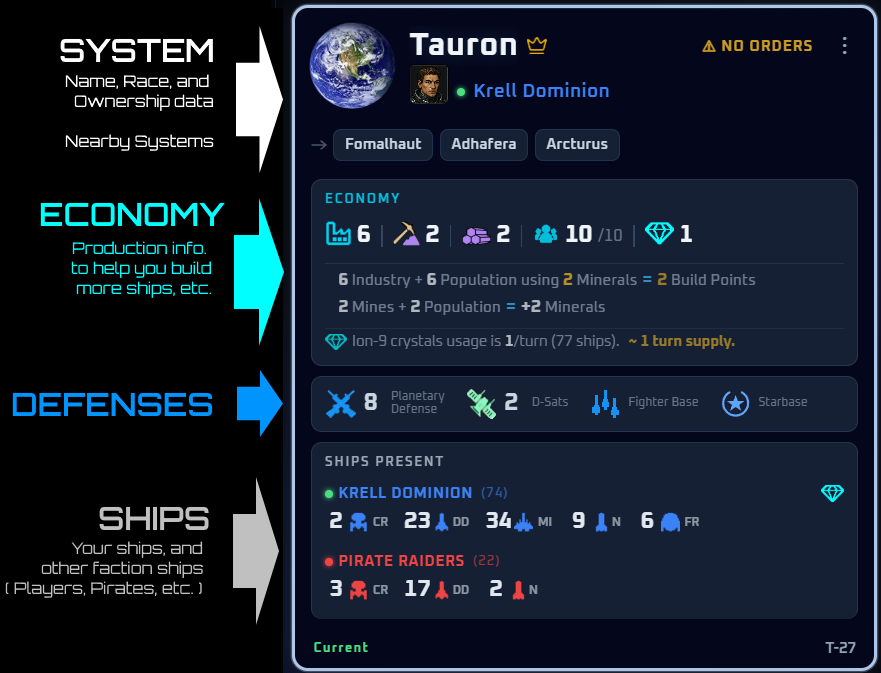
 Population
 Industry
 Minerals/Turn
 Minerals on Hand
 Ion-9 Crystals
 Planetary Defense
 D-Sats
 Starbase